Skip to content

Posts from the ‘Commentary’ Category

Lasting influence


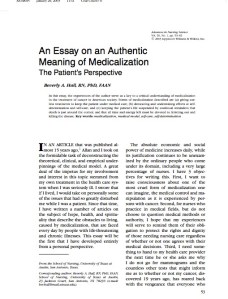
A few days ago we sent out an email giving the latest ANS ranking of 15th out of 85 nursing journals, with a new 5-year impact factor ranking of 1.587.  Beverly HallBeverly Hall's article in ANS responded with congratulations and a story illustrating the lasting influence of her article published in ANS titled “An Essay on an Authentic Meaning of Medicalization:  The Patient’s Perspective” (2003, Vol 26:1).  Here is what Beverly shared:

I took a copy of my medicalization article in to my physician 3 years ago when I first hooked up with him and asked him to read it. He not only read it, he said it changed his whole way of relating to patients. He mentioned it again a few weeks ago when I went in to see him.  Thanks to Advances for publishing this.

The physician is Alan Weiss, and he also sent me a personal message affirming how significant Beverly’s work has been:

Beverly’s work and meeting her made me rethink how people, in our current medical system, often become not people with certain conditions to address, but become and are related to as their diagnosis by the medical community. And often by others. This can be dehumanizing and certainly not empowering. Beverly is one of those rare examples who refused to let this happen and she is now committed to sharing her experience with others and showing them a way to stay true to themselves while dealing powerfully with their illness.

This account is one of many examples of the lasting influence of what we publish in the journal.  In fact ANS has many articles that are recognized as classic and timely long after the date of publication.  I have identified many of these in the “Classics Collection” that appears on the ANS web site.  There are a number of other Collections that give a listing of significant articles by topic – articles that were published in the first two decades of the journal and that have retained lasting significance.

If you have not yet discovered this treasury of timeless and thought-provoking articles, visit the web site now!  When you find something that is important to you, share it with others.  We cannot imagine how powerful the ideas that speak to us as individuals might be for others as well!

How to list your credentials and title when you publish


Updated resource (Sept. 12, 2019)
APA “Misuse of the PhD(c)

Diploma and notebook

Here is a topic that is not often discussed, but remains a persistent issue for many!  “What is the proper way to list my credentials?  Which should come first, RN, PhD, MS?”  Most folks have very strong opinions about this and will most certainly object if you list their credentials in an order other than what they prefer.  They will typically give you very good reasons for why they feel one credential or another should be first.  Therefore, as an Editor, my guideline for this is that each person’s credentials should be listed exactly as they prefer them to be listed!

However, there is one “credential” that is frequently indicated that we will not use — the non-credential “PhD(c).”  I am not sure how this convention started, but it is one of my particular pet peeves.  And in many formal and informal polls of other editors, by far the majority agree — this is not an acceptable credential.  Yes, the little (c) does indicate that a person has passed

Read more

Nurse scholars shape the future – funding opportunities pending


The groundbreaking report release last fall by the Institute of Medicine and the Robert Wood Johnson Foundation on the Future of Nursing.  This report provides a blueprint for action to shape a stronger, more effective nursing presence in health care.   It also opens doors of opportunity for nurse scholars. Nurse researchers played a key role in shaping the substance of the report, and in the months ahead, the Robert Wood Johnson Foundation will publish a national research agenda based on the report’s recommendations.  You can sign up for alerts on funding opportunities related to this agenda at www.rwjf.org.

I recently invited Lori Melichar and Susan B. Hassmiller to share their thoughts about the role of nurse scholars in fulfilling to vision of the future that the report sets forth.
Here is their message for the ANS blog:

Nurse researchers played a crucial role in producing the evidence that resulted in the recommendations from the landmark Institute of Medicine report, The Future of Nursing: Leading Change, Advancing HealthNow they must play Read more

Attention to detail


“Your great attention to detail is both a blessing and a curse”  – Chinese proverb

This message, found in a fortune cookie, inspired the folks at Oxford University Press (the Pencil and question markpublishers of the AMA Manual of Style, used by ANS), to start a blog!  The blog is the AMA Style Insider, and I highly recommend it – even for those who are not blessed with great attention to detail!  It is free of charge and anyone can visit the blog — I recommend that you subscribe to stay informed of many important issues facing writers, editors and publishers.  As they note in the announcement that circulated about the new blog, even though the AMA Manual of Style is over 1000 pages long, there are endless issues and questions that come up for writers every day.  And, the issues they address are not limited to any one approach to “style” – in fact they refer to other style manuals and traditions besides their own.

So far there are only a handful of posts on the blog, but every one of them is interesting!  They deal with topics ranging from recent FAQ’s from users of the AMA Manual of Style, to word usage (heathy vs healthful for example), placement of an apostrophe, the dangers of duplicate e-publication, and much more!  And, the information addresses not just the “facts” of how to handle problems of style, spelling, grammar, usage, and so forth, but the issues surrounding the problems and various points of view about how to deal with the issue in your own work.

The Importance of Letters to the Editor


Letters to the Editor are vital in achieving a primary purpose established early in the history of Advances in Nursing Science.  The current issue (Vol. 34:1) contains two letters in response to the article titled “The Politics of Nursing Knowledge and LettersEducation: Critical Pedagogy in the Face of the Militarization of Nursing in the War on Terror.” (Vol. 33:3).  The letters in response to this article are free downloads from the ANS web site.

These letters prompted lively discussion at our annual Advisory Board meeting (November, 2010), and the Board recommended that we invite external reviews of the issues that were raised in the Read more

Disaster preparedness


The Washington Post had a story yesterday that should raise some concerns, for a day or two:  “US Health Care System Unprepared for Major Nuclear Emergency, Officials Say”Disaster Relief

As I suggested in another post, it is difficult, if not impossible to be prepared for a catastrophe when our health care facilities are barely handling routine loads.

Disaster preparedness requires tremendous redundancies: Extra staff, extra supplies, extra equipment, extra medications, extra food, and alternative energy sources. Read more

Regulating Medical Loss Ratios


I was just thinking about a new paper in the American Journal of Managed Care:

—————————————————————————————————————————————————
Regulating the Medical Loss Ratio: Implications for the Individual Market
Jean M. Abraham, PhD; and Pinar Karaca-Mandic, PhD
(Am J Manag Care. 2011;17(3):211-218)

“Results:In 2009, using a PPACA-adjusted MLR definition, we estimated that 29% of insurer-state observations in the individual market would have MLRs below the 80% minimum, corresponding to 32% of total enrollment. Nine states would have at least one-half of their health insurers below the threshold. If insurers below the MLR threshold exit the market, major coverage disruption could occur for those in poor health; we estimated the range to be between 104,624 and 158,736 member-years.”Conclusion: The introduction of MLR regulation as part of the PPACA has the potential to significantly affect the functioning of the individual market for health insurance.”————————————————————————————————————————

The Robert Wood Johnson Foundation thought enough of it to post it on their website and I did a post over there

http://www.rwjf.org/coverage/product.jsp?id=72089&cid=XEM_910232#disqus_thread

but sometimes they don’t like them, so I’ll edit it and redo it here because I think Read more