Skip to content

Reflections on the current issue: Trauma & Stress


The current issue of ANS is now available on our ANS Web site, and it promises to another issue of lasting influence!  If you have not already done so, take a look at the Table of Contents and see for yourself what this issue contains.  We will be featuring each of these articles in the “Featured Articles” section of the web site, and while they are featured you will be able to download them at no cost.  If you are a journal subscriber, you have access to all of the articles in not only this issue, but all issues of ANS published since the beginning in 1978!

Given that ANS articles are unsolicited, we can never predict the content profile of any single issue.  We publish issue topics well in advance of the date by which manuscripts must be submitted to considered for each issue, but we leave the interpretation of issue topics open.  But for this issue of ANS, I anticipated that authors might address two substantive areas – trauma and stress brought about by war, and that brought about by violence in the home.  Indeed, both of these areas of concern appeared in the articles we considered for publication, as well as those that were accepted for publication.

Predominantly, nurse authors represented in this issue Read more

Self-Plagiarism


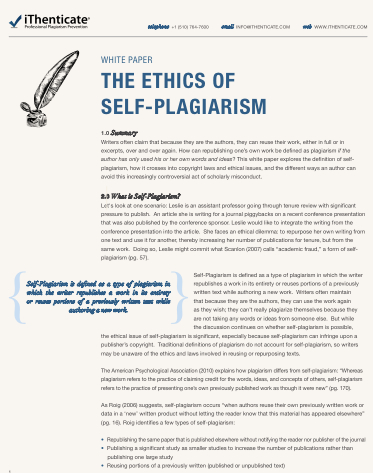
By now most authors have at least heard this term, but it has only recently begun to be Self-Plariarism White Papermore clearly understood!  So if you are still wondering what the fuss is all about – take heed!  I won’t go into a lot of detail here because the details are described very well by in a recent post on the iThenticate Blog.  And, they have provided a white paper that you can download a copy of the white paper titled “The Ethics of Self-Plagiarism.”

There are two key points that I do want to comment on because I believe these points are important to notice, whether you have considerable familiarity with the idea of self-plagiarism, or are just learning about the concept:

  • When your work is published in a journal or a book, and you have transferred copyright to your publisher, you need to treat your own work in the same manner as you would that of a work published by someone else.  The publisher now owns the copyright, not you!
  • The basics of “fair use” of any work are not governed by strict rules.  Rather, there are guidelines that help to determine how much of a published work, yours or anyone else’s, can be legally (or even ethically) quoted and cited.  Many publishers have their own guidelines concerning how much of a published work can be cited without obtaining the copyright holder’s permission.  So become familiar with not only general “fair use” guidelines, but also the guidelines of your publisher.

The Copyright Clearance Center has an excellent 6-minute video that explains the basics of copyright, including the basics of fair use.  Watch it, and make sure everyone on your team knows that this resource is available.  

Nursing Journal Editors’ Conference in San Francisco!


Last week was the annual conference of the International Academy of Nursing Journal Editors (INANE) in San Francisco!  You might wonder about the choice of our name! I don’t have an accurate historical account about this, but I do know that this name helps us all to remember theLogo for the International Academy of Nursing Editors pitfall of taking ourselves too seriously!  We are probably one of the most talented and knowledgeable groups of  nurses anywhere, and we remain mindful that we are the keepers of one of the most precious resources of the profession.  Several times during the conference I heard one person after another comment on the awe they felt just being in the company of this group of nursing professionals.  At the same time, each of us realizes that we all face challenges and problems that reduce our daily realities to the mundane/inane.  Each day we ride a roller coaster of concerns that range from such basic details as punctuation, format and style, to concerns of substantive content with life-changing proportion.

I had the honor of hosting the conference along with a dynamic team of other editors and publishers.  We had a record attendance of 135 people from all over the world.  This is a conference where everyone attends every session, despite the temptations that lie beyond the conference venue.  The reason?  Each and every attendee Read more

Lasting influence


A few days ago we sent out an email giving the latest ANS ranking of 15th out of 85 nursing journals, with a new 5-year impact factor ranking of 1.587.  Beverly HallBeverly Hall's article in ANS responded with congratulations and a story illustrating the lasting influence of her article published in ANS titled “An Essay on an Authentic Meaning of Medicalization:  The Patient’s Perspective” (2003, Vol 26:1).  Here is what Beverly shared:

I took a copy of my medicalization article in to my physician 3 years ago when I first hooked up with him and asked him to read it. He not only read it, he said it changed his whole way of relating to patients. He mentioned it again a few weeks ago when I went in to see him.  Thanks to Advances for publishing this.

The physician is Alan Weiss, and he also sent me a personal message affirming how significant Beverly’s work has been:

Beverly’s work and meeting her made me rethink how people, in our current medical system, often become not people with certain conditions to address, but become and are related to as their diagnosis by the medical community. And often by others. This can be dehumanizing and certainly not empowering. Beverly is one of those rare examples who refused to let this happen and she is now committed to sharing her experience with others and showing them a way to stay true to themselves while dealing powerfully with their illness.

This account is one of many examples of the lasting influence of what we publish in the journal.  In fact ANS has many articles that are recognized as classic and timely long after the date of publication.  I have identified many of these in the “Classics Collection” that appears on the ANS web site.  There are a number of other Collections that give a listing of significant articles by topic – articles that were published in the first two decades of the journal and that have retained lasting significance.

If you have not yet discovered this treasury of timeless and thought-provoking articles, visit the web site now!  When you find something that is important to you, share it with others.  We cannot imagine how powerful the ideas that speak to us as individuals might be for others as well!

Evaluating Web (and other) resources


In just the past few short years, the World Wide Web has become like a physical library.  Academic libraries, to a significant degree, now provide journal articles

WWW imageto their constituents as PDF files, replacing the old, large, and very popular “copy machine” room housed in their physical spaces.  A natural extension of this is the use of material “published” on the web as a resource not unlike that accessed through an academic library.

The developer of the Web (and current director of W3C, the organization that oversees Web standards) Tim Berners-Lee, established a vision of the World Wide Web as a valuable tool that would democratize knowledge, making access to valuable information accessible to all regardless of wealth, social standing, race, or any other factor. However, in many academic circles, Web resources are still regarded with skepticism and Web articles are not considered valid scholarly resources, except where a Web site is itself the subject of the investigation or is used to make a particular point.

Rather than simply dismiss Web resources, it is time to recognize the Web and its wealth of information as an opportunity to sharpen our abilities to discern a valid resource from one that is less than valid, and to refine the criteria by which we make this assessment.  Indeed, as the management team of the popular Wikipedia.org clearly states in their own guidelines on “Researching with Wikipedia”, the veracity of information published in the Wikipedia should be judged in ways similar to standards used for any other resource.

Here are “ABCSS” guidelines that I recommend in deciding on the credibility of any resource, web or otherwise:

Agency.  Is the author of the work clearly identified? Are the author’s professional affiliations and qualifications clearly identified? Is there a clearly identified way for me to contact the author if I have questions or concerns about the work? 

Bias.  Everything has a bias!  Does the author identify their perception of their own perspective on the subject?  What bias, standpoint, or perspective is implicitly embedded in the work?  How does bias potentially shape or influence what is published?

Corroboration.  How does the information in this source compare to what I find in other resources?  If it is wildly at odds with other resources, and the source can be identified as having value for my work, how can I explain the difference? 

Sponsorship.  Is the work sponsored, funded, or “commissioned” by an organization of any kind?  If so, what is the nature of that organization and do they have an explicit or implicit interest in what is published?

Scholarly value.  Do the methods used and the logic presented meet generally accepted standards of investigation, ethics and logic?  Are the sources that the author used clearly identified, and can I trace those sources accurately?

In fact, in my view the Web actually has greater power to demonstrate each of these guidelines much more explicitly than does print media.  Print media is limited by space and cost constraints that greatly constrain the kind of background information that is important to fully understand the worth of that which is published.  

In evaluating Web resources, I believe we can and should expect each and every one of the ABCSS to be clearly evident.  If they are not, unless there is some strong justification otherwise, the source needs to be eliminated from serious consideration.  What are your thoughts, and what shifts might you recommend for the ABCSS guidelines?  

How to list your credentials and title when you publish


Updated resource (Sept. 12, 2019)
APA “Misuse of the PhD(c)

Diploma and notebook

Here is a topic that is not often discussed, but remains a persistent issue for many!  “What is the proper way to list my credentials?  Which should come first, RN, PhD, MS?”  Most folks have very strong opinions about this and will most certainly object if you list their credentials in an order other than what they prefer.  They will typically give you very good reasons for why they feel one credential or another should be first.  Therefore, as an Editor, my guideline for this is that each person’s credentials should be listed exactly as they prefer them to be listed!

However, there is one “credential” that is frequently indicated that we will not use — the non-credential “PhD(c).”  I am not sure how this convention started, but it is one of my particular pet peeves.  And in many formal and informal polls of other editors, by far the majority agree — this is not an acceptable credential.  Yes, the little (c) does indicate that a person has passed

Read more

Nursing Editors to meet in San Francisco


In August, the International Academy of Nursing Editors (INANE) is holding our annual conference in San Francisco at the Sir Francis Drake hotel.  Nursing journal editors worldwide attend this conference each year to discuss issues related to publishing nursing literature, to meet with other editors and publishers, and to learn the latest advances in publishing.  Our common focus, regardless of the nature of the various nursing journals, is how to improve the quality of nursing literature and enhance our service to the profession.

This year the conference will be focusing on social networking media, and how new networking tools on the internet can enhance the missions of each of our journals.  If you have been following the latest developments related to ANS, and if you are reading this blog, you will already be aware Read more

ANS online and on paper: is there a difference?


By now ANS readers are familiar with accessing articles online, either through the ANS web site, or the electronic collection provided by their organization’s library.  The data on usage clearly documents the overwhelming preference that readers have for journal content online.  Since all of the journal content is accessible online, you may not be aware thatLaptops and paper books some of the content of the journal appears only online, and not in ANS on paper!  Regardless of the format on paper or online-only, all articles that appear in ANS have undergone the exact same peer-review scrutiny, and meet the scholarly criteria established for publication in ANS. All articles have also been revised to address issues and suggestions offered by the reviewers, adding substantially to the quality of what you read.

We began including online-only content about 3 years ago.  This has been a tremendous value for the journal, as well as for the discipline.  When a journal is limited to paper only, the result can be a huge back-log of excellent material with long periods of time between submission and actual publication, or a severe limitation in what can be published by the journal, dictated not by Read more

April-June issue now available – Practice-Based Evidence


This is a terrific issue of ANS that you will not want to miss!  The Table of Contents is on the ANS web site, where you can go directly to details about each article.  This issue focuses on the topic “Practice-Based Evidence” but also features commentaries about two previously published articles that raised quite a bit of reader response!  These commentaries are available as free downloads in the “Featured Articles” section of the Home Page.

Here is some background on the commentaries.  The article by David Keepnews titled Lesbian, Gay, Bisexual, and Transgender Health Issues and Nursing: Moving Toward an Agenda is a thoughtful response to the article published last fall in ANS 33:3.  That article, titled Nursing’s Silence on Lesbian, Gay, Bisexual, and Transgender Issues: The Need for Emancipatory Efforts is based on an analysis by Eliason, Dibble and DeJoseph examining content in nurse journals with high impact-factor scores.  Their analysis revealed Read more

Nurse scholars shape the future – funding opportunities pending


The groundbreaking report release last fall by the Institute of Medicine and the Robert Wood Johnson Foundation on the Future of Nursing.  This report provides a blueprint for action to shape a stronger, more effective nursing presence in health care.   It also opens doors of opportunity for nurse scholars. Nurse researchers played a key role in shaping the substance of the report, and in the months ahead, the Robert Wood Johnson Foundation will publish a national research agenda based on the report’s recommendations.  You can sign up for alerts on funding opportunities related to this agenda at www.rwjf.org.

I recently invited Lori Melichar and Susan B. Hassmiller to share their thoughts about the role of nurse scholars in fulfilling to vision of the future that the report sets forth.
Here is their message for the ANS blog:

Nurse researchers played a crucial role in producing the evidence that resulted in the recommendations from the landmark Institute of Medicine report, The Future of Nursing: Leading Change, Advancing HealthNow they must play Read more