Skip to content

Nursing Models for the Future: Acknowledging the Political Nature of Nursing


Adeline Falk-Rafael, PhD, RN, FAAN in her guest editorial for the current issue of ANS makes a strong case for nursing models that ground practice in our own disciplinary knowledge, and makes nursing work visible and credible.  Dr. Falk-Rafael serves as a member of the ANS Advisory Board, and is a renowned nurse author/scholar whose work focuses on critical caring and social justice. She has shared these reflections on the message conveyed in her guest editorial (available here):

Version 2

Adeline Falk-Rafael

I first learned to be a nurse in a hospital “training” program in the early 1960s. During that time, I learned what nursing was in relation to medicine – what nursing care was in the context of specific medical diagnoses and treatments. Likewise, the relatively minimal attention to health promotion focused almost entirely on disease prevention. A substantial amount of the content of many of the program’s courses was delivered in the form of a physician’s lecture. Ethics was medical ethics and taught by the hospital’s priest. The nursing scope of practice was defined by employers as largely an ancillary medical service that also had some usefulness as a supplementary housekeeping service (cleaning linen and utility rooms and carbolizing the beds of discharged patients were required duties) as well as providing cheap labor in the guise of an educational experience through rotations that including several weeks of making and sterilizing infant formulas and filling individual dietary requests through short-order cooking. Little wonder that as a Registered Nurse, I had difficulty articulating what nursing was, let alone what nurses knew!

While much has changed, thankfully, in the education of nurses, I do not find that nurses practicing at point of service are much more proficient today in clearly articulating the valuable and often unique contribution they make to the health and healing of patients and populations. Because most nurses continue to be employees in bureaucratic organizations and/or large corporate structures, their scope of practice typically remains heavily influenced by prevailing medical and business models.

Nurses are still, in the words of Susan Reverby1, “ordered to care in a society that refuses to value caring.” For this reason, I am a strong apologist for nursing models. I believe they have a strong potential to strengthen nurses’ sense of identity as professionals who make a complimentary but unique contribution to health and health care. As such, nursing models can be tools of empowerment by grounding nurses solidly in disciplinary knowledge and naming aspects of nursing work, thus giving nurses language and credibility to make their work more visible. Grand theories help shape our values and belief systems about what caring for human beings means. Mid-range and micro theories provide more focused approaches to the provision of care that can and must be tested through research and linked to patient/health outcomes. To be useful, nursing models must be seen to be relevant and useful to nurses at point-of-practice, for example, as “apps” that can provide a quick resource when needed. But nursing models of the future must also have a critical perspective. They must serve as tools of resistance by assisting nurses to examine and challenge the larger societal and political forces that advantage a few while disadvantaging many others, whether those others are patients or nurses.

1Reverby S. Ordered to Care: The Dilemma of American Nursing, 1850-1945. New York, NY: Cambridge University Press: 1987.

What Would Florence Nightingale Do (WWFND)?: Nightingale and 21st Century Health Care Reform


From the Bates Center Blog:

What Would Florence Nightingale Do (WWFND)?: Nightingale and 21st Century Health Care Reform


Historical Nursing Documents Archived by City of Toronto


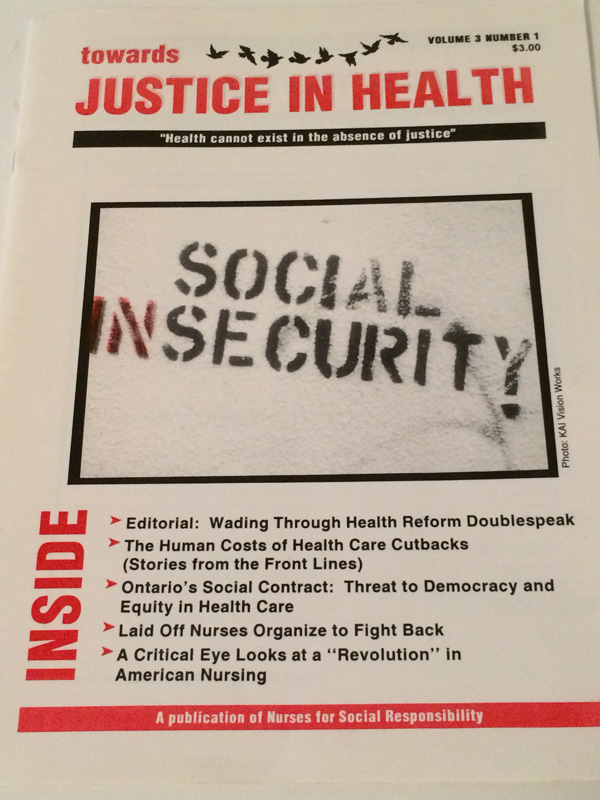
This update has been provided by Adeline Falk-Rafael to follow-up on the ANS article titled “Towards Justice in Health.”An Exemplar of Speaking Truth to Power.

Our article “Towards Justice in Health: An exemplar of speaking truth to power” is an analysis of 6 issues of the magazine (TJH) produced by Nurses for Social Responsibility (NSR) in Toronto, Canada, between 1992 and 1995. The article reported that the request of the magazine’s editors for archival of the magazine in the Library and Archives Canada had been denied.

A few days ago, Cathy Crowe, one of the magazine’s editors, notified us that the City of Toronto Archives has accepted both the 6 issues of the magazine and the NSR’s newsletters which predated the magazine and were alluded to in the article but were not part of the analysis. As Cathy Crowe noted, they will now be available “to aid and inspire future nurse and academic researchers on nursing and social justice.”

The vision and courage of these remarkable nurses for social responsibility is evident in some of the topics they wrote about and in which they actively sought change between 1985 and 1995. Their newsletter s and, in the later years, their magazine, covered many contentious issues that impacted health, including the environment, the sale of arms and war itself, women’s reproductive rights, health care policy, trade agreements, lesbian nurses, and needle-exchange programs, as well as issues that affected nurses in the workplace, such as working conditions and staffing mix. As we said in the article, they were exemplars in speaking truth to power and it is fortunate that the newsletters and magazines will now be available for aspiring historians and activists.

The images below of the newsletter and the magazine provide examples of the amazing topics that were addressed in this publication! Their placement in the City of Toronto archives provides a valuable resource and inspiration for nursing’s continuing social justice commitment.  For more information about Dr. Falk-Rafael’s and Dr. Bradley’s analysis of these important historical publications, see their blog message published here in August 2014.

Newsletter

Magazine

Interview with Dr. Barbara Carper


 We are delighted to publish the first “ANS General Topic” article, which is an interview with Dr Barbara A. Carper by Elizabeth R. Eisenhauer, RN, BSN, MLS.  Dr. Carper is the author of one of the most important articles published in ANS – “Fundamental Patterns of Knowing in Nursing,” published in the first issue of the journal in 1978!  Still among the most frequently cited articles in nursing, Dr Carper’s insights set in motion a major shift in nursing scholarship and practice.

Ms Eisenhauer shared this description of her experience interviewing Dr. Carper, and of her own reflections on the meaning of Dr. Carper’s ideas:

I remember being so struck by the paper “Fundamental patterns of knowing in nursing” that my librarian skills immediately kicked in —What else had Barbara Carper written? Where was she? What more did she have to say? When Google provided few answers to these questions, I knew I had to seek her out. Her views about there being so much more to nursing than science are foundational; I couldn’t let it go. However, I was afraid people would think I was going off on a zany tangent, so initially, I kept the project a secret.

Eventually, I knew that I needed to discuss it on a professional level. So I confided in one of my professors, Dr. Arslanian-Engoren, at the University of Michigan. I had gotten the idea for the project while I was sitting in her advanced nursing theory development class. She was very supportive and encouraging of the project! If she had dismissed it, I am not sure I would have had the courage to pursue it so ardently. I am very grateful for her mentorship.

The “patterns of knowing” are also ways of making decisions, and this relates to my research on informed consent and decision-making among clinical research volunteers who are asked to donate biospecimens for research purposes. For example, there is a movement to collect, store, analyze, and even manipulate DNA. But DNA can alternatively be seen as more than just scientific material. It can be seen in a spiritual sense as the “essence of our individuality” [1]. Therefore, tinkering with it may have implications for some people that go beyond science and empirics. Research volunteers may not understand or consider these ethical implications, until they are explicated, weighed against volunteers’ personal values, and the consequences clearly described [2]. Helping patients or research volunteers clarify their values and make informed choices are acts of caring, fundamental to nursing [3,4]. Carper discusses the connection of veracity and transparency, during informed consent, to caring and nursing in her 1979 paper, “The ethics of caring” [3]. I fear such values are being overlooked in the modern age of blanket consent for genetic research. Again, there is so much more than science that goes into caring for and knowing a patient.

On a personal note, talking to Dr. Carper and getting to meet her was phenomenal—-a dream come true! Anyone who has had the experience of getting to meet someone they so admire will understand. I was awestruck, and she was so humble and gracious. It was an amazing, remarkable experience that I will never forget, and for which I am most grateful.

References

  1. This phrase has been used by numerous people, including Senator Pete V. Domenici in discussing the Genetic Information Nondiscrimination Act of 2005. See: Weeden, JL.      Genetic liberty, Genetic property: Protecting genetic information. Ave Maria Law Review.2006; 4(2): 611-664. (Quote p.631).
  2. Tomlinson, T, Kaplowitz, SA and Faulkner, M. Do people care what’s done with their biobanked samples? IRB: Ethics & Human Research. 2014;36(4):8-15.
  3. Carper BA. The ethics of caring. Adv Nurs Sci. 1979;1(3):11-20.
  4. Dungan, JM. Dungan model of dynamic integration. International Journal of Nursing Terminologies and Classifications. 1997;8(1);17-28.

Visit the ANS web site today to download Ms. Eisenhauer’s interview, and return here to contribute your ideas and comments to further discussion!

ANS 38:2 now published!


ANS 38:2 was released today and is available to view online!  This issuwhich focuses on the topic “Models of Care for the Future.” This issue contains two notable “firsts” for the journal, To begin, an interview with Dr Barbara Carper by Elizabeth Eisenhauer introduces our new feature: “ANS General Topics.” This issue also contains the first ANS “open access” article: “Adaptive Leadership Framework for Chronic Illness” by Dr. Ruth Anderson and her colleagues. The articles that focus on the issue topic “Models of care for the Future” cover a broad spectrum of settings and approaches to care that can inspire new ideas and possibilities. If you follow this blog, you will receive notices of our posts that feature each of the articles included in this issue over the next several weeks!  I hope you will also visit the blog frequenty, and share your comments and ideas!  We will respond!

The Ultimate ANS “Ethics” Collection


“Ethical Practice, Quality Care,” is the theme for this year’s National Nurses’ Week, which begins on May 6, 2015.  To celebrate this week, we have compiled from the Journal archives the most groundbreaking, read and cited ethics articles that address ethical issues in nursing and health care!  The collection features classic ANS articles from the first 20 years – articles that remain relevant, timely and essential guides for discussion and dialog related to the pressing ethical issues of our discipline.  The authors of the twenty articles in the collection are among the most cited nursing scholars whose writings continue to shape ethical thought in nursing.

This collection will be prominently displayed on the ANS Web site all week.  But it is available now so that you can have a head start in preparing for the many discussion that will focus on ethics during the week of celebration.  Click here to go to the collection.  ANA-NNW2015-Logo

Health Change Trajectory Model


The discipline of nursing now has a growing and rich body of theoretical models that provide useful perspectives from which we can build practices addressing some of the most pervasive health challenges we and our patients face.  These models also facilitate the design and implementation of research projects that add to the evidence required for effective outcomes of practice.  Our current featured article is an example!  The title is “The Health Change Trajectory Model: An Integrated Model of Health Change” by Deborah Christensen, BSN, RN.  Here is a message Ms. Christensen has prepared for the ANS blog:

Health change appraisal is unique to each individual with dynamic changes across the lifespan. To promote understanding of evolution and change in health care appraisal, I developed the Health Change Trajectory Model by

Deborah Christensen

Deborah Christensen

integrating concepts from uncertainty in illness and illness trajectory theories. The integrated model is applicable to any change in health, not just the occurrence of chronic illness.

Nurses are the key health care providers who assist others in understanding and coping with health changes. Placing the experience of health change in a trajectory framework offers a new and creative perspective for nurses as they assist patients and families with positive adaptation to changes in health throughout the life course. Conceptualizing the nurse as health change management partner emphasizes the nurse and patient/client partnership with patients clearly in charge of shaping their health management trajectory.

Studies from uncertainty in illness theory indicate that there are phases when uncertainty can be perceived as an opportunity rather than a threat. For example, in several types of cancer there are periods of remission (comeback phase) interrupted by disease progression (acute or downward phase). Through genomic research and the development of targeted and immunotherapies, patients may have several different treatment options that can be perceived as opportunities. Further, the experience of decreased energy in the absence of illness can be perceived as a threat or as an opportunity for positive changes in physical activity and nutrition. How is uncertainty perceived in these situations? How can uncertainty as opportunity be supported? I believe that in answering these questions, nursing interventions can be developed to help patients move toward adaptation and a balanced perceptual shift from threat to opportunity in uncertainty, thus, optimizing their health change trajectory. The Heath Change Trajectory Model provides the theoretical framework for exploration of all perceived health changes, not just those specific to chronic illness, as unique opportunities for a more optimistic view of health change.

This article will be featured on the ANS web site for the next couple of weeks and will be available at no charge while it is featured!  So please visit the web site to get your copy, and come back to this blog and share your feedback and ideas!  We would be delighted to hear from you!

Shifting the discourse around large bodies


Ingrid Ruud Knutsen, RN, PhD from Oslo and Akershus University College of Applied Sciences and University of Oslo, Norway is the author of our current featured article that explores the health consequences of contemporary society’s views about large bodies.  The article is titled “A Discursive Look at Large Bodies—Implications for Discursive Approaches in Nursing and Health Research.  Dr. Knutsen shared this message for ANS readers about her work:

How have we come to understand obesity as an illness that is treated by surgery and medication in contemporary healthKnutsen300 care? Through research projects, I have experienced that people in large bodies often feel stigmatized, especially by health professionals. There are reasons to question whether the general attitude towards people in large bodies represent a greater challenge than the large body itself for obese people. For what is health? – is it happy, self-confident people enjoying life and their opportunities or is it people striving towards a perfect exterior? For scientists it is important sometimes to stop and question premises for our knowledge, conditions and situations, to reflect about whether we could serve patients better by approaching them in other ways and understand their situations through alternative perspectives. A reflective and critical approach related to how to challenge understandings we take for granted represents an important angle in research. Discursive perspectives and discourse analysis are based on an epistemology welcoming other questions and new approaches to challenge traditional knowledge and understandings. Such perspectives give opportunity to enrich research in nursing and health.

We would be delighted to see your comments and responses appear here!  You can download your copy of Dr. Knutsen’s article while it is featured on the ANS web site, then come back here to leave your comments!

Social Withdrawal and Migraine Headaches


Starting on March 18th, a new article will be featured for free download from the current issue of ANS!  The article, titled “Social Withdrawal as a Self-Management Behavior for Migraine: Implications for Depression Comorbidity Among Disadvantaged Women,”  is authored by Shawn M. Kneipp, PhD, RN, ANP-BC, APHN-BC and Linda Beeber, PhD, RN, CS, FAAN.  Recognizing social withdrawal as a distinct, highly nuanced coping strategy in
symptom self-management, they explore its relevance for understanding migraine-depression symptoms within the life context of socially and/or economically disadvantaged women.  They recommend further nursing research  that draws from complexity science theory and methods to better understand these dynamics and ultimately improve care.  Dr. Kneipp  shared this message about their work for ANS readers:

I would not have expected to be writing on this topic two years ago.  As is frequently the case with scientific inquiry, however, unexpected study findings, combined with ongoing clinical work and research with women who are socioeconomically disadvantaged, led me down this path.  The unexpected findings came from a

Shawn Kneipp

Shawn Kneipp

clinical trial with women in a Welfare Transition Program (WTP), which suggested headaches may be associated with job loss in the previous year.  Given the erosion of economic safety nets in the U.S. generally, and the current limits on economic assistance receipt through the Temporary Assistance for Needy Families (TANF, or ‘welfare’) program more specifically, obtaining and maintaining employment has become an even more critical social determinant of health for women who are socioeconomically disadvantaged.

Linda-Beeber-e1380548224649

Linda Beeber

From a number of prior studies, we have also known for a while that depression is highly prevalent in this group, that depression impedes women’s ability to function in the workplace, and that depression is most often present in the context of other chronic health conditions.  Despite this, there are large gaps in the literature on headache symptoms (predominantly migraines for women) in relation to socioeconomic status and self-management, in the context of other highly prevalent disorders (i.e., depression), and the associated morbidity in terms of work-related functioning.  This recognition, informed by clinical observation of how this population was often managing their migraine-related symptoms as they struggle to perform well at work, was the driving force in wanting to begin to pull the relevant disease-trajectory and self-management theoretical pieces surrounding this issue together.

The theoretical perspectives offered in this article underlie a current pilot study we are conducting to determine the feasibility of a novel data collection approach to further examine how disadvantaged women self-manage migraine symptoms. As with the majority of my research, women from the community of interest are playing a crucial advisory role in designing, conducting, and interpreting the findings from the pilot work. Given the preliminary feasibility findings, and looking to our future work in this area, nurse researchers have a great deal to contribute in the way of both theory and intervention development and testing to better manage comorbid health conditions, improve work-related functioning, and improve their odds of achieving economic self-sufficiency.

Go to the ANS web site now to download your copy of this article – it is important both in content and method.  then come back here and share your thoughts, questions and ideas – we would be delighted to hear from you!

Issue topic planned on “Toxic Stress”


We have just announced our projected issue topic on “Toxic Stress” for ANS Volume 39:4.  Manuscripts are due on April 15, 37-3 cover2016, but can be submitted at any time! Here is the description of this topic:

Toxic Stress
Vol 39:4 – December 2016
Manuscript Due Date: April 15, 2016

Toxic stress, unlike positive or tolerable stress, can result in life-long health challenges. For this issue of ANS we seek manuscripts that focus on the contributions that nurses are making to understanding the dynamics of toxic stress, and nursing approaches that demonstrate effective outcomes for children and adults suffering the effects of toxic stress. Articles that provide research outcomes, theoretic and philosophic constructions, practice models, or educational programs related to toxic stress are welcome. Implications for the development of nursing knowledge must be emphasized.

In addition, we always welcome submissions for the new “ANS General Topic” at any time!  Here is the information about this type of submission:

ANS General Topic
Manuscripts considered any time

Manuscripts submitted as “ANS General Topic” are expected to address the purposes of ANS, which are to contribute to the development of nursing science and to promote the application of emerging theories and research findings to practice.

You can see the full listing of our planned issue topics on the ANS Web site!  And our guidelines for authors can always be found here!