Skip to content

Hoping: An exemplar of scholarly dialogue


The current “Editor’s Pick” article is an inspiration reflected in the title – “’Hoping to See the Future I Prefer’ An Element of Life-World for Older Women Living Alone” by Eileen J. Porter, PhD, RN, FGSA; Tolu O. Oyesanya, MS, RN and Kathy A. Johnson, MSN, RN.  In this article, the authors discuss their secondary analysis of  the findings of four completed phenomenologic studies that focused on the concept of “hope.”  Prior work has established a tradition in nursing of focusing on hope per se and on hope in suffering and despair.  Porter, Oyesanya and Johnson shifted their focus to the experience of day-to-day life, and discuss at length this important conceptual shift.  They conclude:porter3

Hoping emerges from one’s past, through one’s present and toward a horizon that has various degrees of clarity. We view hoping as an anticipatory stance, rather than a purposeful aim.

Their discussion reflects one of the important dimensions of scholarship – that of interaction and dialogue.  This article exemplifies an “interaction” with prior conceptualizations that pushes the discourse forward.  It acknowledges the importance and value of prior work, but also exposes the importance of a shift in focus that begins at the conceptual level.  This shift has far-reaching implications for nursing scholarship related to that which constitutes the essence of nursing – the experience of health and illness.  Visit the ANS web site now to see this inspiring article – you can download it for free while it is featured!

Making time for dialogue


In contemporary academic cultures, time for dialogue has become almost extinct. Productivity has succumbed to the tendency to seek measurable outcomes of concrete products, which in turn neglects the vital conceptual, theoretic and philosophic underpinnings that make reliable and valid concrete outcomes possible.  When dialogue is neglected, scholars are deprived of the important processes of challenge and critique, processes that serve to refine and develop ideas in the context of community values.  The authors of the current Editor’s Pick article share their process of scholarly dialogue that  extends the debate on the topic of militarization of nursing. The article, titled “Making Time for Reflexive Dialogue in Philosophical Group Discussion: Extending the Debate on the Militarization of Nursing” is authored by  Rusla Anne Springer, PhD; Arlene Kent-Wilkinson, PhD; Carol Ewashen, PhD; and Ruth Ali, MN. In the article they call for more dialogue among nurse scholars as an avenue to examine nuances in language and discourse that sustain inequity, injustice, and cultural practices that

Rusla Anne Springer

Rusla Anne Springer

diminish human health and well-being.  The authors provide this background about their process:

The formation of the Inter-University Philosophical Discussion Group, from which this collaborative paper arose, stemmed from a shared desire on the part of Springer and Ewashen to re-ignite past associations and shared nursing philosophies and interests. The origins of the present collaboration date back to 2003, when Springer was a graduate student at the University of Calgary.  At that time Dr. Ewashen, along with other members of the nursing faculty, initiated a philosophical discussion group that offered graduate students the opportunity to engage with faculty in the safety of informal monthly gatherings

Arlene Kent-Wilkinson

Arlene Kent-Wilkinson

to explore and solidify the philosophical underpinnings of their graduate thesis and dissertation research. Those informal engagements with faculty proved invaluable for Springer and remain a highlight of her graduate experience. Based on a keen desire to re-ignite past associations, and recognizing the value of philosophical discussion, reflection and debate for graduate students and for faculty, in the fall of 2012 this new cross-university collaboration was born!  Of note is that all four authors are alumni (Springer & Kent-Wilkinson), faculty (Ewashen), or a present doctoral student (Ali) of the Faculty of Nursing at the University of Calgary.  For Ali, the opportunity to contribute to this collaborative article was “a great experience”, one in which she has “learned so

Carol Ewashen

Carol Ewashen

much”!  Enriching the graduate student experience by providing the opportunity to engage with faculty to confront, inquire, disrupt, challenge, debate and share perspectives in the safety of an open, inviting, respectful, and truly collegial space is the purpose of this newly formed cross-university collaboration.

This article is available for free download while it is featured on the ANS web site!  Perhaps the experience of these authors will inspire you to also make the time for dialogue of a kind that inspires, challenges and informs!

Ruth Ali

Ruth Ali

Engaging with Nursing Theory


The current featured article by Marjorie McIntyre, PhD, RN and Carol McDonald, PhD, RN offers a significant perspective on the importance of understanding nursing theory and its philosophic underpinnings in practice. Their article is titled: Contemplating the Fit and Utility of Nursing Theory and Nursing Scholarship Informed by the Social Sciences and Humanities. They draw on their own experiences in nursing education and practice to present a framework to guide philosophic explorations that strengthen nursing practice and nursing education. Dr. McIntyre gives some background related to their work:

mcintyre-mcdonald

Marjorie McIntyre and Carol McDonald – photographer Robbyn Lanning

We were particularly thrilled to have this article published in the ANS as it is a reflection of three decades of curriculum work in nursing education and follows on and extends an earlier article published in the ANS in 1995. This article presents a philosophical framework as one possibility for organizing and interrogating knowledge, bringing together ontological assumptions of nursing with other vital epistemologies. While Carol and I have both been deeply influenced by the process of theorizing in our nursing practice, in more recent years we have come to see more clearly the place of philosophical thought in nursing. Indeed, the movement “beneath” theory, to philosophical underpinnings provides a way to more fully take up, to make meaningful the theoretical connections that are nursing practice. This opening from the extant nursing theories to broader philosophical underpinnings has created space to hold the meaning of theories from within and beyond the discipline, without relinquishing our disciplinary groundings. As nurses who have worked in highly interprofessional practice settings and have at times felt overshadowed by medicine or psychology, this work to express our theoretical situatedness, in a disciplinary sense has been closely connected to our experiences as nurses in practice and as nurse-educators.

While this article is featured, you can download and read the article!  Visit the ANS web site now and explore this and other articles in this issue!

Development of a theory of compassion


The current issue of ANS focuses on the topic “Critique and Replication.”  Dr. Jane Georges’ article in this issue illustrates a “long view” account of how ideas evolve over time.  Her various publications over the years may have seemed unrelated to one another  – articles on suffering, biopower, Nazi Germany nurses – but in fact each aspect of her work has contributed to an evolving theoretical development.  She reports the evolution of this theory in the currently featured article that appears in this issue of ANS. Dr. Georges has shared for this blog the experience of her work, and pays tribute to the students and colleagues who have contributed to the development of her ideas:

The relational nature of nursing is what is most precious to me and informs my work most deeply. Wherever we practice- as clinicians, educators, or administrators- the bonds we share with our fellow nurses are strong and indissoluble. I call it the nurse-nurse bond. The compassion we show for each other can and does carry us through the most unimaginable experiences everyday, everywhere. When asked about the source from which my work in compassion emerges, I always respond that it is the love and caring of my nurse colleagues. I have been so very blessed to have compassionate helpers in my journey. From the outstanding faculty at the University of California San Francisco School of Nursing in the 1970’s to the superb researchers in my PhD program at the University of Washington School of Nursing, I have been shown the difference that compassion makes. Looking back at my scholarly work during the past decade, I owe so very much to my students at the Hahn School of Nursing and Health Science at the University of San Diego. I couldn’t have done this work without your wisdom, encouragement, and vision. You have taught me what compassion really looks like. It looks like nurses who work for 12 long hours in unimaginable environments, then come to class eager to learn about strategies to improve health care. It looks like nurses from diverse backgrounds that work hard to forge bonds of community in a classroom. It looks like nurses who read Advances in Nursing Science deeply and discuss it passionately. In short, compassion looks like YOU.

Dr. Georges (green jacket) with a group of students

Dr. Georges (green jacket) with a group of students

The networks of that we develop in our communities are significant, and influence the ongoing development of nursing knowledge.  This blog provides an avenue for all ANS readers to participate in this community.  W welcome your comments, questions and perspectives!

Common roadblocks to publishing, and how to overcome them


Over the years I have had occasions to answer many questions related to success in publishing scholarly manuscripts.  There are occasional unique issues that prospective authors face, but mostly people experience very similar challenges.  Take heart — most of these challenges can be overcome!  Here is a summary of  common roadblocks, and how to overcome them!

  • Failing to follow the journal guidelines.  Success in publishing in any journal depends to a large extent on your preparation related to that journal.  Read the “Information for Authors” that all journals provide, and follow it as closely as possible.  The ANS guidelines are readily accessible on the ANS home page. Pay particular attention to the purpose of the journal, and make sure that your manuscript is in line with that purpose. If you have questions about the guidelines, do not hesitate to contact the journal editor!
  • Lack of familiarity with the journal.  Become familiar with the past 2 to 3 years of the journal content to know the kinds of articles they are publishing, and to identify possible gaps that your manuscript might fill. Notice the style of writing in the published articles, typical article length, and the typical “profile” of article style and format. Identify the audience that the journal reaches, and if that is the audience for which your manuscript is intended. Notice if the journal has published articles on your topic in the past several months, and if so, consider how your work can add to what has already appeared in the journal.  The author’s guidelines probably address some of the style and format issues, but you will get a greater familiarity with the “personality” of the journal if you do this bit of homework!
  • Knowing when to get editorial assistance.  If you have difficulty with composition, challenges with the English language, or specific writing challenges (for example, improving the logical flow of ideas or making a long manuscript shorter), do not hesitate to seek help.  Consider teaming up with a colleague to exchange feedback on your writing, and to get suggestions for improving your writing.  There are a number of excellent  professional resources that you can explore; we list a few in the ANS guidelines in the “Preparation of Manuscript” section.
  • Becoming discouraged. Often the accomplishment of preparing a manuscript and getting it submitted is a major undertaking, and to get back a rejection letter after all that hard work is truly discouraging.  However, you can prepare publishingWoman250yourself for this disappointment by taking steps to be ready for any outcome.  Have a second and third journal option in the wings from the outset, so that if you need to submit your manuscript to a different journal you are ready to do so from the beginning.  Also, be ready to make revisions based on reviewer comments.  I recommend that authors immediately develop a table containing all of the reviewer comments in one column, and a second column with notes about what to do to address the comments.  Be prepared to tackle revisions the day after you receive the editor’s decision letter!  Do not put it aside and wait … be persistent, and get right back into the task of moving the manuscript forward!

There are factors beyond your control that could lead to rejection of your manuscript. But you can take some steps to minimize the possibility that these factors will interfere with your being published. These include:

  • Space constraints that limit the inclusion of all worthy manuscripts. All journals have some space constraints, so the more you keep your manuscript within reasonable length requirements, the greater your chances of success.
  • Editorial priorities that do not include the topic that your manuscript addresses. Sometimes you can determine these priorities in advance.  Seek publication in a journal that you know includes a priority for your topic, or contact the Editor to determine if they have an interest in your topic.
  • Editorial perspectives and practices related to controversial or sensitive issues. If your topic involves a controversial or sensitive issue, you may seek to determine the journal’s stance related to your topic in advance by becoming familiar with recent journal content, or direct contact with the Editor.

If you heed these hints for overcoming obstacles, you will almost certainly get your work published!  If you have questions or other suggestions to add to mine here, post them as a comment and let us discuss them!

Designing Evidence-based Practice


If you are interested in a model for designing approaches in practice that are evidence-based, this is the article for you!  The article is titled Development and Testing of an Intervention to Improve Outcomes for Partners Following Receipt of an Implantable Cardioverter Defibrillator in the Patient” and is authored by Cynthia M. Dougherty, PhD, FAHA, FAAN, ARNP; Elaine A. Thompson, PhD, RN; and Peter J. Kudenchuk, MD, FACC, FAHA.  Go to the ANS web site while this article is featured, and you can download a copy of the article free of charge!

This “Editor’s Pick” article describes how the authors used the results of three research studies to design and test a “patient and partner” nursing intervention for patients in the time after they return home from receiving an implantable cardioverter defibrillator. Dr. Dougherty has shared this photograph of the team that worked on this project, and a brief description description of their work:

team

P+P Research Team, University of Washington, School of Nursing, 2012

Back Row:  Dr. Elaine Thompson (Author), Lisa Foley, Susanne Steffes, Chayna Davis, Lisa Hales, Mary Strasser.

Front Row:  Pagna Prom, Seieun Oh, Caylene Castagno, Dr. Cynthia Dougherty (Author).

Since 1990, Dr. Dougherty has been working with patients who suffer cardiac arrest and receive an ICD and their families.  This research program spans numerous iterations in the technological development of the implantable defibrillator (ICD) as well ever changing patient populations who are eligible to receive the ICD.  The paper outlines a series of investigations that have lead to the formal testing of the patient and partner (P+P) intervention after ICD study, currently funded by the National Heart, Lung, and Blood Institute of the NIH.


Critical Caring Model update!


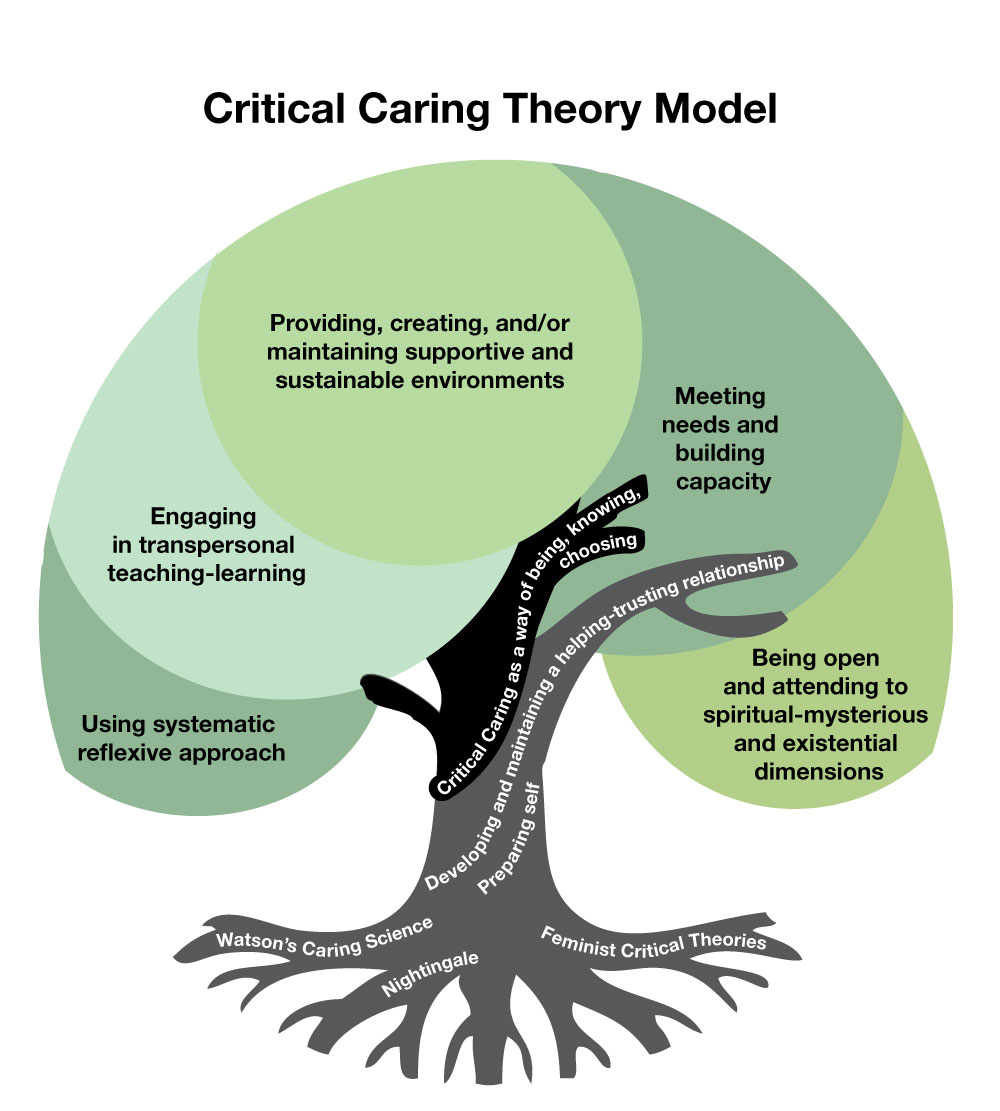
One of the best things about having a blog for ANS is the ability to update content along the way!  Adeline Falk-Rafael has provided an update on the model that she and Claire Betker used as the basis for their research reported in the article titled “The Primacy of Relationships: A Study of Public Health Nursing Practice from a Critical Caring Perspective.”  (See the recent blog post about this article).  Dr. Falk-Rafael explains this new depiction as follows:

This model of Critical Caring theory represents more of an evolution in the graphic depiction of the model than in the theory itself.  The color and artwork better depict the metaphor of the tree and are more suitable for the web than the previous black-and-white diagram and results, hopefully, in more legible text.  As in the previous model (published in ANS 35:4), the trunk of the tree, which supports the praxis branches, is comprised of the tenet of Critical Caring as a way of being, knowing, and choosing, along with 2 carative health promoting processes.  The shading  and positioning of each is helpful both in differentiating the carative processes from the tenet and in emphasizing the centrality of the latter.

I believe this model brings the elements of critical caring into focus, and helps to comprehend the whole of the process that the model represents.  Many thanks to Dr. Falk-Rafael for providing this update!

critical caring-DRAFT3

Prevention of Re-hospitalization


One of the most important preventable factors that contributes to high medical costs for the elderly is re-hospitalization.  In the current “Editor’s Pick” article, Dr. Hong Tao, PhD, RN, and her colleagues (Carol Hall Ellenbecker, PhD, RN; Jie Chen, PhD; Lin Zhan, PhD, RN, FAAN and Joanne Dalton, PhD, APRN,BC) provide specific evidence that can be used in reaching the goal of preventing re-hospitalization.  The article, titled “The Influence of Social Environmental Factors on Rehospitalization Among Patients Receiving Home Health Care Services,” summarizes a study based guided by Orem’s Self-Care theory.  The researchers conducted a retrospective study of the Outcome and Assessment Information Set (OASIS) records of 1268 elderly patients, 262 of whom were rehospitalized within the first 20 days of being enrolled in home care.  The two hypotheses of the study were supported, providing important evidence that can be considered in designing programs aimed toward prevention of rehospitalization.

Dr. Tao shared this description of how this study evolved, as well as her current and future research activities:

I embarked on this program of research during my doctoral studies supervised by Dr. Ellenbecker, whose expertise is health policy and home healthcare. Since the Prospective Payment System case mix methodology does not contain

Hong Tao and Carol Ellenbecker

Hong Tao and Carol Ellenbecker

OASIS items that are cited as triggers for social work referrals, we realized that it may be critical to find evidence that social environmental factors could be independent predictors for readmission and should be assessed to identify high-risk patients.

The findings of the study summarized in this article have led to a series of studies and expanding collaboration to sites in Wisconsin where I am now residing. In a recently conducted pilot study of Visiting Nurses and case managers we found that the early identification of changes in health condition by family members is a factor in preventing re-hospitalization. Families’ ability to identify changes in health condition in a timely manner was influenced by three primary factors: effective communication between healthcare providers and patients/families; supportive self-care/family-care guidance; and patient and family member’s perception of constricted option (e.g. the hospital is the only place/first option at all times). My future research will focus on developing an intervention to reduce re-hospitalization targeting family members of elderly patients with multiple comorbid conditions, who are discharged to home healthcare immediately following hospitalization.

This is an excellent example of research based on a nursing framework that has broad applicability for all disciplines concerned with prevention of rehospitalization.  You can download your own copy of this article now, at no charge!  Visit the ANS web site today!


Cultivating Nursing Leadership for Our Envisioned Future


In this “Editor’s Pick” featured article, author Lee Galuska, MSN, RN, summarizes the result of a metasynthesis of qualitative studies on nursing leadership development.  Her analysis offers significant evidence that can shape leadership development programs and curricula.  Galuska described the development of this research:

This article emerged out of my passion for promoting excellence in nursing leadership.  As I started my doctoral work, the driving questions centered on effective nursing leadership in healthcare organizations.   In exploring leadership models and theories, I became interested in complexity science and leadership in complex adaptive systems. I became intrigued with the work of Tim Porter O’Grady and Kathy Malloch on quantum leadership.  Their discussion of leadership in complex health care systems helped to shape my studies.  For nurse leaders, an understanding of complexity science and the behavior of complex systems is essential for creating the conditions for leadership to emerge in nurses throughout the system.

As I was learning more about leadership and complexity, the Future of Nursing: Leading Change, Advancing Health report was released.  The report reflected a recognition that our healthcare system is a complex adaptive system and that in order to achieve the outcomes of a transformed system and a healthier nation, nursing leadership development was critical.  That triggered my pursuit of understanding how best to cultivate nursing leadership

Lee Galuska

Lee Galuska

competency in nurses at all levels.   I wanted to study it from the perspective of nurses themselves.  I wanted to find out what nurses had found to be effective in helping them to develop leadership competency.

I had the good fortune at that time to be studying qualitative research methods with Cheryl Beck at the University of Connecticut.  Under Cheryl’s guidance I began to conduct a metasynthesis of qualitative studies of nurses’ experience with leadership development.  That work ultimately evolved into three metasyntheses.  This article focuses on the role of the context or environmental considerations on the development of nursing leadership competencies.  Another focuses on the role of purposeful, guided experiential learning and the third on formal leadership learning strategies.  My hope is to propose a model or “bundle” for effective nursing leadership development at all levels.

This is an important article that can inform efforts to bring the recommendations of the “Future of Nursing” report to reality.  Visit the ANS web site and download your free copy of this article today!

The Primacy of Relationships


Public health nursing has a rich history demonstrating the difference that nursing makes in the health and well-being of individuals, families and communities.  This “Editor’s Pick” article by Adeline Falk-Rafael, PhD, RN, FAAN and  Claire Betker, MN, RN, CCHN(C) titled “The Primacy of Relationships: A Study of Public Health Nursing Practice from a Critical Caring Perspective” makes a major contribution showing evidence of the potential influence of public health nursing when nurses can practice to the full scope of practice.  Their research explored the relevance of the mid-range theory of critical caring to the practice of expert public health nursing, and provides evidence that supports a critical caring approach to nursing practice.  They each speak to their experience with this research:

I (Adeline Falk-Rafael) never set out to “develop” a nursing theory, nor do I claim to have done that.  Critical Caring reflects public health nursing as I experienced it in my own practice and observed it in the practice of other public

Adeline Falk-Rafael

Adeline Falk-Rafael

health nurses (PHNs) and taught it to nursing students.  Although I had used Watson’s Caring Science to inform my own practice, as I taught public health nursing, I began to realize the influence of Nightingale as well as feminist and critical social theories on contemporary public health nursing practice. I see Critical Caring, therefore, as a descriptive mid-range theory of public health nursing that I have set into a theoretical framework.

The study described in part in this article began in 2005.  After the initial data were gathered, professional and personal circumstances made it impossible for me to continue with the work. I owe my most profound thanks to Claire Betker, a public health nurse with a breadth of public health nursing experience. Beginning her doctoral studies in 2010, Claire saw value in the theory and approached me about work we might do together.  Together we began to analyze the data that, in turn, energized us to complete the study.

I (Claire Betker) embarked on doctoral studies, as I wanted to contribute to theory to guide the practice of public health nurses so their practice could be better articulated and made visible. Early into my studies, I discovered that in 2005 Dr. Adeline Falk-Rafael had published several articles describing a middle range theory, Critical Caring, that

Claire Betker

Claire Betker

rooted public health nursing practice in an expanded nursing caring science and the social justice agenda characteristic of early public health nursing practice. Adeline describes a reciprocal relationship between theory and

public health nursing practice which she illustrated using a metaphor of a tree (practice) anchored by its roots (theory) where theory is nourished by practice and continues to evolve while supporting practice and giving it definition. This description of theory and the 7 carative health promoting process that represent the  ‘core’ of public health nursing practice resonated with what I had experienced in practice, just as they did with the participants in the research described in this article.  I  encourage those within the pubic health nursing community to consider how Critical Caring could: a) guide practice; b) assist us to articulate and give voice to our practice and its importance; and c) be a tool of resistance to those forces that prevent PHNs from working to their full scope of practice.

If you have already downloaded the new ANS iPad app, you can read this article now!  All of the articles in the current issue of ANS are available at no charge on the iPad app, and on the ANS web site.  Get your copy of this important article now!