Skip to content

Conversational Interviewing


This week’s Editor’s Pick article is titled “Making Meaning in Qualitative Research With Conversational Partnerships: A Methodological Discussion” by Susan M. Hunter Revell, PhD, RN.  In this article, Dr. Revell describes the interviewing method she uses in her research.  This is a 3-part approach to interviewing that facilitates a deep understanding of a person’s experiences.  I highly recommend this article for anyone interested in qualitative methods, because Dr. Revell provides a rich description of the method, and discusses some of the challenges she encountered in using the method.  She uses an example of her own approach to this type of interview with a person who has experienced a traumatic spinal cord injury.  By using a 3-part interview, she was able to reflect on the person’s words, the messages that Revell-wheelchair_smwere conveyed in both verbal and non-verbal elements of the interview, and plan subsequent interviews to explore meanings of the person’s experience in greater depth.  Dr. Revell starts her discussion of the example as follows:

 When using the responsive interviewing method, it is the conversational partnership that becomes the instrument in the study. The following discussion reflects on this perspective including the importance of establishing trust and rapport in the conversational partnership, challenges faced regarding the researcher role, and some unexpected findings from using the method.

To read more of her insights in this discussion, visit the ANS web site now!  Her article is available for download at no cost while it is being featured!
Experience of genetic vulnerability


This current featured article addresses the fundamental focus of nursing identified by Margaret Newman and her colleagues – caring in the human health experience.  The article, titled “Theory Development From Studies With Young Women With Breast Cancer Who Are BRCA Mutation Negative” is authored by Rebekah Hamilton, PhD, RN; Samantha Kopin, BA.  Here is Dr. Hamilton’s message about their work:

I am very pleased to have this article on theory development published in ANS.  Theory development is an integral but infrequently accomplished process in grounded theory research.  It takes time…time that is generally not going to be supported by research funds, at least not at the NIH level.  For a grounded theorist one of the interesting things about theory development is considering the impact of context.  In the group of young women interviewed for this study, the influence of family history quickly became apparent in their level of skepticism over the negative result of the BRCA test.  Most of them initially stated that they simply didn’t believe the results.  Their perception of their risk for future breast cancer development was grounded firmly in their family’s experiences around breast cancer and other cancers as well.  While the young women who had no family history of early onset breast cancer were puzzled they were not influenced by past events and were much more likely to want to simply “move on”…to get over the treatments and get beyond the breast cancer.  Those with a family history did not express this idea of “moving on” because they attributed their experience to genetics…and that moves with you.

As a researcher it was encouraging and interesting to see some of the concepts developed in the first theory (Theory of Genetic Vulnerability) present in the second analysis.  The concepts of “Experiencing the family disease”, Testing for a mutation” , and “Foregrounding inherited genetic risk” were also present with the participants that had a family history of breast cancer while only “Testing for a mutation” was evident in those without a family history.  The clinical implications of this is that a nurse must realize that the “facts” that are presented to someone when faced with genetic testing must blend well enough with the family history or it will largely be discounted or at least perceived as not particularly relevant to the patient.

I recently presented the original theory at the International Family Nurses Association in Minneapolis and received interesting and supportive comments on using a mid-range grounded theory in a family practice setting to help the RN or APN guide an assessment of a patient.  It was suggested by a colleague that perhaps the most pertinent questions are not related to what brings a patient into the clinic on  that day but what they perceive to be the vulnerabilities of their families.  Would we get different answers about our patient’s concerns and perceptions of their own and their family’s risks?  Might be an interesting conversation to have!

Outside_the_circle_of_genetic_vulnerability.pdf-2

We invite you to join the conversation here on this blog!  Go to the ANS web site to download your copy of this article at no charge!

Grounded Theory and the Literature Review


The current Editor’s Pick article addresses a methodological issue that remains controversial – the timing of the literature review in the grounded theory method.  This article, titled  “The Timing of the Literature Review in Grounded Theory Research: An Open

Tracey Giles

Tracey Giles

Mind Versus an Empty Head” is authored by Tracey Giles, MNg, MACN, RN; Lindy King PhD, BN, DippAppSc, RN; and Sheryl de Lacey, PhD, MA, BAppSc, RN.  Ms. Giles describes their work, and invites you to respond with your perspectives on this issue:

What an absolute pleasure it is to have our article published in Advances in Nursing Science and featured as the editor’s article of the week on the ANS blog. I am a nursing lecturer and PhD candidate at Flinders University School

of Nursing and Midwifery. The aim of my PhD research is to explore decision making by health care professional and family members around family presence during cardiopulmonary resuscitation in an acute care setting using a constructivist grounded theory method (GTM).

I wrote this article with the support and guidance of my PhD supervisors in response to the often confusing advice I

Lindy King

Lindy King

encountered around the timing of the literature review in GTM research. My initial reading of methodological texts and articles revealed inconsistent and conflicting recommendations, many of which were to delay the literature review until analysis begins, or even until codes begin to emerge. However this advice was not compatible with my constructivist approach to GTM research. A constructivist approach actively repositions the researcher as a co-constructor of experience and meaning and takes into account their past and present perspectives, experiences and knowledge. This often includes an extensive knowledge of the existing literature.

A critical examination of the methodological literature was therefore undertaken in order to clarify and justify my use of the literature, and to offer recommendations to other researchers who are considering GTM as a potential research approach. We found that previous recommendations to delay the literature review are out-dated and that preconceptions are not only unavoidable but can enhance creativity,

Sheryl deLacey

Sheryl deLacey

theoretical sensitivity and rigour. We concluded that any bias that could potentially distort data analysis can be addressed by using correct, GTM transparent techniques and by ensuring the researcher openly acknowledge the influence of previous work in their perspective of what is emerging from their own data. We believe that if used reflexively, a preliminary literature review can enhance GTM research.

Thank you for the opportunity to share our ideas about GTM research. We look forward to your feedback about our recommendations.

Visit the ANS web site now to download your copy  of the article, and contribute your comments and feedback here!

Creativity and Quality: Qualitative research with people with aphasia


beritabr-1

Berit Arnesveen Bronken

The authors of the current Editor’s Pick article in ANS provide an inspirational example of overcoming a research challenge that may seem impossible!  The challenge: to understand the experience of people with aphasia, despite their limitations in being able to convey their experience in spoken or written language.  The authors, Berit Arnesveen Bronken, MNS and Marit Kirkevold, EdD, provide thought-provoking explanations to address this challenge.  In addition, their approaches and their conclusions provide creative and rigorous approaches for conducting qualitative studies with all populations.  This article, titled “Between the Lines: Generating Good Qualitative Data in Studies Involving Persons With Aphasia” is a “must read” for anyone who is planning and conducting qualitative research.  Here is a description of their work:

maritk

Marit Kirkevold

Studying experiences of persons with aphasia following stroke challenge traditional norms of generating data of good quality because the research methods are based on abilities to produce and understand oral and written language, read and write. A longitudinal design, using a combination of research methods contributed to generate relevant and important data from a dialogue-based nursing intervention which included persons with moderate to severe aphasia.

To get your copy of this article, visit the ANS web site while it is being featured, and you can download it at no cost!

Improving outcomes of care transitions


I am delighted to post our first author video for this current “Editor’s Pick” article from the current issue of ANS! The article titled “Comorbidities in the Context of Care Transitions” is authored by  Janet H. Van Cleave, PhD, RN; Rebecca L. Trotta, PhD, RN; Susan Lysaght, PhD, RN; Melinda R. Steis, PhD, RN; Rebecca A. Lorenz, PhD, RN; and Mary D. Naylor, PhD, RN. In this article the authors  present the findings of their Dimensional Analysis approach that resulted in a schematic that can be useful for future nursing research studies that focus on evaluating outcomes of programs designed to improve health of vulnerable populations involved in care transitions.  Watch the video, in which Janet Van Cleave describes the study!

To download your copy of this article, visit the ANS web site.  Featured articles are free to download for a limited time, so do not delay!

Developing Compentency Assessment Tools


The featured article by Shoa-Jen Perng, PhD and Roger Watson, PhD titled “Psychometric Testing of an Instrument Measuring Core Competencies of Nursing Students: An Application of Mokken Scaling” provides a report of a study  developing a tool to measure 8 core competencies of nursing students in Taiwan.  The authors propose that one way to bridge the gap between nursing education and practice is to competency-based approaches that prepare nursing students for practice.  Dr. Perng describes their work here:

shoajen-watson400

Drs. Perng and Watson

It is an honor to have our manuscript published in Advances in Nursing Science. As a nurse educator I have strived to find an instrument that is useful to measure students’ learning outcomes. Previous literature has offered a lot of significant works, but some of the content or items in the existing instruments were not suitable for my needs. I needed an instrument that is not only valid for varied types of students, but also one that shows the strength and weakness of the students. The use of Mokken scaling analysis seemed suitable to expand the possibilities of assessment outcomes. In my role as a Director, Department of Nursing I hope that the results of assessing nursing students using this approach can provide information for further educational improvement. My co-author, Dr. Watson is a respected scholar and also a wonderful mentor for my research career. We are grateful for this opportunity to share our work in ANS and in this blog post. I hope you find our work is helpful to develop a new measure, and I look forward to your comments.

To examine their work further, visit the ANS web site now, and you can download a copy at no cost while the article is featured!

Practical Guidelines for Feminist Research


The current “Editor’s Pick” article is by Eun-Ok Im, PhD, MPH, RN, CNS, FAAN, who has published a number of articles that focus on feminism and nursing.  As a feminist scholar in nursing, she is well qualified to offer to the discipline her article titled “Practical Guidelines for Feminist Research in Nursing.”  Dr. Im provided this message, and an invitation for readers to engage in discussion of this article with her on this blog!

First of all, thanks a million to you, Dr. Chinn, editor of  ANS!!!  Thanks for choosing my article as the “Editor’s Picks” so that I could have scholarly discussion with all my respectable colleagues throughout the world.

To explain the background of the article…  The article was motivated by questions from my own doctoral students.  In my doctoral classes, I have frequently been asked about “how to conduct” a feminist study.  As all of us would agree, there is no one way to conduct a feminist study, but the students were eager to hearN753-April-2013 about my previous experience in feminist studies and some advice for their future feminist studies. That was the start point when I re-collected all my previous research notes from three feminist studies that I had conducted and re-analyzed to identify what would be essential components in feminist research.

Through the process, I have extracted a total of 10 idea categories, and I have proposed guidelines for these idea categories. Yet, these guidelines would not be new to feminist scholars/researchers who have been conducting feminist research. Rather, these are the ones that feminist scholars/researchers have taken for granted. However, for our novice feminist scholars/researchers, these kinds of explicit guidelines would be helpful (my hope!!!).

As noted in the article, there are several major limitations of the article.  I simply took a pragmatic approach to provide tangible guidance for feminist research. Also, the guidelines are from only three Internet-based studies with limitations in generalizability.

Anyway, I think we could further develop the guidelines for our future generation through our future collective efforts.  So, please feel free to add absent components that you found in your studies.  Thanks for all your attention to this article and thanks again to Dr. Chinn for this opportunity to dialogue with other scholars!

I invite you to download your copy of this article now at no cost, and engage in this dialogue!

Storytelling, narrative inquiry, health inequities and health outcomes


These four “topics” do not often appear in the same context together, but that is exactly what authors Nicole Y. Pitre, PhD, RN; Kaysi E. Kushner, PhD, RN; Kim D. Raine, PhD and Kathy M. Hegadoren, PhD, RN have accomplished in their featured article titled “Critical Feminist Narrative Inquiry: Advancing Knowledge Through Double-Hermeneutic Narrative Analysis.”  This article describes an innovative approach to research that holds great potential for creating sustainable social change that supports positive health outcomes, especially for those whose “voice” is rarely heard.  Dr. Pitre shared this message about her work:

Critical feminist narrative inquiry is a research methodology that evolved from Dr. Kaysi Kushner’s work on theoretically triangulated critical feminist grounded theory (also published in ANS in 2003). I developed this approach to narrative inquiry through my doctoral work under the supervision of Dr. Kushner and Dr. Hegadoren, and with the support of Dr. Raine, all members of my supervisory committee and co-authors of this article. I am particularly grateful to them for their guidance as I developed this method of narrative analysis. We are delighted that this article is published in ANS.

My work was inspired from my reflections on the following assertion: “Know that no one is silent though many are not heard. Work to change this” (Anonymous). Narrative inquiry is known to be a method designed to give voice to participants through the stories that they wish to share. While I found that during the interview process narrative inquiry approaches were consistent with a feminist agenda, I soon realized that existing methods of narrative analysis did not provide a foundation or strategies to examine stories from a theoretically triangulated critical feminist perspective. I concluded that current approaches did not allow for participant’s voices to be fully heard, nor did these permit an explication of the constraining and silencing social, structural, and ideological conditions and practices that shaped their experiences. This integration is the aim of critical feminist narrative inquiry.

Critical feminist narrative inquiry constitutes a means for participants’ voices to be heard and to influence social action toward change. Through critical feminist narrative inquiry, it also is possible to uncover women’s or men’s strengths, challenges, and reflexive choices and decisions as they strive to manage adverse conditions. The use of critical feminist narrative inquiry ultimately allows the researcher to reveal the conditions that create and perpetuate marginalization, vulnerability, and stigmatization and that limit agency and identity in a person’s life.

We believe that this evolving methodological innovation has the potential to support the work of nurse researchers who are dedicated to expose and to act upon health inequities and social injustice. We greatly appreciate this opportunity for dialogue and we welcome your comments and thoughts.

While this article is featured, it is available for free download!  So visit the ANS web site now!

The cognitive work of nurses


In the current Editor’s Pick article titled “Use of the Critical Decision Method in Nursing Research: An Integrative Review,”  author Priscilla K. Gazarian, PhD, RN reports on her synthesis of  7 studies that explored nurses’ cognitive processes in today’s work environment.  She describes her work as follows:

I have been curious about how nurses make decisions for some time. How  do nurses “know” what the right action is in any given situation? Intuition has not been a complete enough explanation for me.

Nursing is unique in many ways, but especially in its decision making. Nurses make decisions under extreme conditions. Often, the nurse has only an instant to decide. The stakes may be very high, maybe even life or death. The decision occurs in an environment that is marked by complexity. In addition, nursing’s commitment to holism requires that the nurse consider each situation within an individual context.

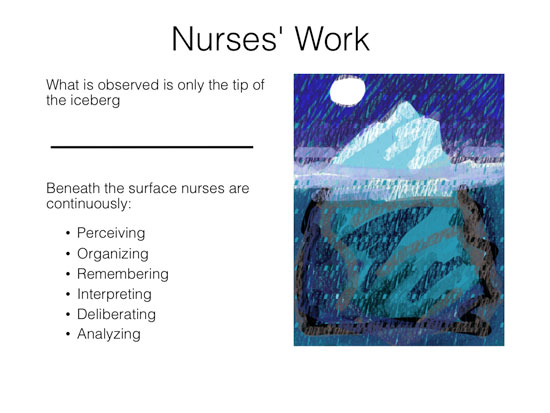
In my role as a Clinical Nurse Specialist and Nurse Educator I have observed nurses act with precision and accuracy in complex situations. I have also seen beginning nurses struggle to learn to “Think like a nurse.” When I watch an experienced nurse, the actions seem well coordinated and fluid, but I am only seeing the tip of the iceberg. Beneath the surface, nurses are continuously perceiving, organizing, interpreting, and deliberating. All the time. In fact, researchers have documented an ICU nurse makes a decision every 30 seconds (Bucknall 2000). How do they do it, and do it so well?

I was first introduced to the critical decision method as published in 1993 here in ANS. The method seemed a good fit for understanding the uniqueness of nurse decision-making. I read more about the method and digested other studies that had used the method. When I looked at the body of studies that had used CDM in nursing, I became aware that when taken together,  these studies corroborated much of what I had observed in practice about nurse decision making.

iceberg550

The Critical Decision Method is certainly useful in describing the cognitive processes of nurses. In addition, the resulting descriptions of situated decision making can provide a framework for instructional materials, to inform the design new information technologies, and to improve and advance nursing practice.

I am grateful for this opportunity to share my work in ANS and in this blog post.  I hope you find my synthesis rings true to what you know about the complexity and uniqueness of nurse decision-making, and I look forward to your comments and dialogue on how this method can be used to influence the development of nursing practice.

Go to the ANS web site now to download your copy of this informative article!

Intellectual Curiosity


This week we introduce a new “Editor’s Pick” article titled  “Intellectual Curiosity: A Principle-Based Concept Analysis” by Bedelia Russell,  MSN, RN, CPNP-PC, CNE.  She has shared the background about her work with us, providing insight into the influences on her thinking including her daughter’s drawing!

If someone had told me when I began doctoral work I would not only contribute to ANS but also participate in the ANS blog, I would have questioned their sanity. I am so honored to be among all these other respected contributors. I began my doctoral work in 2010 following nine years of work as a fulltime faculty… I was the last Master’s prepared nurse to be tenured in our system so tenure was not a variable in my return to graduate school. Why then consider the daunting task of PhD work? When I reflect back, I guess I am guilty of the very subject of my article… intellectual curiosity. Around me… everyone was going back to school… newer faculty with eyes on tenure had made the commitment and I was continuing on in my role as a well-respected educator. But the pressure was there… internally, some external… to join in, and admittedly, I was curious. Could I do the work? Bedelia RussellHow would I balance family? Would I finish? How would I continue to do my job… my job … it was then it hit me… my pull towards PhD work, my motivation, was my job… I had hit a plateau in course redesign and I was asking questions and approaching nursing education with questions that no one around me could answer. It occurred to me that maybe doctoral study would help with those questions and provide new insights into my practice of nursing education.

Intellectual curiosity is something I have for many years evaluated baccalaureate students on… they either demonstrated it or they did not… and I knew what that looked like. So when my first concepts class in my doctoral program required a concept analysis, my cohort talked me into analysis of intellectual curiosity. I remember us all trying to decide on our concept and throwing out ideas to each other. When intellectual curiosity was suggested, it was followed by my peers adding, that should “be easy” and there should be “plenty of information out there.” I have both thanked them and cursed them since those days of convincing me but would not for one day regret the path that seemingly simple decision has led me down.

My work so far has revealed two things. The first is concept analysis that can provide context and understanding of the existing state of the concept is important to advance the science of our discipline. It is in part why I utilized a principle-based concept analysis method. I do not believe it is enough to simply breakdown a concept into its elements… we need to take that concept and look at it from multiple perspectives… multiple disciplines… and then see how our discipline can utilize it. The second revelation is that while I knew what intellectual curiosity looked like… albeit, merely from my perspective… I was unaware of the possible influencing variables and potential consequences for intellectual curiosity.

I am now intrigued with the role it seems motivation has in relation to curiosity. I am left to wonder what our role should be as nurse educators in influencing and modeling the concept of intellectual curiosity and can we perpetuate curiosity once is has occurred.

An important lesson from our first semester philosophy class was to determine our philosophy of science. It was an arduous discovery of finding out I aligned with interpretive inquiry, specifically with Heidegger’s assertions on phenomenology. This view was cemented in a drawing my youngest daughter made at that time, included here.

drawingWhen I asked my four year old daughter where her eyes, nose, and mouth were, her response was “Mommy, I am looking at the clouds…. You are looking at the back of my head.”  This picture is now a bit faded but still hangs on my wall beside my desk. It serves as a reminder on the importance of context, history, and multiple perspectives… something important in examination of the concept of intellectual curiosity in my work ahead. Going forward, my dissertation will look at intellectual curiosity from the perspectives of educators who teach in online learning environments. I welcome your comments on my current work and am both humbled and appreciative of this opportunity for dialogue.

You can download a copy of this article now, while it is featured on the ANS web site!  Then, leave your comments here to discuss your thoughts with the author!