Call for ANS Editor
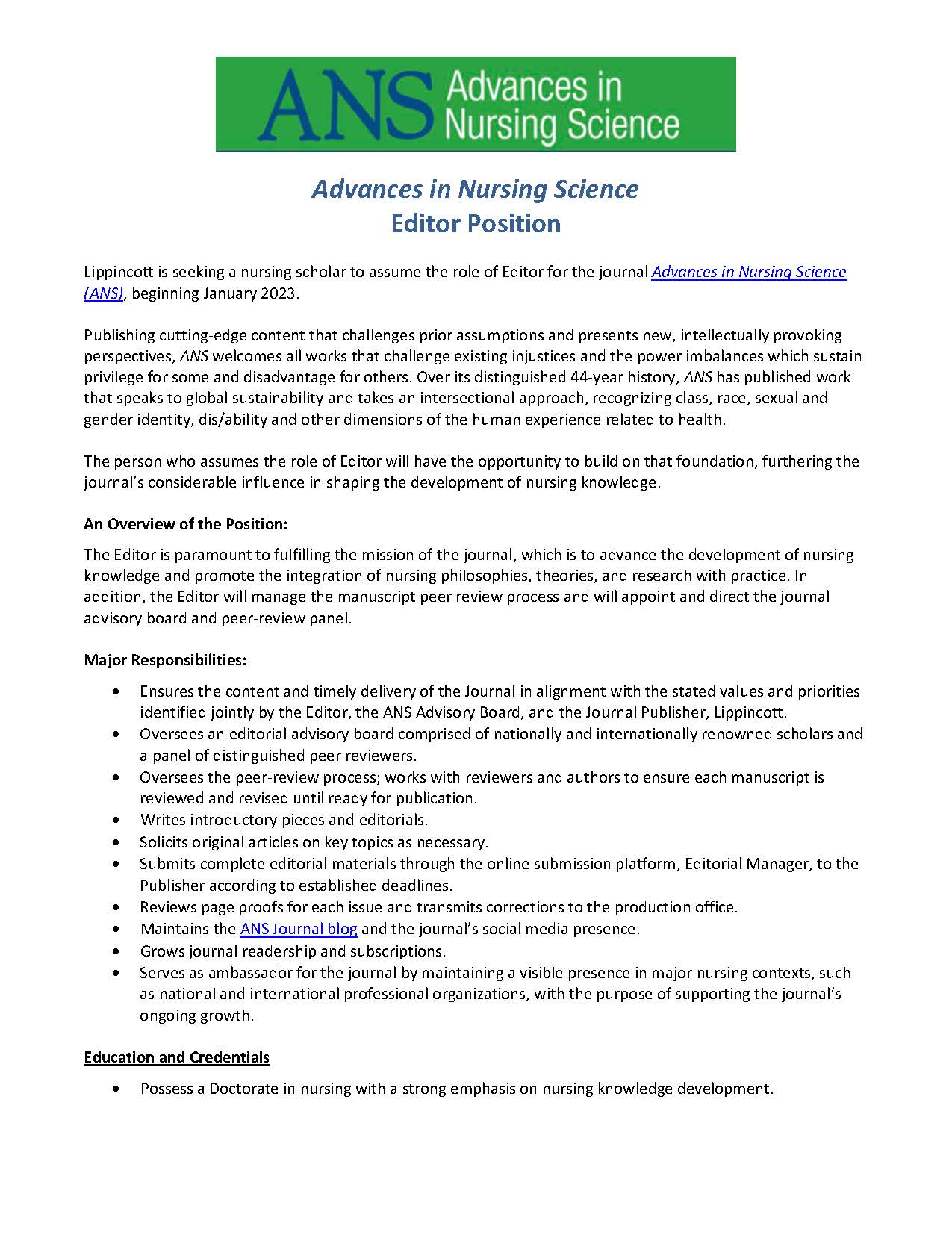
The time has arrived for me to “retire” from my role as Editor of ANS, and to engage a nurse scholar to assume this role starting in January 2023! The Call for ANS Editor is now posted ! Download PDF.


Jul 12
The time has arrived for me to “retire” from my role as Editor of ANS, and to engage a nurse scholar to assume this role starting in January 2023! The Call for ANS Editor is now posted ! Download PDF.


The current featured article in ANS is titled “Learning in the Third Room—A Way to Develop Praxis by Embracing Differences Between Theoretical and Practical Knowledge” authored by Elisabeth Dahlborg, PhD. You can access the article at no charge while it is featured, and we would be delighted to know your comments and ideas about this article in the comments below! Here is the abstract for the article:
Contradictions between theory and practice are well known in nursing. To this end, this article discusses a learning strategy that might facilitate the capture of the dialectic between theory and practice, equally valid components of a nurse’s competence, giving the 2 forms of knowledge equal relevance. Using a virtual platform (ie, the “third room”) decreases the power order between different forms of knowledge. Nurses, students, and teachers all contribute to a seminar using nonhierarchical structures and concepts to capture the knowledge that enables to learn the praxis of nursing. Key words: discourses, nursing education, philosophy, power order, virtual seminar, work integrated learning.
Source
The current ANS featured article is titled “A Critique of the Theory of Planned Behavior in the Cancer
Screening Domain” authored by Jinghua An, MSN, RN and Catherine Vincent, PhD, RN, both at the University of Illinois at Chicago College of Nursing. The article is available for download at no cost while it is featured. Here is a message that Jinghua An provided about this work.
As a nurse, are you involved in promoting cancer screening participation in your community? Early cancer detection is key to improving patients’ chance of survival. The Theory of Planned Behavior (TPB), one of the most frequently applied behavioral theories, has been used to understand, predict, and change cancer screening–related behaviors. In this paper, we applied Fawcett and DeSanto-Madeya’s 2013 framework for analysis and evaluation of nursing theory to critique the TPB from a nursing perspective.
We systematically analyzed and evaluated the TPB to identify its contributions to and usefulness in cancer screening research and practice. The TPB is philosophically congruent with the nursing metaparadigm. The logical congruence between the TPB and the nursing discipline provides the basis for nurses to consider the TPB as a shared theory. The propositions of the TPB could provide information about the individual, interpersonal, social, and environmental determinants of health behavior. Thus, the TPB is applicable in diverse nursing practice situations and settings. It could have profound theoretical significance on nursing if researchers better integrated research findings within the nursing discipline.
The predictive validity of attitude, subjective norm, and perceived behavioral control for intention and behavior has generally been supported in empirical studies. Nevertheless, inconsistencies and gaps exist between empirical data and the theory, particularly with respect to the multiplicative combination rule, intention as a mediator of the effects of attitude and subjective norm on behavior, and the moderation effects of perceived behavioral control. Methodologically sound empirical studies are called for to test these theory propositions.
In addition, the TPB’s utility for developing interventions to promote behavioral change in the cancer screening domain requires further empirical testing. Specifically, future research should provide details of the mechanism of change, the intervention characteristics, and the corresponding theory elements (either from the current TPB or an expanded TPB that integrates other theories). Finally, we believe that translational studies are needed to evaluate the theory’s pragmatic adequacy for promoting cancer screening in nursing practice.
Our current ANS featured article is titled “Gender Influences in the Intersection of Acute Care: Registered Nurses and Law Enforcement – The Collision of Caring and Carceral Institutions” authored by Danisha Jenkins, PhD, RN; Candace Burton, PhD, RN and Dave Holmes, PhD, RN, FAAN, FCAN. We invite you to download the article while it is featured, and share your comments here! Dr. Jenkins shared this information about this work:
Over a decade ago, when working as a nurse in a detention center for children and adolescents, I was first introduced to my position in the intersection of nursing and law enforcement. I saw the ways in which nursing practice and ethics were deformed and often made impossible, when working within carceral walls. My heart was broken. I committed at that point to study and make visible this terrifying phenomenon I was participating in; one in which nurses became tentacles of a system causing unfathomable harm. As I continued my work in trauma and critical care, I continued to witness the carceral influence that pervaded in the acute care setting, particularly in the care of some of our most marginalized and at-risk communities. Today, as legislation is introduced such as requiring nurses to report patients and families for seeking such medical services as gender affirming and reproductive care, nurses increasingly must grapple with their role and interactions with law enforcement and the prison industry. This manuscript is one in a series that reports on a study titled “Care Incarcerated: The Intersection of Nurses and Law Enforcement in the Acute Care Setting”. We hope to strengthen insight and understanding as to the complexities, challenges, and dangers inherent to the intersection of these “caring” and “carceral” institutions.
The current ANS featured article is titled “Art Making as a Health Intervention: Concept Analysis and Implications for Nursing Interventions” by Kyung Soo Kim, PhD, RN and Maichou Lor, PhD, RN. You can download this article at no cost while it is featured! Here is a message sent by D. Kim about this work:
Hello, my name is Kyung Soo Kim, a junior nurse researcher at the University of Iowa, College of Nursing. My program of research focuses on chronic pain in older persons and chronic pain management using art making intervention. I am currently designing an art making intervention using visual art making activities for older persons with chronic pain. If you want to know more about and/or you are interested in my research, please contact me (kyungsoo-kim@uiowa.edu)! I am delighted to introduce my recent article entitled, “Art Making as a Health Intervention: Concept Analysis and Implications for Nursing Interventions”.
Art making has been adopted across multiple disciplines as a health intervention. However, our understanding of art making as a health intervention and how it differs from art therapy is limited. Therefore, we conducted a concept analysis to better understand art making as a health intervention guided by Walker and Avant’s approach. In this article, we reviewed 85 studies and found four defining attributes, four antecedents, and physical and psychological consequences. In addition to these findings, we provided several nursing research and practical implications for nurse researchers and clinicians to aid in designing and implementing art making as a health intervention.
The current ANS featured article is titled “The Potential of Merging Intersectionality and Critical
Ethnography for Advancing Refugee Women’s Health Research” authored by Areej Al-Hamad, PhD, RN; Cheryl Forchuk, PhD, O Ont, RN, FCAHS; Abe Oudshoorn, PhD, RN; and Gerald Patrick McKinley, PhD. While this is featured you can download it at no cost. We welcome your comments and discussion of the article here! Here is a message from Dr. Al-Hamad about this work:
At a time of rapidly developing sciences and an enlarging research arena, this article highlights the paradigmatic moments of complexity, collaboration, and unrealized potential of merging critical ethnography and intersectionality. Exploring such theoretical complexity can inform knowledge development and knowledge-to-action for social justice through research. This merger allows scholars to embrace the best of both perspectives versus having to make a trade-off in choosing a single approach. Ultimately, knowledge of the intersection of theoretical perspectives and methodologies supports the advancement of scholarship and refugee women’s health research.
We intersperse our considerations regarding critical ethnography blended with intersectionality and clarify the complexities and strengths of this combination. This article seeks to contribute to critical research methodology by detailing and providing insights into the strength and potential of merging critical ethnography and intersectionality into a combined approach. To mapping the terrain of emancipation and empowerment, we align the philosophical underpinnings and methodology of critical ethnography with an intersectionality-based analysis to demonstrate a coherent fit between the two.
This blended approach is relevant across research with populations on the margins, such as refugee women, particularly research that seeks to effect enhancements in health equity. Ultimately, we should think about a theoretical approach for future nursing research by exploring the synergetic effect of merging critical ethnography and intersectionality.
The current featured article for ANS is titled “’Be Strong My Sista’ – Sentiments of Strength From Black Women With Chronic Pain Living in the Deep South” authored by Lakeshia Cousin, PhD, APRN, AGPCNP-BC; Versie Johnson-Mallard, PhD, WHNP-BC, FAANP, FAAN; and Staja Q. Booker, PhD, RN. We welcome you to download this article at no cost while it is featured, and share your comments below in the ‘comments’ section. Here is a message that co-author Staja Booker shared about this work:
After meeting a Black woman on vacation who voluntarily shared her raw experience of living chronic
pain, it was clear that this conversation was a true representation of how many Black women feel living
with chronic pain. But more importantly, we were convinced that the story of aging Black women with
chronic pain had to be shared, but from a perspective that could (1) adequately explain the cultural
context of coping because of the gendered racial socialization that plagues us throughout our lives and
(2) realistically educate healthcare providers about Black women’s nuanced experience of living with
pain and seeking pain care in an unjust healthcare system.
The traditional connotation and expectations of “strength” have been associated with women who identify as Black for many decades. The Strong Black Woman (and its corollary The Superwoman Schema) is a unique cultural phenomenon with both paradoxically endearing positive and enduring negative characteristics. While evidence of the Strong Black Woman was robust in our sample, we also identified that women with a lived experience of chronic pain also submitted to God for strength and code-switched to counter the weaponization, misunderstanding, and implicit bias of being perceived as “strong” in healthcare encounters.
Research now and in the future must leverage the inner strength of the “sisterhood” and spirituality as cultural assets to empower Black communities to effectively manage chronic pain. We hope this work will lead to a greater appreciation of narrative inquiry of underrepresented individuals as rigorous scientific evidence that can lead to innovative and equitable health solutions that transform lives. “There is a kind of strength that is almost frightening in Black women. It’s as if a steel rod runs right through the head
down to the feet” (Dr. Maya Angelou).
Today the ANS Volume 45, issue 2 is published! The opening featured article for this issue is titled “The COVID-19 Mask: Toward an Understanding of Social Meanings and Responses” authored by Oona St-Amant, PhD, RN; J. Anneke Rummens, PhD; Henry Parada, PhD, MSW; and Karline Wilson-Mitchell, DrNP, RM, RN, CNM, FACNM. This article is available to download at no cost while it is featured, and we are offering continuing education credits for this timely article! Here is the abstract :
The COVID-19 pandemic has imposed unprecedented restrictions on everyday life. Unlike lockdown or shelter-in-place measures, the facemask has emerged as an empowering response to the public spread of the virus, permitting some degree of return to prepandemic life—such as school or work—by disrupting transmission that would otherwise occur. And yet, this utilitarian tool has attracted considerable controversy and polarized opinions. This article uses Blumer’s adaptation of symbolic interactionism as a theoretical roadmap to examine the various meanings ascribed to the facemask and its usage. We discuss how it is socially perceived and consider implications for health care providers within the Canadian social context.
This just appeared out of nowhere just now and I had totally forgotten writing it – but it would have been so appropriate 2 years ago – not that it will not continue to be appropriate going forward because the earthquake/hurricane/tsunami is still ahead of us.
Yesterday Thomas Cox sent around a terrific commentary on what is happening in Japan, and with his permission, I am posting it here. If you want to see the actual post on the Nurse-Philosophy list, go to this link: http://bit.ly/hUfKBM.
But this is so important, I am posting it here in its entirety:
Risk – The Real Butterfly Effect
by Thomas Cox, PhD, RN, author of the soon to be available book: Standard Errors: Life, Health & Death When Hospitals, Long Term Care Facilities, Home Health Agencies, Physicians & Nurses Are Insurers.
I have resisted the impulse to comment on Japan. But there are only a few “Teachable moments” as profound as this one.
45+ years ago somebody thought it would be a great idea to build a nuclear reactor along the pacific ocean coastline in a country with high seismic activity and high risks of tsunamis.
That day, a butterfly emerged…
View original post 816 more words
Apr 11
The current featured ANS article is titled “Revisioning Assessment and Evaluation in Nursing Education Through Critical Caring Pedagogy: Using Authentic Examinations to Promote Critical Consciousness” authored by Laura A. Killam, MScN, RN and Pilar Camargo-Plazas, PhD, RN. We invite you to download this article at no cost while it is featured, and contribute to a discussion in the comments below! Below is a brief message from the authors, and a video abstract that can also be accessed from the article PDF.
As nurse educators, we believe that written exams are an important part of how we help students learn to think critically and be empowered to speak-up against oppression in society. Since the beginning of the pandemic, we noticed increasing debate in our professional circles around testing practices. This article provides an overview of historical sources of oppression and injustice that educators may unknowingly propagate during traditional exam design. It also addresses the unintended consequences of encouraging surface learning, uncaring practices, oppression, inequity, and cheating when traditional testing is overused or used poorly in nursing education. In the context of critical caring pedagogy and universal design for learning we advocate for authentic assessment, more specifically exams that mirror the real-world context of nurses such as open-book open-web written exams.