Skip to content

Posts from the ‘Journal Information’ Category

Perinatal Palliative Care


The featured article from the current ANS issue is titled “Quality Indicators and Parental Satisfaction With Perinatal Palliative Care in the Intrapartum Setting After Diagnosis of a Life-Limiting Fetal Condition” by Charlotte Wool, PhD, RN; Beth Perry Black, PhD, RN; and Anne B. (Nancy) Woods, PhD, RN.  The article is available for download at no cost on the ANS website while it is featured!  Dr. Wool provided this background about her work:

Dr. Wool began her doctoral studies in 2009 with a program of research in perinatal palliative care (PPC), an interdisciplinary approach to services for parents who opt to continue a pregnancy after learning of life-limiting fetal condition (LLFC). Her early work was a  multiphase study to devise and test an instrument that filled a gap in understanding clinician attitudes and practice barriers to providing perinatal palliative care (PPC). The Perinatal Palliative Care Perception and Barriers Scale is a clinician-level instrument in use or in translation worldwide.

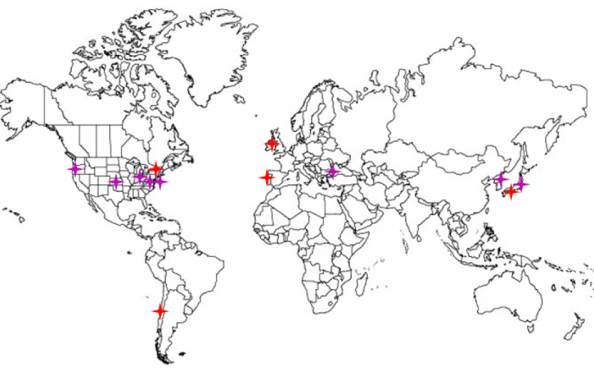
More recently, Dr. Wool developed a parent-level instrument in order to create the foundation for future work in quality metrics. The palliative care sector is dedicated to ensuring the highest quality of care is given to all dying patients. The aim of this quality initiative is to eventually enable benchmarking in the field. The development of the instrument Parental Satisfaction and Quality Indicators Scale included 405 participants.  This instrument has generated a great deal of interest and is currently in translation in Chili, Japan, and Portugal and in use at Harvard Medical School.

ANS recently published the results from parents’ reports of care during their labor and birth experience, known as the intrapartum period. Parents who have their medical needs addressed have higher odds of being satisfied with their care. Psychosocially, parents also yearn for the health care providers to treat their baby with respect and dignity, in spite of their life-limiting condition. Families who experience such tragic loss need clinicians who come alongside them and help shoulder the burden and provide resources for healing.

Dissemination of Instruments

wool-figure

Purple stars: Perinatal Palliative Care Perception and Barriers Scale

Red stars: Parental Satisfaction and Quality Indicators Instrument

End of Life Care: An Emerging Praxis


The latest ANS featured article from the current issue focused on Palliative Care is titled: “What End-of-Life Care Needs Now: An Emerging Praxis of the Sacred and Subtle” by William Rosa, MS, RN, LMT, AHN-BC, AGPCNP-BC, CCRN-CMC and Tarron Estes, BA.  We invite you to download the article at no charge while it is featured, and return here to offer our responses for discussion.  Here is a message from the author about the work behind the article:

billy-rosa

William Rosa

As the tsunami of aging population grows, and medical technical care alone misses the heart of caring, so does the cry to “Occupy Death”, to create care and healing at end of life and “Restore Death to its Sacred Place in the Beauty, Mystery, and Celebration of Life”. It is no longer enough to expect death with dignity; we must strive toward evolving human-centered care. It is not sufficient to ‘do no harm’; we must deliberately create healing environments guided by the spiritual autonomy of the dying one.

tarron-estes2

Tarron Estes

The wonderful news is this: As this cry grows to restore sacred, comforting care to our loved ones during their final months, weeks, and days of life, there is an equivalent groundswell of desire to serve, and a growing numbers of end of life doulas rising to meet the needs of those nearing death. This is the premise and guiding force behind our work.

New Published Ahead-of-Print Articles!


The following 7 items were Published Ahead-of-Print (PAP) on 12/6/2016.

Evans-Agnew, Robin A.; Boutain, Doris M.; Rosemberg, Marie-Anne S.
Original Article: PDF Only
Butterfield, Patricia G.
Original Article: PDF Only
Padgett, Stephen M.
Original Article: PDF Only
Liehr, Patricia; Smith, Mary Jane
Original Article: PDF Only
Stone, Teresa Elizabeth; Maguire, Jane; Kang, Sook Jung; Cha, Chiyoung
Original Article: PDF Only
Gonzalez-Guarda, Rosa M.; Jones, Emily J.; Cohn, Elizabeth; Gillespie, Gordon L.; Bowen, Felesia
Original Article: PDF Only
Sawatzky, Richard; Porterfield, Pat; Roberts, Della; Lee, Joyce; Liang, Leah; Reimer-Kirkham, Sheryl; Pesut, Barb; Schalkwyk, Tilly; Stajduhar, Kelli; Tayler, Carolyn; Baumbusch, Jennifer; Thorne, Sally
Original Article: PDF Only


Decision Making at the End of Life


Our latest featured article is “Decision Making Among Older Adults at the End of Life: A Theoretical Perspective” by Rafael D. Romo, PhD, RN, PHN; Carol S. Dawson-Rose, PhD, RN, FAAN; Ann M. Mayo, DNSc, RN, FAAN; and Margaret I. Wallhagen, PhD, GNP-BC, FGSA, AGSF, FAAN. The article is available for no-cost download while it is featured, so I encourage you to visit the website, read the article, and return here to add your comments about this work!  Dr. Romo shared this background information about his work for ANS readers:

We are honored to have our manuscript has been selected as an Editor’s Pick. This work has special meaning for me (the first author) as it is the culmination of a long journey, one that began with my mother’s death in 2000, led to my career as a nurse, and on to a PhD. Through her death (and my father’s death that occurred while I was working on my

Rafael Romo

Rafael Romo

dissertation), I saw first-hand how the process in which decisions are made is at least, if not more, important as the choices themselves. As clinicians, however, we often find ourselves perplexed by patients’ decision making.

Anticipating and predicting patient decision making would help clinicians who are responsible for supporting and guiding patients through the process, which at times may feel like gazing into a proverbial crystal ball. In my PhD program I began to look at different frameworks that exist to explain, if not predict, decision outcomes among older adults, particularly at the end of life. Prospect theory1 is one important theory that attempts to explain decision making, though in the area of economics. Not only is the original paper one of the most frequently cited papers ever published,2 but the theory has been rigorously tested through numerous studies in a wide variety of fields.

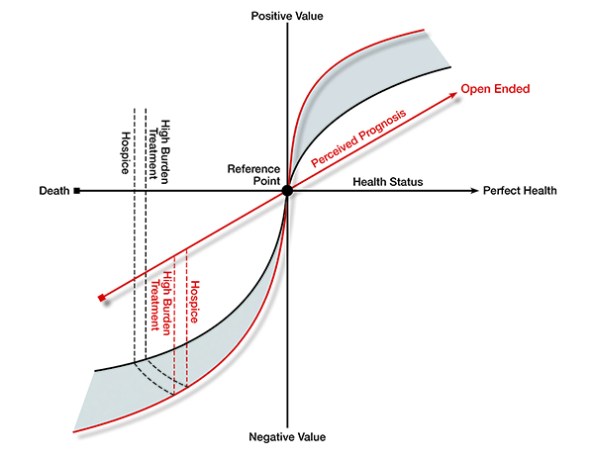
I became interested in prospect theory because it has emerged as a potential framework in healthcare decisions and shows great promise. However, I was struck by one aspect to the existing healthcare research: how the commodity is determined. This commodity is a continuum on which a choice can be measured as a gain or a loss. In economics, the commodity has generally been a purely monetary measure. This is easily measured and constructed as everyone has a sense of what $100 is, even if it is more or less important based on one’s financial situation. In healthcare, the commodity has been measured not so much from patients’ perspectives but from an objective clinical criterion of health. In this study we found that participants’ subjective perceptions of health were markedly different than those determine by traditional clinical measures. While clinicians may use disability or comorbidity as a commodity on which to value choices that is indeed objective, participants were determining their health differently. Not only that, they were trying to value choices on two competing criteria: their desire to live as long as possible and their hope to maintain a high quality of life.

By using prospect theory as an a priori framework in this analysis, we bring important innovations to our understanding of the theory as it is used in healthcare. First, we chose to look at commodities of health status and prognosis as the participants defined them. Thus, rather than using their clinical status and prognosis – which was poor for all the participants – we relied on their personal perceptions as this is the point of reference from which they make decisions. Second, we examined how these two commodities were being utilized together, as it became apparent our participants were valuing choices on both. Even those who felt they were in the best of health didn’t make choices solely on that criterion; rather, they still considered how long they felt they had to live. Likewise, those who felt they had a very short prognosis still “wanted a chance,” as one participant put it. What we discovered is that participants were trying to achieve a delicate balance between the two and that using multiple criteria appears to become more and more important as ones health declined. As they approach the end of life, they are not willing to sacrifice quality of life completely to live as long as possible. Instead, they want a happy medium. This desire to use two commodities seems unique to end-of-life decisions and was not fully addressed by prospect theory.

Is theory needed to understand decision making at this specific time of life? We argue yes. Theory is important both to clinical practice and research. Because clinicians are called upon to resolve the discordant views patients may have of both their health and prognosis, they greatly benefit from understanding this important balancing act. Clinics need to help patients navigate through the complex choices around end-of-life care. While “correcting” patients’ subjective self-assessments may seem like taking away hope, patients cannot make the value-based decisions they say are important without fully understanding the true nature of their situations. Our participants understood this and looked to providers to guide them – and in many cases, to simply make decisions for them.

Besides its value for clinicians and patients, theory plays an important role from the research perspective, as it helps us identify what needs to be studied, and by extension, what interventions may be helpful. Theory also helps us determine where interventions can be applied. Despite all the research that has been done in end-of-life decision making, older adults frequently continue to receive care that is \inconsistent with long-held views, so we continue to have a weak understanding of how older adults are making these choices. In this paper we propose an extended view of prospect theory that can be used to better frame decision making at this unique and challenging time of life. We do not propose this extension as the definitive statement on theory related to end-of-life decision making. We cannot yet offer ways to test and validate our perspective. Rather, we seek to start a dialog that will lead to new and innovative thinking in end-of-life decision making, particularly when the decisions transition from choices about what one would want in an abstract future to what one does want in a concrete reality of today. There are, and will be, detractors of our perspective of prospect theory. We welcome this and hope our manuscript initiates a long, vibrant conversation that will indeed push the envelope and prompt further research that enables us to ensure older adults at the end of life receive high-quality care that is consistent with their own values and goals at the end of life.

  1. Kahneman D, Tversky A. Prospect theory: an analysis of decision under risk. 1979;47(2):263-292.
  2. Wu G, Zhang J, Gonzalez R. Decision under risk. In: Koehler DJ, Harvey N, eds. Blackwell Handbook of Judgment and Decision Making. Malden, MA: Blackwell Publishing; 2004: 399-423.

figure-2


ANS 39:4 just published! Palliative Care


ans-39-4Nurses are at the center in providing palliative care, and at the center of the larger enterprise of exploring and finding effective ways of responding to the physical, emotional and spiritual suffering of patients and their loved ones.  The articles in this issue of ANS Make important contributions to the theoretical, philosophic and empirical approaches that inform practices that shape effective palliative care.  Follow this blog for information as each article is featured, and take advantage of the opportunity to download the articles at no cost while they are featured!

Four new articles Published Ahead-of-Print


The following 4 items were added to PAP on 10/28/2016.
Walter, Robin R.
Original Article: PDF Only
Rew, Lynn; Thurman, Whitney; McDonald, Kari
Original Article: PDF Only
Bender, Miriam; Elias, Dina
Original Article: PDF Only
Falkenstrom, Mary Kate
Original Article: PDF Only

Published Ahead-of-Print!


The following item was added to PAP on 10/25/2016.
Pickett, Stephanie; Peters, Rosalind M.; Templin, Thomas
Original Article: PDF Only


New Articles Published Ahead-of-Print


Published Ahead-of-Print on September 7:

Adkins, Cherie S.; Doheny, Kim K.
Original Article: PDF Only
Wool, Charlotte; Black, Beth Perry; Woods, Anne B. (Nancy)
Original Article: PDF Only
Reimer-Kirkham, Sheryl; Stajduhar, Kelli; Pauly, Bernie; Giesbrecht, Melissa; Mollison, Ashley; McNeil, Ryan; Wallace, Bruce
Original Article: PDF Only
Perry, Donna J.; Willis, Danny G.; Peterson, Kenneth S.; Grace, Pamela J.
Original Article: PDF Only
Cook, Laura Beth; Peden, Ann

Transgender Patient Care


Our current featured article is by Rebecca M. Carabez, PhD, RN ;Michele J. Eliason, PhD and Marty Martinson, DrPH title “Nurses’ Knowledge About Transgender Patient Care: A Qualitative Study.” This article is available for download at no cost while it is featured on the ANS website!  Dr. Eliason sent this message about her personal experiences embarking on a career focused on LGBTQ health:

In 1988, I started my first study of LGBTQ issues in nursing, and I was NERVOUS! I had escaped a homophobic healthcare clinic setting for the supposedly academic freedom environment of the university the year before, but they had hired me as a developmental psych person. Nothing on my vita indicated an interest in LGBTQ issues at that

Mickey Eliason

Mickey Eliason

point, nor had these issues every been discussed in my formal education, except for an off-handed comment about homosexuality being a mental disorder in one psychiatric nursing course I took.

I talked to my research mentor at the time, who told me, “It’s all well and good that you do this type of research, but just make sure that you get 2 or 3 publications in legitimate areas for every one you do on this topic.” I did that, but even then, had some challenges when I came up for tenure.  I am glad to report that things have shifted in nursing since then, and articles on LGBTQ issues are becoming much more widespread. Now people are able to say LGBTQ and now what it means.  Even Donald Trump, halting and awkward as it was, uttered the initials at the Republican National Convention and called for equal rights (it might be the only sensible thing he has ever said on the campaign trail). We have made progress on LGB issues, but the growing edge of our movement in the past few years has been related to transgender issues.

In regards to this particular study, on nurses’ knowledge of transgender health care needs, our findings demonstrated that nurses’ willingness to work with diverse patients is laudable, but their lack of knowledge and fund of misinformation is quite alarming. This study was conducted in the San Francisco Bay Area, where presumably, nurses have much more exposure to LGBTQ issues than in many other places, but even here, we encountered negative attitudes and nurses saying that they never learned anything about this population in their educational programs or in continuing education.

This study was part of a much larger project on LGBTQ issues more broadly initiated by Rebecca Carabez, and a team

Rebecca Carabez

Rebecca Carabez

of nursing students worked on the project.  One identified as transgender, and we watched as they struggled with finding employment when the student’s appearance did not match their gender on legal documents, and who became more depressed as time wore on without meaningful employment. Transphobia has material consequences on individual’s daily lives—without adequate employment, transgender people are likely to live in poverty and suffer all the negative consequences of that poverty, from lack of any regular source of healthcare (leading to getting needed hormones and other treatments on the street), to “illegitimate” employment in the drug or sex trades, homelessness, and other serious issues.  We found in our study that many nurses laughed when talking about transgender issues—that nervous kind of laugh that means, “I’m really uncomfortable with this question.” They often gave long, rambling, circuitous answers to the questions that indicated that they really had no idea how to answer. Few were overtly negative about transgender patients, but imagine what it would be like for a transgender patient to try to communicate with a nurse who was that uncomfortable.

Marty Martinson

Marty Martinson

My co-authors and I had long discussions about gender.  We all identify as sexual minority women, but none of us as transgender or genderqueer. We tried to imagine ways to break down the gender binary that has been in operation in our own lives but like most others, we are somewhat entrenched in that system and it is hard to imagine life without the breaking down of people into two genders. It requires a radical transformation in thinking and in language itself. We firmly believe that this transformation is necessary, not just to improve services for transgender patients, but for all patient care, because the gender binary and gender stereotypes have hurt us all.

We hoped that our article might start some conversations among nurses about how to treat their transgender clients/patients more respectfully, but even more, about how to have hard conversations about the nature of gender and sexuality and ultimately, how we treat each other.  I am gratified that today, unlike the late 1980s when I started writing about LGBTQ issues in nursing, that there is now a willingness to publish articles on these topics and to discuss how to integrate them into  nursing education. Talking and writing about LGBTQ issues is a first step, but I challenge you to read the article and ask yourself, “What can I do personally to effect change for transgender patients in my nursing setting?”


Parents as Partners in the NICU


The latest featured article in the current issue of ANS is by Amy L. D’Agata, PhD, MS, RN and Jacqueline M. McGrath, PhD, RN, FNAP, FAAN, titled “A Framework of Complex Adaptive Systems Parents As Partners in the Neonatal Intensive Care Unit.”  The article is available for download at no cost while it is featured.  Dr. D’Agata sent this message for ANS readers, portraying the important interplay of her clinical experience and academic science to create new insights and new practices to improve care:

Amy pic

Amy D’Agata

I am honored to have my paper A Framework of Complex Adaptive Systems: Parents as Partners in the Neonatal Intensive Care Unit featured as an editor pick in Advances in Nursing Science.  This paper highlights complexities within the NICU, particularly around relationships and environments of care that may contribute to infant neurodevelopmental outcomes.  It is hoped that by acknowledging challenging factors of interpersonal communication, individual differences in practice and acute care environments, we may begin to redesign the current NICU model of care into a model that better promotes neurodevelopment.  Importantly, reframing how we think about parents and their participation in the care of their infant.

As a novice neonatal intensive care nurse, I loved the excitement the NICU provided, both from a technical and interpersonal perspective.  Through advances in technology and medicine, precious newborn lives were saved and family dreams were realized.  Supporting families as they went through a sea of emotions, learned who their baby was as a person and became a strong advocate for their baby.  I always loved working with families and helping them through this process, all while I was caring for their baby.  This is how we practice in the NICU, right?  By and large, nurses and physicians care for patients while families stand by and watch, right?  This is what has to happen in order to save lives, right?  We know best, right?  This is basically how we have always been trained, but now I wonder if there isn’t a different and better way.

McGrath pic

Jacqueline McGrath

After 14 years of professional nursing practice, I entered doctoral studies.  Early in the program I felt as though I was floundering because my research interests were all over the map.  I knew my population of interest would be NICU infants, but I wanted to fix lots of different issues.  Most of which were medical issues.  When potential ideas around developmental care were suggested by my advisor (and co-author) I quickly pooh-poohed them.  Developmental care was a fundamental component of NICU care, but not in my wheelhouse to study.

One day my doctoral advisor shared an article she had co-authored, Epigenetics and Family-Centered Developmental Care for the Preterm Infant. At the time I knew nothing about epigenetics so I was immediately curious.  After reading this paper I literally experienced a professional paradigm shift.  Swiftly brought into focus was the idea that all of our daily experiences impact us.  While this may not seem like a game-changing statement, the fact that seemingly insignificant experiences may trigger molecular changes was something I never considered.  This certainly wasn’t something I considered for our patients.

I have always passionately believed that the work we do in the NICU is important to an infant’s future, but as a nurse, I had practiced with the thought of meeting the necessary medical needs so that infants may one day leave the NICU with their family.  I didn’t intentionally practice with the idea that everything I did in the NICU, every single day, may leave a permanent molecular mark or imprint that may shape who that person becomes.  If I had understood the potential magnitude of my influence, I would have most certainly practiced differently early in my career.

Back to doctoral studies, following lots and lots of reading, my research program began to take shape.  I read volumes about early life experience, epigenetics, genetics, molecular experiences that ‘get under our skin’ and neurodevelopment.  During my academic studies I also continued practicing as a staff nurse in the NICU.  This was a time in which I felt a lot of turmoil as a caregiver, because of what I was learning academically and what I was observing and taking part in clinically, sometimes I felt such internal conflict.  To get through I need to reconcile that what I was learning from basic science was ahead of where we were clinically.

As a conceptual model and framework of the NICU infant experience, Infant Medical Trauma in the NICU, broadly reflects the adverse exposures that occur within the NICU doors and how they may contribute to long-term outcomes (see figure below).  Designing this model was the foundational to my dissertation work for exploring the relationships between NICU stress, genotype of stress associated gene FKBP5 and neurodevelopmental outcomes.  The goal of my dissertation study was to understand if some infants may be genetically more vulnerable to stress experiences in the NICU.

Understanding that some infants may be predisposed to stress sensitivity, and the dynamics of the NICU, parents may be ideally positioned for the role of co-caregiver.  Given the typical parent’s desire to learn anything that helps their infant, their sensitivity to their infant’s needs and awareness of the role they must fulfill once they leave the NICU, why do we place parents on the sideline while we care for their infant?   Are parents incapable of learning how to assess their infant or perform caregiving tasks beyond diaper changes, temperature measurement and feeding?  We expect them to be fully capable once we indicate discharge is eminent, why not earlier in the process?

If we are to improve neurodevelopmental outcomes in the NICU, we may need to critically assess how we practice and consider alternative models.  As care providers, our goal is to save lives and promote health.  While not intentionally inflicted, there are adverse experiences that result from that goal.  Parents are the constants in their infant’s life and the people who will care for their infant beyond the NICU.  In light of this we must begin to see parents as partners in every step of the NICU, including in the provision of care.

Infant Medical Trauma_final rev2 copy


  1. Samra, H., McGrath, J. M., Wehbe, M., & Clapper, J. (2012). Epigenetics and family centered developmental care of the preterm infant. Advances in Neonatal Care, 12(5s), s2-s9