Skip to content

Posts from the ‘Journal Information’ Category

New ANS issue just published!


ANS 37:4 was just published! This issue contains Part II of our focus on “Health Equities.” Both of these articles address equities related to specific populations – African American mothers living with HIV, and children with mental health symptoms. The planned topic for this issue – “Post-Hospital Nursing” is one that is becoming increasingly significant for 37-4 covernurses, as health care shifts more and more to the home and the community. Each article in this issue will appear on the ANS blog with messages from the authors, inviting you to engage in discussions of their work. Join us in this conversation!
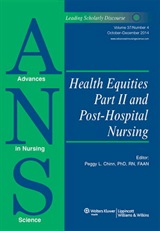
Here is what you will find in this issue!

Health Equities Part II

Using an Intersectional Approach to Study the Impact of Social Determinants of Health for African American Mothers Living With HIV by Courtney Caiola, MSN, MPH, RN, Sharron Docherty, PhD, PNP-BC, FAAN, Michael Relf, PhD, RN, ACNS-BC, AACRN, CNE, FAAN, and Julie Barroso, PhD, ANP-BC, APRN, FAAN

Perceived Discrimination and Children’s Mental Health Symptoms by Cheryl L. Cooke, PhD, MN, RN, Bonnie H. Bowie, PhD, MBA, RN, and Sybil Carr `ere, PhD

Post-Hospital Nursing

Can Nurses Tell the Future?: Creation of a Model Predictive of 30-Day Readmissions by Adonica Dugger, MSN, Susan McBride, PhD, and Huaxin Song, PhD

Analysis of Barriers to Cognitive Screening in Rural Populations in the United States by Lisa Kirk Wiese, PhD, RN, Christine L. Williams, RN, DNSc, PMHCHS-BC, and Ruth M. Tappen, RN, EdD, FAAN

Tried and True: Self-Regulation Theory as a Guiding Framework for Teaching Parents Diabetes Education Using Human Patient Simulation by Susan Sullivan-Bolyai, DNSc, CNS, RN, FAAN, Kimberly Johnson, BSN, CDE, RN; Karen Cullen, BSN, CDE, RN, Terry Hamm, BSN, CDE, RN, Jean Bisordi, BSN, CDE, RN, Kathleen Blaney, MPH, RN, Laura Maguire, MS, RN, and Gail Melkus, EdD, RN, FAAN

Predicting Transition to the Supine Sleep Position in Preterm Infants by Sherri L. McMullen, PhD, RN, NNP-BC, and Mary G. Carey, PhD, RN, CNS

Ethics and Democratic Professionalism in Nursing


Our current featured article, titled “Discourses of Social Justice Examining the Ethics of Democratic Professionalism in Nursing” by Janice L. Thompson, PhD, RN is a thought-provoking article that challenges all nurses – in practice, academics or research – to contribute to social justice in health care.  Dr. Thompson has shared this

My article “Discourses of Social Justice: Examining the Ethics of Democratic Professionalism in Nursing” was written between December 2011 and  May 2014.  I’m very happy to see this paper published in the current issue of ANS.  In this instance like others, as the manuscript developed, my writing progressed to a finished product that addressed other outcomes than I originally intended. I’m forever thankful to my colleagues for inviting me to begin a writing project on the topic of emancipatory philosophies and practices of social justice in nursing, and for their support in suggesting a re-direction of this manuscript for publication in ANS.

    Here I want to acknowledge the help and influence of three scholars who offered important comments and suggestions during the composition of this essay. As always, Peggy Chinn provided insightful meta-analytic perspective, helping me to remember the Thompson400importance of thoughtfully balancing the work of intellectuals in nursing and philosophers in other fields of study. Similarly Paula Kagan offered important and welcome support in collegially inviting me to consider emancipatory interests in nursing. Her helpful comments on the relevance of the work of Cornel West were most welcome.  Finally, Richard Pattenaude’s critical reading helped me to recognize the centrality of the concept of democratic professionalism in my analysis. His thoughtful suggestion provided important affirmation, helping me to recognize a recent turn to questions of democratic professionalism in my work.

    I write from a position that considers professional formation in nursing. I do this with a background and context of having practiced now in the U.S. and in Canada. I’m employed as a professor of nursing at the University of New Brunswick in Fredericton, New Brunswick, Canada. There I teach undergraduate and graduate students in nursing and interdisciplinary PhD students. My teaching and research examine the ethics and epistemic conditions of social justice and caring in nursing and health care. I consider practice with marginalized populations from a critical theoretical perspective in transcultural nursing.  I foreground the importance of anti-racist, anti-colonizing and feminist post-structuralist analysis in my research.  And I use theories of nursing in an interpretive (hermenetic) interface with interdisciplinary work to understand the formation of nursing as a profession. I recognize that these phrases mark me as an academic , although I hope I am still an organic intellectual in nursing.  

     I’ve practiced as a registered nurse for thirty eight years, first in the United States and more recently, in Canada. My work includes 31 years as an educator in nursing and interdisciplinary studies in public universities. My permanent residence is in the United States, in the state of Maine. This lifestyle arrangement carries with it a fair amount of border crossing (literally and symbolically). I maintain registration as a nurse in Canada and the U.S. For the last eight years, I’ve worked and resided temporarily in Canada while retaining my U.S. citizenship.  I maintain active connections with nursing educators on both sides of the Canadian and U.S. border.   These life choices have produced a growing “border subjectivity” with deepening recognition of the similarities and differences between Canada and the United States and with growing appreciation for nursing practice internationally.

    Increasingly, I’m noticing the historical influence of nursing leaders from Canada and the United States who worked together, sometimes as close friends, to address issues related to the formation of our profession.  I’ve become somewhat preoccupied with thinking about those nursing leaders who engaged important transnational issues of professional formation at the turn of the twentieth century. It’s been important for me to see how American and Canadian nurses have worked together as leaders, frequently in friendship, to address common concerns. Adelaide Nutting and Lavinia Dock are examples of Canadian and American women who provided “wicked” strong leadership to ensure the formation of professional nursing practice in North America during the early decades of the twentieth century. Their collegial influence as global citizens and global thinkers inspired a larger vision of nursing education and regulatory authority, influencing what nursing could be as a unique profession.  Similarly, scholars Bertha Harmer and Virigina Henderson worked collaboratively finding common ground in North  America by focusing on core knowledge of the profession. And of equal interest, nurses on both sides of the U.S. – Canadian border learned together in the early decades of the twentieth century to engage practice and policy in the settlement house movement –addressing urban health equity for immigrants and refugees.

    What is common for me in these examples is the willingness of Canadian and American nurses to engage together and to learn from each other, despite important differences in the way our political economies have organized the delivery of health care. These collaborative experiences were bound by strong commitments to social justice and health equity. They demonstrated a kind of leadership that remains highly relevant, in practices that were guided by commitments to a common model of democratizing professional ethics, despite cultural differences. That model of ethics in professional practice, found in our history and today, is different from one shaped only by social trustee professionalism.  As I’ve suggested in my article, democratic professionalism sees nurses working collaboratively with each other and with others in activity that shares power and empowers citizens and communities, improving access to care and improving health outcomes in marginalized communities by addressing the social determinants of health.  This kind of democratic professionalism, in hospitals and in other community contexts, operates with a complex constellation of ethical capacities, with a keen sense of local, regional, and transnational politics, fully understanding the importance of correcting injustices in the political economy of health, and tending to policy level innovations that correct health disparities in advanced post industrial capitalism. These sensibilities include an understanding of contradictions that occur when the ethics of health care systems are organized in privatizing ways within market economies .

    Democratic professionalism has been practiced historically and is alive in North America. In nursing and in other professions in the early decades of the twentieth century, it was closely tied to the scientific vision of practice found in the philosophy of North American pragmatism. That model of professionalism and that philosophy of science had much to offer North America in the first decades of our growing democracies. Its contemporary revisions in critical American pragmatism continue to have important relevance  today.  

    My essay explores some of these ideas.  I’m interested in critical American pragmatism as  a philosophy that provides coherent epistemic, ethical and ontological connections  between a model of scientific activity and a democratising ethics in professional practice. I’m interested in understanding how professional commitments and the formation of nursing as a profession can be helped by a democratizing model of practice and how that model of practice can support the health of my American democracy.  As I reflect, I think perhaps my essay may be informed by a maturing sense of love for my profession, despite its flaws. Understanding it now from a different place-with more appreciation for cultural and transcultural influences, and with an abiding faith in the healing influence of professional formation of nursing, I take inspiration from generations of nurses who also have seen themselves as “organic intellectuals.”            

Please visit the ANS web site and download Dr. Thompson’s manuscript while it is featured!  We welcome your responses and ideas – let’s have a lively discussion of the issues and possibilities that Dr. Thompson unveils!


Reflections on experience researching LGBT health


Our current featured article titled “Enhancing our Understanding of Emancipatory Nursing: A Reflection on the Use of Critical Feminist Methodologies” by Judith Ann MacDonnell, PhD, RN, provides a rare glimpse in to the life of a researcher.  Dr. MacDonnell’s reflections are particularly significant given the focus on her scholarship – LGBT health.  Dr. MacDonnell shared this message for ANS readers, addressing how her article emerged, and the importance of this work for nursing education:

In my experience, there are just a few detailed research reflections in the published nursing literature. The idea for writing a reflection on my LGBT- and equity-focused research program came to me as I was going through the tenure process, a time when (it would be fair to

Judith MacDonnell

Judith MacDonnell

say) there’s lots of reflection and writing about what you have done, why you have done it and where you are going.    Using emancipatory nursing as a lens was the opportunity to move beyond this individual focus in an iterative way, situating these experiences in the larger contexts of higher education, the profession and the social landscape, opening space to consider what it might take to build LGBT-focused nursing research.

I expect many of us would agree that a nursing curriculum focus on cultural competence that is inclusive of LGBT issues is crucial.  Another approach to embed LGBT content in the curriculum is to expand nursing students’ exposure to and engagement with diverse critical feminist methodologies and LGBT-focused research in both nursing research and clinical courses at both the undergrad and graduate levels.. Framing in-class or clinical discussions with an emancipatory nursing lens may help broaden students’ understandings of the potential within diverse nursing  roles to identify injustices and take action. Highlighting how dimensions of emancipatory nursing are embedded in such research (e.g., praxis, situated privilege) may spark discussions of nurses’ everyday political practice and opportunities for nurses to open space to challenge heterosexism, biphobia, transphobia (and how they intersect with racialization, ableism, etc.)  in education, administration, direct clinical practice, research or policy arenas.

While this article is featured on the ANS web site, you can download it at not cost!  Take this opportunity to obtain you copy, and return here to share your comments and enter into a discussion about the issues addressed in this article!

New Issue Topic for 2016: Women & Girls!


For everyone whose scholarship addresses health and health care for women and girls – this is for you!  We have just scheduled ANS 39:2 to focus on “Women & Girls!”  The due date for manuscripts is October 15, 2015, so you have ample time to plan your submission for this issue!  Here is the issue description:

Women & Girls
Vol 39:2 –   June 2016
Manuscript Due Date: October 15, 2015

In 2011, the United Nations declared October 11th an annual “International Day of the Girl Child.” We are dedicating the mid-girlchildlogoyear 2016 issue of ANS in anticipation of the October 2016 international observance focusing on girls. We seek manuscripts that address nursing perspectives on health care for girls and women, their families and communities. We welcome research reports that provide evidence for nursing practice, theoretical and philosophic perspectives, or methodologic issues related to investigating health issues and nursing concerns for women and girls. We particularly welcome manuscripts with an international focus.

Visit the ANS web site any time to see all of our projected issue topics – but to save you a an extra web-trip, here is the current list!  

Models of Care for the Future 
Vol 38:2 –   June 2015
Manuscript Due Date: October 15, 2014

As nations worldwide seek to establish models of care that provide quality and efficiency, nurse leaders are emerging to play a significant role in the development of these models. For this issue of ANS we are seeking manuscripts that provide theoretical underpinnings of creative models of care, as well as evidence that supports their implementation. Manuscripts should be clearly grounded in a nursing perspective; the content can include philosophic, theoretic, empirical or ethical aspects related to the model.

Translational Scholarship 
Vol 38:3 –   September 2015
Manuscript Due Date: January 15, 2015

For this issue of ANS we are seeking manuscripts that provide methodologic innovations that bring nursing theory, research and practice together, including translational research, emancipatory and participative approaches. Nursing research reports of studies using these methodologies are welcome, as are manuscripts that provide philosophic, theoretical or methodologic explanations of these approaches to scholarship. Manuscripts should include a strong emphasis on the development of nursing as a discipline.

Veterans Health 
Vol 38:4 –   December 2015
Manuscript Due Date: April 15, 2015

Given recent history of international conflict and violence, the health and well-being of those who have served the military of any country world-wide has become a major challenge that influences the well-being of families, communities and nations. For this issue of ANS we seek manuscripts that address nursing perspectives on health care for veterans, their families and communities. We welcome research reports that provide evidence for nursing practice, theoretical and philosophic perspectives, or methodologic issues related to investigating health issues and nursing concerns for this population.

Technologies, Nursing & Health
Vol 39:1 –   March 2016
Manuscript Due Date: July 15, 2015

Nursing, of necessity, has adapted over the past half century to the burgeoning presence of technology that has been developed for the diagnosis and treatment of sickness and disease. For this issue of ANS we seek scholarly works that extend the critical analysis of technologies from a nursing perspective, and works that provide evidence upon which to build nursing practice in ways that balance the use of appropriate technologies with the person-to-person relationship and caring that is central to nursing practice. We welcome articles that present empirical research, philosophic analyses, and development of theoretical models that inform the appropriate use of technology.

Women & Girls
Vol 39:2 –   June 2016
Manuscript Due Date: October 15, 2015

In 2011, the United Nations declared October 11th an annual “International Day of the Girl Child.” We are dedicating the mid-year 2016 issue of ANS in anticipation of the October 2016 international observance focusing on girls. We seek manuscripts that address nursing perspectives on health care for girls and women, their families and communities. We welcome research reports that provide evidence for nursing practice, theoretical and philosophic perspectives, or methodologic issues related to investigating health issues and nursing concerns for women and girls. We particularly welcome manuscripts with an international focus.

ANS 37:3 – “Health Equities” just released!


The new current issue of ANS is now available online!  This issue, focusing on “Health Equities,” affirms the conviction upon which many nurses historically have built their practice – a conviction that social inequities have profound health consequences. The articles in this issue 37-3 coveradd to a growing body of literature that provides depth and breadth to expand nursing’s disciplinary perspective on social justice as central to our mission. Each article will be featured on the ANS blog over the next several weeks, so watch this blog to learn more about each author’s important work.

Watch for the “Editor’s Pick” on the ANS web site over the next several weeks – each of the articles in this issue will be featured for a couple of weeks.  While each article is featured it will be available for free download!  These articles are all very thought-provoking, and we welcome your responses and comments here on this blog!

Informed Advocacy: An Emancipatory Nursing Perspective


The current ANS featured article is titled “Informed Advocacy: Rural, Remote, and Northern Nursing Praxis.”  In this article, the authors, Karen MacKinnon, PhD, RN; Pertice Moffitt, PhD, RN present present a synthesis of their combined research about nursing practices in Western and Northern Canada. They compared the stories of rural Canadian public health nurses with feminist and critical theoreticalnurse-advocate3_300 perspectives in order to discern evidence of informed advocacy as emancipatory nursing practice. In their conclusion they describe the elements of informed advocacy:

 . . . we learned that the informed advocacy work of rural, remote, and northern nurses includes the following dimensions: (1) ensuring that people’s concerns are heard  (by listening with intention and responding with action), (2) contextualizing practices  (by making visible or using information about the contexts of people’s lives to inform health care decision making), (3) safeguarding  (by ensuring that people remained safe), and (4) addressing systematic health inequities  (by mobilizing local resources and by providing leadership at the health system or health policy level).

We welcome your ideas and responses!  While this article is featured, it is available for free download, so visit the ANS web site now, read the article, and come back here to share your comments!

Issue scheduled on “Technologies, Nursing & Health”


We have just scheduled the issue topic for ANS Volume 39:1 – Technologies, Nursing & Health!  Manuscripts for this issue will be due no later than July 15, 2015, but we accept manuscripts for review before the due date if you want to have some extra time for revisions after the manuscript review process.  Here is the description of what we seek for this issue:

Vol 39:1 – Technologies, Nursing & Health Nursing, of necessity, has adapted over the past half century to the burgeoning presence of technology that has been developed for the diagnosis and treatment of sickness and disease. For this issue of ANS we seek scholarly works that extend the critical analysis of technologies from a nursing perspective, and works that provide evidence upon which to build nursing practice in ways that balance the use of appropriate technologies with the person-to-person relationship and caring that is central to nursing practice. We welcome articles that present empirical research, philosophic analyses, and development of theoretical models that inform the appropriate use of technology. Date manuscripts are due: July 15, 2015

As a reminder, here is the lineup of all of our future topics with manuscript due dates:

Patterns of health behavior
Vol 38:1 –   March 2015
Manuscript Due Date: July 15, 2014

For this issue of ANS we seek manuscripts that focus on nursing perspectives related to specific health behavior patterns (for example fear, hope, despair, uncertainty, inner strength). Manuscripts can be based on empiric evidence related to these patterns as factors in health and illness, conceptual and theoretic developments, or philosophic perspectives grounded in nursing. We particularly welcome articles that provide direction for the development of nursing practice.

Models of Care for the Future
Vol 38:1 –   June 2015
Manuscript Due Date: October 15, 2014

As nations worldwide seek to establish models of care that provide quality and efficiency, nurse leaders are emerging to play a significant role in the development of these models. For this issue of ANS we are seeking manuscripts that provide theoretical underpinnings of creative models of care, as well as evidence that supports their implementation. Manuscripts should be clearly grounded in a nursing perspective; the content can include philosophic, theoretic, empirical or ethical aspects related to the model.

Translational Scholarship
Vol 38:3 –   September 2015
Manuscript Due Date: January 15, 2015

For this issue of ANS we are seeking manuscripts that provide methodologic innovations that bring nursing theory, research and practice together, including translational research, emancipatory and participative approaches. Nursing research reports of studies using these methodologies are welcome, as are manuscripts that provide philosophic, theoretical or methodologic explanations of these approaches to scholarship. Manuscripts should include a strong emphasis on the development of nursing as a discipline.

Veterans Health
Vol 38:4 –   December 2015
Manuscript Due Date: April 15, 2015

Given recent history of international conflict and violence, the health and well-being of those who have served the military of any country world-wide has become a major challenge that influences the well-being of families, communities and nations. For this issue of ANS we seek manuscripts that address nursing perspectives on health care for veterans, their families and communities. We welcome research reports that provide evidence for nursing practice, theoretical and philosophic perspectives, or methodologic issues related to investigating health issues and nursing concerns for this population.

Technologies, Nursing & Health
Vol 39:1 –   March 2016
Manuscript Due Date: July 15, 2015

Nursing, of necessity, has adapted over the past half century to the burgeoning presence of technology that has been developed for the diagnosis and treatment of sickness and disease. For this issue of ANS we seek scholarly works that extend the critical analysis of technologies from a nursing perspective, and works that provide evidence upon which to build nursing practice in ways that balance the use of appropriate technologies with the person-to-person relationship and caring that is central to nursing practice. We welcome articles that present empirical research, philosophic analyses, and development of theoretical models that inform the appropriate use of technology.

Be sure to visit the ANS web site to see our planned issue topics, information for authors, and access to all articles published in ANS since the very first issue in 1978!

ANS 37:2 “Relationships and Health” just published!


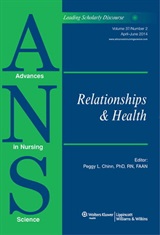
The topic of this issue of ANS – Relationships and Health – is central to nursing practice, and yet this vital connection is often taken for granted.37-2 cover Articles in this issue focus on family relationships, philosophic and theoretic foundations of human caring in the nurse-patient relationship, and the complexities of these relationships on health and well-being.

Each article in this issue is featured in our “Editor’s Pick” section of the ANS web site, and while an article is featured, it is available for free download.  It is also featured here, along with a message from the author that provides interesting background about their work.  Watch the web site to see which article is currently featured, and  return to the blog regularly to see messages from the authors!

Here is the Table of Contents for this issue

SmithBattle, Lee; Leonard, Victoria
McKelvey, Michele M.
St-Amant, Oona; Ward-Griffin, Catherine; Brown, Judith Belle; Martin-Matthews, Anne; Sutherland, Nisha; Keefe, Janice; Kerr, Michael S.
Ray, Marilyn A.; Turkel, Marian C.
Wolf, Karen Anne
MacKinnon, Karen; Moffitt, Pertice
Lobar, Sandra L.

Manuscript due date extended for ANS issue on “Post-Hospital Nursing”


Yes, indeed!  If you are close to polishing a manuscript related to the topic of “port-hospital nursing,” you have some time to send it in to be 15684347considered for publication in this issue!  The new due date is May 1, 2014!  Here is the description of this issue:

The period following hospitalization is a critical period in the process of recovery and healing. can be significantly influenced by nursing care in the hospital and in the community. For this issue we seek manuscripts that focus on nursing in post-hospital recovery. We particularly welcome articles that provide evidence on which nursing practice can be designed, as well as philosophic, theoretic, or economic analyses that address issues related to post-hospital recovery and the risk of re-hospitalization.

Nursing can play a significant role in quality of life and care after hospitalization, and this focus is growing as health care practices are changing to support efforts to reduce re-hospitalization!  So if you have something to contribute to this issue, please let us hear from you!!

Issue topic on “Veterans Health” planned for 2015


The ANS schedule for future issue topics now includes the planned topic for Volume 38 No. 4 – “Veterans Health.”  Manuscripts are due for this issue on April 15, 2015.  Here is the description:

Given recent history of international conflict and violence, the health and well-being of those who have served the veterans300military of any country world-wide has become a major challenge that influences the well-being of families, communities and nations. For this issue of ANS we seek manuscripts that address nursing perspectives on health care for veterans, their families and communities. We welcome research reports that provide evidence for nursing practice, theoretical and philosophic perspectives, or methodologic issues related to investigating health issues and nursing concerns for this population.  Date manuscripts are due: April 15, 2015

Be sure to watch our ever-evolving list of future issues!  All of the planned issue topics for which manuscript submissions are open are on the ANS web site, and we will announce new topics here as they appear.  The current list of topics for which manuscript submissions dates are coming up are (click the link for an issue topic to wee the full description):

37:4 – Post-Hospital Nursing – December 2014
Manuscript Due Date – April 15, 2014

38:1 – Patterns of Health Behavior- March 2015
Manuscript Due Date – July 15, 2014

38:2 – Models of Care for the Future- June 2015
Manuscript Due Date – October 15, 2014

38:3 – Translational Scholarship- September 2015
Manuscript Due Date – January 15, 2015

38:4 – Veterans Health- December 2015
Manuscript Due Date – April 15, 2015