Skip to content

Posts from the ‘Journal Information’ Category

ANS is Featured Journal on Lippincott’s NursingCenter.com


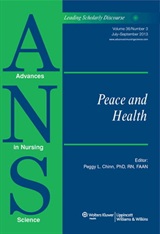
The current issue of ANS, focusing on the timely topic of “Peace and Health” is the current featured journal on NursingCenter.com!  As a featured journal, all contents are available for free download until October 1!  Here is what NursingCenter.com says about ANS:

Advances in Nursing Science (ANS) is the most stimulating publication in nursing science and education today. ANS is 36-3 coverintellectually challenging, yet readable; innovative, yet scientifically sound; reliable research without the tedious, traditional hard science approach found in so many other journals.

This issue would not be possible if it were not for the scholarship of the nurses whose work focuses on this very important topic.  Here is  the Table of Contents:

Just announced: Future issue topic “Models of Care for the Future”


ANS Vol 38:2  will focus on Models of Care for the Future.  As nations worldwide seek to establish models of care that provide quality and efficiency, nurse leaders are emerging to play a significant role in the development of these models.  For this issue of ANS we are seeking manuscripts that provide theoretical underpinnings of creative models of care, as well as  evidence that supports their implementation.  Manuscripts should be clearly grounded in a nursing perspective; the content can include philosophic, theoretic, empirical or ethical aspects related to the model.   Manuscripts will be due October 15, 2014.

For a complete updated listing of all future issue topics, and the due dates for manuscripts, visit the ANS web site!

ANS Issue “Peace & Health” just released!


This just-released issue of ANS focuses on the topic of  “Peace and Health.” I believe that nursing can significantly influence conditions the

ANS 36:3 "Peace & Health"

ANS 36:3 “Peace & Health”

promote peace. In fact to reach for an ideal of  high-level wellness and health for all, understanding and creating peace is an absolute necessity. The articles in this issue of ANS stand as a signal that within the nursing community, this potential does exist. Nursing

scholarship and research contributes to understanding relationships between peace and health, and evidence that can be used to build family-wide, community-wide, nation-wide and even world-wide possibilities for peace. I hope that as a reader you will be inspired to join these authors, and many others in the nursing community to build a science, and a practice, that promotes peace!

Manuscript due date extended for “Innovations in Health Care”


Spread the word!  we have extended the manuscript due date for “innovations in Health Care” to April 25, 2013!  Given the challenges of the current system changes, and nursing’s unique role in creating these changes, this issue topic is extremely important.  We want a strong nursing “voice” to come through in this ANS issue!  Here is a description of the topic:

Innovations in Health Care Delivery
Vol 36:4 –  December 2013
anspic2004.jpgManuscript Due Date: Extended to April 25, 2013
Health care systems worldwide have undergone dramatic changes since the beginning of the 21st century, and for this issue of ANS we are calling for manuscripts that provide evidence of approaches to health care that address pressing issues that gave rise to the changes. In particular, we seek manuscripts that describe nursing models that have influenced health care delivery, and evidence related to outcomes based on these models. We also welcome manuscripts that present theoretical and philosophical perspectives that contribute to understanding and shaping health care delivery policy and decisions.


Development of a theory of compassion


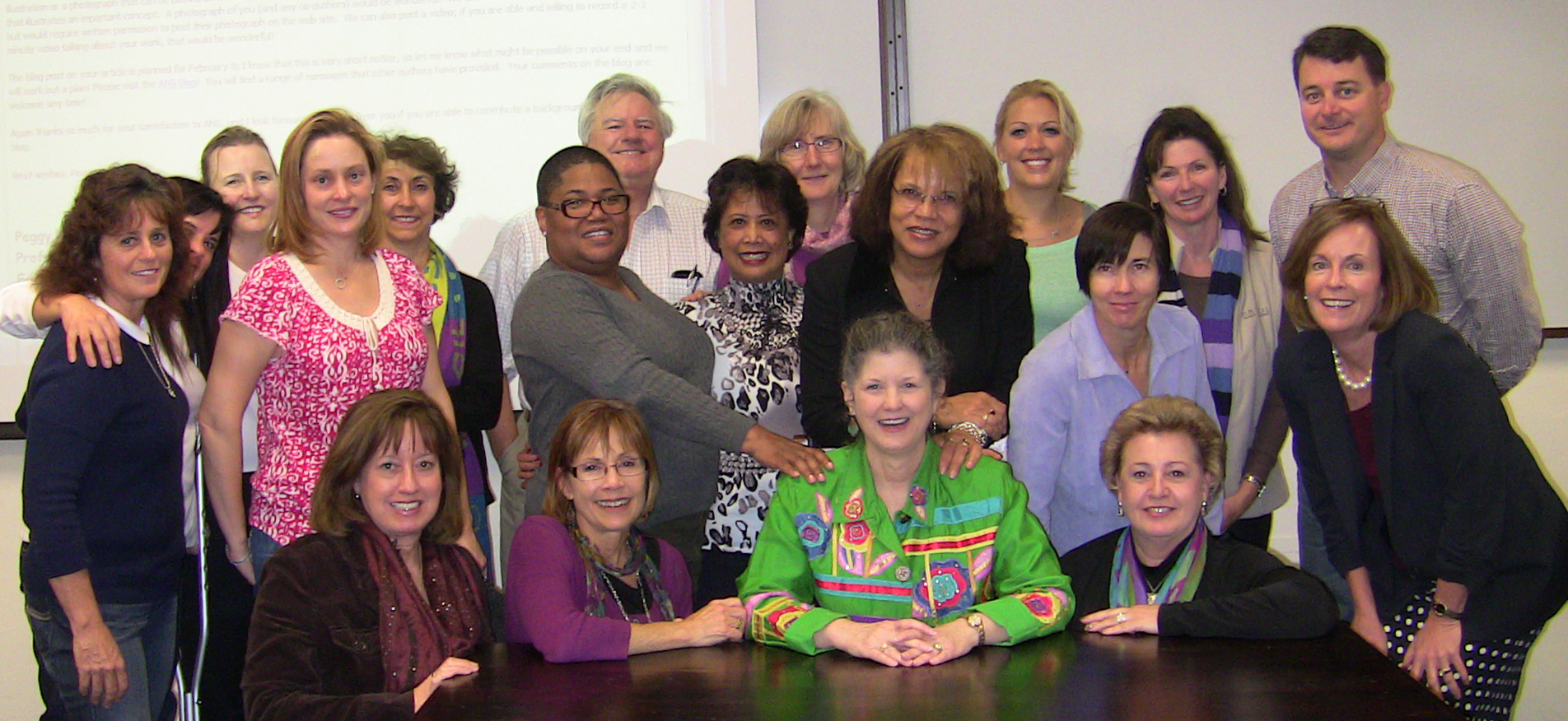
The current issue of ANS focuses on the topic “Critique and Replication.”  Dr. Jane Georges’ article in this issue illustrates a “long view” account of how ideas evolve over time.  Her various publications over the years may have seemed unrelated to one another  – articles on suffering, biopower, Nazi Germany nurses – but in fact each aspect of her work has contributed to an evolving theoretical development.  She reports the evolution of this theory in the currently featured article that appears in this issue of ANS. Dr. Georges has shared for this blog the experience of her work, and pays tribute to the students and colleagues who have contributed to the development of her ideas:

The relational nature of nursing is what is most precious to me and informs my work most deeply. Wherever we practice- as clinicians, educators, or administrators- the bonds we share with our fellow nurses are strong and indissoluble. I call it the nurse-nurse bond. The compassion we show for each other can and does carry us through the most unimaginable experiences everyday, everywhere. When asked about the source from which my work in compassion emerges, I always respond that it is the love and caring of my nurse colleagues. I have been so very blessed to have compassionate helpers in my journey. From the outstanding faculty at the University of California San Francisco School of Nursing in the 1970’s to the superb researchers in my PhD program at the University of Washington School of Nursing, I have been shown the difference that compassion makes. Looking back at my scholarly work during the past decade, I owe so very much to my students at the Hahn School of Nursing and Health Science at the University of San Diego. I couldn’t have done this work without your wisdom, encouragement, and vision. You have taught me what compassion really looks like. It looks like nurses who work for 12 long hours in unimaginable environments, then come to class eager to learn about strategies to improve health care. It looks like nurses from diverse backgrounds that work hard to forge bonds of community in a classroom. It looks like nurses who read Advances in Nursing Science deeply and discuss it passionately. In short, compassion looks like YOU.

Dr. Georges (green jacket) with a group of students

Dr. Georges (green jacket) with a group of students

The networks of that we develop in our communities are significant, and influence the ongoing development of nursing knowledge.  This blog provides an avenue for all ANS readers to participate in this community.  W welcome your comments, questions and perspectives!

Cultivating Nursing Leadership for Our Envisioned Future


In this “Editor’s Pick” featured article, author Lee Galuska, MSN, RN, summarizes the result of a metasynthesis of qualitative studies on nursing leadership development.  Her analysis offers significant evidence that can shape leadership development programs and curricula.  Galuska described the development of this research:

This article emerged out of my passion for promoting excellence in nursing leadership.  As I started my doctoral work, the driving questions centered on effective nursing leadership in healthcare organizations.   In exploring leadership models and theories, I became interested in complexity science and leadership in complex adaptive systems. I became intrigued with the work of Tim Porter O’Grady and Kathy Malloch on quantum leadership.  Their discussion of leadership in complex health care systems helped to shape my studies.  For nurse leaders, an understanding of complexity science and the behavior of complex systems is essential for creating the conditions for leadership to emerge in nurses throughout the system.

As I was learning more about leadership and complexity, the Future of Nursing: Leading Change, Advancing Health report was released.  The report reflected a recognition that our healthcare system is a complex adaptive system and that in order to achieve the outcomes of a transformed system and a healthier nation, nursing leadership development was critical.  That triggered my pursuit of understanding how best to cultivate nursing leadership

Lee Galuska

Lee Galuska

competency in nurses at all levels.   I wanted to study it from the perspective of nurses themselves.  I wanted to find out what nurses had found to be effective in helping them to develop leadership competency.

I had the good fortune at that time to be studying qualitative research methods with Cheryl Beck at the University of Connecticut.  Under Cheryl’s guidance I began to conduct a metasynthesis of qualitative studies of nurses’ experience with leadership development.  That work ultimately evolved into three metasyntheses.  This article focuses on the role of the context or environmental considerations on the development of nursing leadership competencies.  Another focuses on the role of purposeful, guided experiential learning and the third on formal leadership learning strategies.  My hope is to propose a model or “bundle” for effective nursing leadership development at all levels.

This is an important article that can inform efforts to bring the recommendations of the “Future of Nursing” report to reality.  Visit the ANS web site and download your free copy of this article today!

Update on Future Issue Topics!


We  have added a new issue topic for ANS 37:3 – Health Equities!  Here is our complete list of future topics; follow the links for the issue topics to see a description of the kinds of manuscripts we are seeking for each.

36:3 – Peace & Health – September 2013
Manuscript Due Date – January 15, 2013

36:4 – Innovations in Health Care Delivery – December 2013
Manuscript Due Date – April 15, 2013

37:1 – Emerging Theories for Practice – March 2014
Manuscript Due Date – July 15, 2013

37:2 – Relationships & Health – June 2014
Manuscript Due Date – October 15, 2013

37:3 – Health Equities – September 2014
Manuscript Due Date – January 15, 2014

NEW! ANS for the iPad!


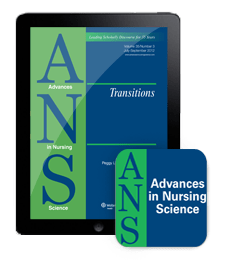
Just released – the ANS app for the iPad!    The app is free, and for a limited time, you will have access to all the current issue contents to read and download!  I am very excited about this feature.  For quite a while now many folks have speculated about the future of journal publishing, and the possibility of paper becoming obsolete. The time has not arrived for paper to disappear for ANS, nor for most professional journals, but the arrival of the ANS app for the iPad certainly unveils a new possibility!

Soon we will begin featuring video abstracts of articles provided by the authors, and these will be directly accessible on the iPad.  Links to the video abstracts will also be available on article PDF files, and will be noted in the paper issue of the journal.  But the iPad app opens up a realm of many multi-media possibilities!  Watch for these as they begin to appear in the months to come!  Download the app today to begin exploring this great new journal feature!


Evidence supporting father-friendly care for families


One of our “Editor’s Picks” for the current ANS issue is the article titled “Transition to Fatherhood: Modeling the Experience of Fathers of Breastfed Infants.”  The authors, Francine deMontigny, Carl LaCharite and Annie DeVault, describe a research project in which they examined a model of the relationships among father involvement, perceived parental efficacy, events related to breastfeeding, support, stress, and income with a sample of 164 fathers of breastfed infants.  The lead author, Dr. deMontigny, whose photo is featured here, describes their work that led to this study:

For over 15 years, I have been meeting with fathers, their partner, health professionals, to hear their point of view of what influences this transition. Needless to say, their spouse is an important source of support. But it stands out that nurses too can make a difference in fathers’ experience. Every time a nurse remarks positively about fathers’ abilities with their newborn, she contributes to strengthening the relationship between the father and the child. Our team has developed the Father Friendly within the Family Initiative to support health professionals in their efforts to build stronger ties with fathers and their families. We strongly believe that engaged fathers contribute to the family’s development.

This article is available for free download now!  So visit the ANS web site, and discover this and many other recent articles that can shape the future of nursing practice!

Improving transition outcomes


Carol Geary and Karen Schumacher explain some of the most vexing issues in nursing care – effective transitions for patients who move from one care setting to another.  The evidence points to major issues in health care that add up to astounding costs – readmissions for Medicare patients alone add up to billions of dollars.  Geary and Schumacher address this issue theoretically by proposing an integration of transitions theory and complexity science.  Their work provides a new and expanded perspective that can improve outcomes for people who are transitioning from hospital to home.
Carol Geary shares this message about her work:
My research addresses care transitions from hospital to skilled nursing facilities among aging patients with advanced chronic disease. I am specifically interested in the multiple perspectives of patients, informal caregivers, and health care providers as described within this paper and suggested by viewing the phenomenon through a complexity lens.
Professionally, as an administratively focused nurse functioning both within and as a consultant to hospitals, the dynamic of care “across the continuum” intrigued me. When Dr. Sheila Ryan introduced me to complexity science in an informational interview for the PhD program in nursing at UNMC, my initial response was: “THIS changes everything.”  After two years of study, I remain fascinated by the challenge of viewing the world through this new lens.