The current featured ANS article is titled “Feminist Abolitionist Nursing,a” authored by Martha Paynter, MSc, RN; Keisha Jefferies, MN, RN; Leah Carrier, BScN, RN; and Lorie Goshin, PhD, RN. This article is published “open access” which means anyone can download the PDF at any time! We welcome you to do so, and to share your comments about this work with us on this blog! Here is a commentary about this work from primary author Martha Paynter:
Martha Paynter
COVID-19, the dominant theme in health care discourse for the past two years, has forced a new level of reckoning among care providers about the ethics of incarceration when prisons are so vulnerable to infectious disease transmission. At the same time, health care providers are recognizing the violence of policing and imprisonment, often lethal, is disproportionately borne by Black and Indigenous people. These twinned socio-clinical crises have served as the background to rising levels of consciousness and consideration of abolition- a movement to end policing and prisons and create alternatives that support communities to thrive. Abolition feminism recognizes the connectedness between gender discrimination and violence against women, trans and nonbinary people with the bias and violence of the criminal justice system, and resists impulses to respond to gendered social harms with further investment in carceral controls. The aims of nursing- to heal, to support, to prevent harm- conflict intractably with the operations and intentions of prisons and policing. Situated in the medical heteropatriarchy, nursing resistance of health institutional subordination and prison operations requires complex feminist praxis. It also requires challenging white supremacy within nursing, and the proximity of nursing to colonial and racist systems of control. Our paper is a call for action for nursing to reject the taken-for-grantedness of carceral responses to social harm; to recognize the urgency of abolition to address the escalating numbers of women, trans and nonbinary people experiencing incarceration, and the gendered harms of imprisonment; and to adopt abolitionist ethics in research, policy, and practice through creativity, solidarity, and persistence.
In this article, we present the application of Postcolonial, Chicana, and Black feminist thought to analyze Latina migrant farmworkers’ mental health needs. Current literature regarding the mental health needs of Latina migrant farmworkers in the upper Midwest is scarce. The contextual factors affecting Latina migrant farmworkers’ mental health needs are informed by a specific socioeconomic, political, and historical context. We chose these theoretical frameworks to help us understand the intersection of the current sociopolitical climate, anti-immigrant rhetoric, and systemic racism on Latina migrant farmworkers’ mental health. The tenets of Postcolonial Feminist theory provide a lens for reflecting on and analyzing the realities of women in the global South or third world women, and Chicana and Black feminist thought enable us to explore the worldviews and life experiences of women of color in the Americas. Applying these feminist epistemologies to our analysis also allowed us to consider the ideologies that have historically informed White hegemonic masculinity, which refers to the enforcement of patriarchal gender hierarchies through constructions of masculinity cast as normative. We believe that research with Latina migrant farmworkers grounded in women’s voices helps us move away from hegemonic representations, informs policy, and leads to culturally appropriate guidelines and interventions.
Nursing theories have been influenced by Western philosophy. For example, existentialism and humanism, which are more or less dominant in nursing theories, are based on Western philosophical thought. Man as the incarnate soul is an Eastern conceptual framework for nursing. The framework has its roots in Iranian philosophy and mysticism, dating back thousands of years. But its main concepts have developed from the theories of Mulla Sadra, Ibn Sina, and Rumi, who are Iranian philosophers, physicians, and Sufi poets, respectively. Ibn Sina’s views are rooted in the philosophical thought of ancient Greece, especially Aristotle and the Unani holistic system of medicine. His unique system of medicine, now academically, is part of the Iranian medical system as traditional Iranian medicine and scientists in this field are working hard to establish Provide scientific and evidence-based for this holistic medical system. Mulla Sadra’s theory of the unity of the essence of beings and their ranking is consistent with modern physical concepts, and finally, in Rumi’s poems, the predominant theme is love. But the conceptual framework of man as an embodied soul is designed with nursing terminology, secular and testable in any population. In this context, the art and science of nursing can be classified into two categories of knowledge-based and love-based interventions. They are considered complementary, and each cannot bring the patient to health without the other. In this context, the concept of human has a novel and unique definition that can explain the range of physical, mental, social, and spiritual health problems and provide them with physical, cognitive, and spiritual interventions. The concept of temperament, the relationship between soul and body, ranking of the soul and having powered in each rank, the issue of balance in temperament and performance of powers to achieve health and harmony with other parts of the universe to maintain and promote the health of others for emerging nursing literature But they are rich, comprehensive and holistic. Eastern views on the development of nursing theories should not be overlooked.
The first featured article in the current ANS issue is titled “Patterns of Knowing and Being in the COVIDicene: An Epistemological and Ontological Reckoning for Posthumans” authored by Brandon Blaine Brown, MSN, RN-BC, CNL; Jessica Dillard-Wright, PhD, MA, CNM, RN; Jane Hopkins-Walsh, MSN, PNP-BC, RN; Chloe O. R. Littzen, PhD, RN, AE-C and Timothea Vo, BS, RN, CTN-B. The article is available at no cost while it is featured, and we are eager for your comments and discussion here! The authors provided this video in which they discuss this timely work!
The Theory of Planned Behavior (TPB) originally developed by Ajzen has long been a useful conceptual framework for my research, including my master’s thesis study and my projects early in my doctoral program. During the first year of my PhD program, I decided to analyze and evaluate this theory in a nursing theory class, and with the assistance of a colleague, I eventually developed this assignment into a publication in ANS.
Despite my generally positive evaluation of the TPB, I acknowledge that its use in nursing research and practice has been somewhat controversial, depending on individual researchers’ perspectives. I remember that I was excited to discuss how theory could advance nursing in my class, but theory testing as well as application of theories borrowed from other disciplines were debated among my classmates in 2019. At that time, I agreed that use of a borrowed theory can be beneficial for capturing nursing phenomena and for contributing to the development of nursing.
To comprehensively analyze a nursing theory, the author’s intentions in disseminating the theory need to be systematically examined, as do later theory revisions. Our manuscript analyzed and evaluated the TPB, which originated in the social psychology field, using Fawcett and DeSanto-Madeya’s framework, which was intended to be applied to nursing theory. A theory borrowed from another discipline will not fully reflect the values and concerns of nursing. However, rather than simply dismissing theories such as the TPB from consideration for the nursing discipline, I contend that different criteria should be employed for evaluation of borrowed theories.
In our case, we could not fully apply some of the elements of Fawcett and DeSanto-Madeya’s framework in our paper. For example, the TPB does not fully incorporate the nursing metaparadigm or include philosophical statements about nursing. Consequently, our paper recommended consideration of additional criteria for evaluation of borrowed theories. I believe that among other potential benefits, use of borrowed theories in nursing raises important questions such as “what are nursing phenomena?” and “what is the definition of nursing?”
I favor the definition of holistic nursing care, and a prerequisite for holistic care is to understand the human being and everything that surrounds the human experience. Consequently, describing the scope of holistic care is extremely challenging, but the new perspectives offered by a borrowed theory can facilitate understanding of such care.
Considering that all efforts from theory development and testing to application in various practice situations contribute to the advancement of nursing, what is your opinion of using the TPB for nursing advancement?
The current ANS featured article is titled “Analysis and Evaluation of the Theory of Planned Behavior” bySueyeon Lee, MSN, RN and Catherine Vincent, PhD, RN. Download your copy of this article while it is featured, and share your comments below – we welcome your discussion! Here is a message sent by Sueyeon Lee about this work:
To explain and predict various human health behaviors, many theories and frameworks have been applied in the nursing discipline. As one of the most influential behavioral theories, the Theory of Planned Behavior has been widely used to predict a number of health-related behaviors and has contributed to knowledge development in nursing. However, the theory has not been examined in depth based on a nursing framework for systematic theory analysis and evaluation. Moreover, there is a need to determine whether the theory can be effectively applied in the current nursing context, in which nursing care, human behavior, and related factors are continuously changing. In our article, we comprehensively and in detail analyzed and evaluated the Theory of Planned Behavior based on Fawcett and DeSanto-Madeya’s nursing framework.
Also, we reviewed previous studies about health behaviors such as physical activity, diet management, and smoking cessation among people with cardiac disease—the leading cause of death worldwide—and evaluated the theory’s application in this population. We think that our results will contribute to a better understanding and appropriate application of the theory within the nursing domain.
This blog is contributed by Eun-Ok Im, PhD, MPH, RN, CNS, FAAN. Dr. Im is author of the current ANS featured article titled Properties of Situation-Specific Theories and Neo-pragmatism (download at no cost while the article is featured). Here Dr. Im describes her journey in the evolution and development of situation-specific theory.
Eun-Ok Im
This article was initiated from a PhD theory class that I taught about 4 years ago. The class was discussing the philosophical bases of situation specific theories that I wrote more than 20 years ago. When I wrote the first paper on situation specific theories in the late 1990s, the main focus on philosophical bases of nursing was given to social critical theories, feminism, and hermeneutics, especially on the west coast of the U.S. Most of my colleagues admired these three specific philosophical bases for the future direction of philosophical bases for nursing discipline, and we were deeply impressed by the qualitative research paradigms at that time. Most of us were critical on positivism and its great influences on biomedical science in general, and we thought nursing approaches should be different from the mainstream biomedical approaches. Due to this great influence of the time, my first paper on situation specific theories focused on these philosophical bases as the philosophical bases of situation specific theories. However, honestly speaking, even at that time, I was thinking something was missing in the list of philosophical bases for situation specific theories.
Going back to the class that I taught about 4 years ago, the students in the class asked me how these specific philosophical bases were chosen as the philosophical bases of situation specific theories, and I mentioned about the background of the time when the paper was written. Then, I suddenly thought I’d better revisit the philosophical bases of situation specific theories because I myself had also been wondering if I missed something in the original paper. Then, in a subsequent literature review, neo-pragmatism was identified as an additional philosophical basis for situation specific theories. Indeed, looking back on it, the raison d’être of situation specific theories was highly practical. Nursing needs a theoretical basis that could be easily adopted in nursing practice and research with high specificity. Yet, I was not sure if neo-pragmatism actually fits with the properties of situation specific theories in the literature. Thus, a systematic integrated literature review was firstly conducted to identify the properties of situation specific theories in the literature and examined the properties from a neo-pragmatic perspective.
The literature review and subsequent examination of the properties of situation specific theories using a neo-pragmatic perspective revealed that the properties of situation specific theories that I found in the literature review were congruent with the philosophical stance of neo-pragmatism. For instance, neo-pragmatism’s declination of the universal truth and representationalism and its definition of truth were consistent with situation specific theories’ support for diversities and multiplicities of truths. Also, neo-pragmatism’s support for multiple truths and objection on the representationalism supports the necessity of different conceptualization and theorization based on contextual understanding, which was another property of situation specific theories that I found from the recent literature review. Despite this paper on the updated philosophical bases of situation specific theories, I still feel like that something is missing in the paper. Maybe, about 10 years later, I would look back on this paper, reflect on what was missing, and decide to do another review on the philosophical bases of situation specific theories. Continuous reflection and repeated revisits on our own thoughts may be essential for further development of our theoretical bases.
Considering drastically changing nursing environments with high complexities, I think the necessity of situation specific theories in nursing would keep increasing. The beauty of situation specific theories would be with their philosophical plurality, through which diversities and complexities in nursing could be addressed with high specificity and contextual understanding. Indeed, I am getting more and more inquiries on situation specific theories from nursing scholars across the globe, and nursing is definitely recognizing the importance of considerations on diversities in nursing phenomenon. Neo-pragmatism could provide an essential philosophical basis for our theoretical bases, especially situation specific theories that aim to address diversities and complexities in nursing phenomenon and to be easily applied to nursing research and practice.
The below pictures show the evolution of flowers blooming at my backyard, which would reflect my feelings about situation specific theories. During the past decades, situation specific theories have grown as a new type of nursing theories by the level of abstraction with an increasing number of situation specific theories that nursing scholars have developed. Situation specific theories started from one theory that I developed under the mentorship of my life-time mentor, Dr. Afaf Meleis. Then, a few situation specific theories began to emerge in the literature. Then, now, we are witnessing an increasing number of situation specific theories that nursing scholars are developing. However, at the same time, many aspects of situation specific theories are not fully unfolded, and the refinement of situation specific theories as a theoretical basis of nursing needs to be continuously done. At this moment of blooming, I think this paper would be a good addition to our thoughts on situation specific theories. Again, I think we need to remember the practical reason we started situation specific theories; we need a theoretical basis that could be directly linked to nursing practice and research. What works for nursing is what nursing needs. Before finishing this blog, I want to give my special thanks to Dr. Chinn for her continuous strong support for situation specific theories, and also want to say how much I appreciate this thoughtful opportunity to reflect on why I started this article and to have a dialogue with my respected colleagues. Have a great start of beautiful fall~
The current ANS featured article is titled “Complexities in Studying and Practicing Nursing—A Theoretical Elaboration Based on Reflections by Nurses and Nursing Students” authored by Joakim Öhlén, PhD, RN; Annette Bramstång, MScN, RN; Frida Lundin Gurné, MScN, RN; Anneli Pihlgren, BSc, RN; Marie Thonander, MScN, RN; and Marit Kirkevold, EdD, RN. You can download this article at no cost while it is featured, and we welcome your comments and discussion of this article in the comments below! This is a message that Dr. Öhlén provided about this work:
We’ve explored ideas about nursing as a subject from the perspectives of nurses and nursing students. The motive for the project was discussions about current nursing practice and the development of nursing as a subject, which in our Swedish healthcare as well as scholarly context has been characterized by a sometimes really intense debate about terminology (nursing vs caring), what it should encompass (generic caring knowledge vs professional nursing knowledge and skills), and where its boundaries with other subjects lie.
For this reason, we performed a participatory action project to explore nursing students’ and clinically active registered nurses’ experiential ideas about nursing – to provide a foundation for a critical reflection on the complexities involved in studying and practising nursing. We performed two empirical cycles and one final cycle with a theoretical interpretation. In total there were 238 participants. We who undertook the study are all nurses in metropolitan Sweden; professors, teachers, clinical nurse specialists and nursing students.
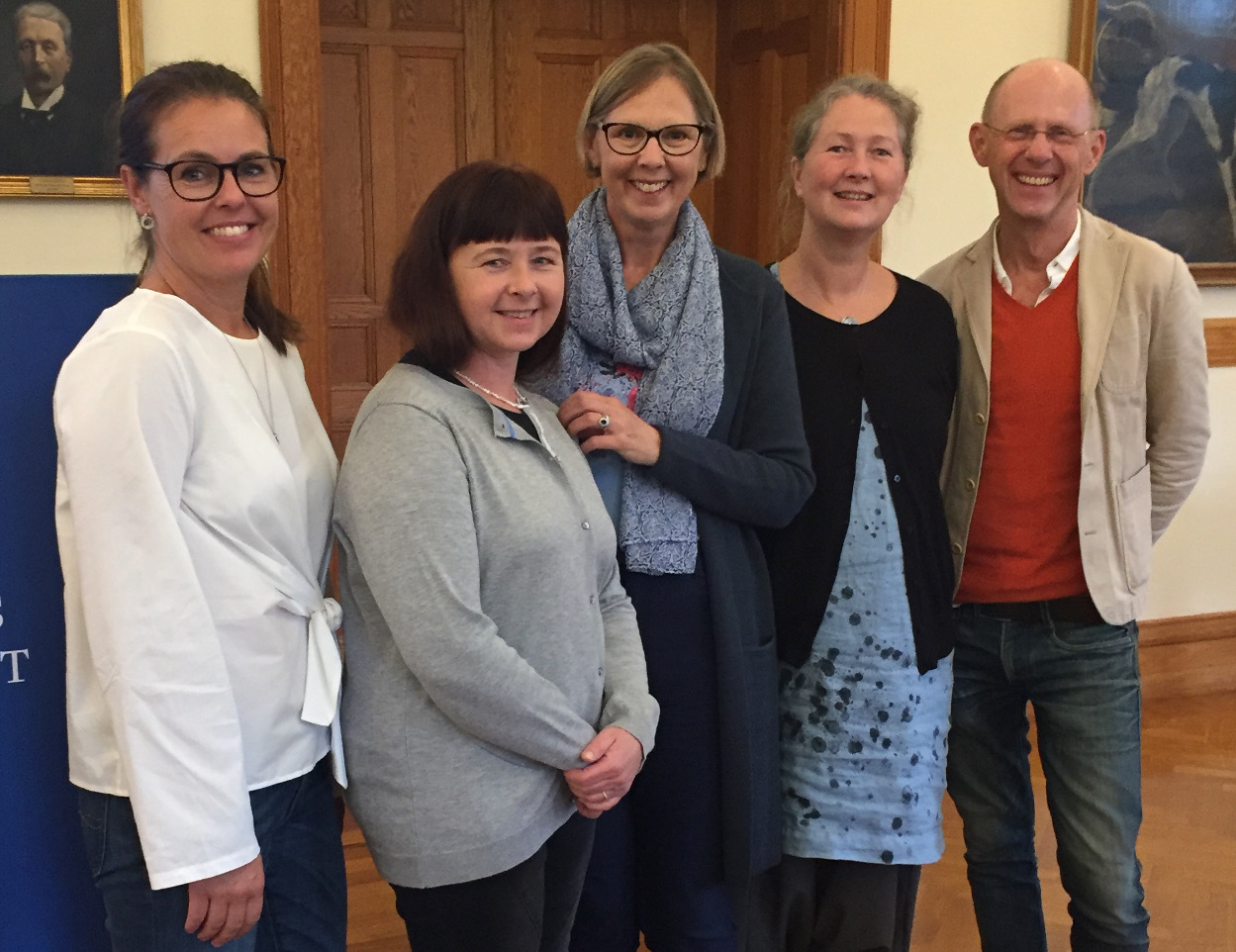
L-R: Marie Thonander, Annette Bramstång, Marit Kirkevold, Anneli Pihlgren, Joakim Öhlén (Frida Lundin Gurné is missing)
From focus group data we identified nine experiential ideas about nursing as a composite of subject, nursing practice and being a nurse. The ideas ranged from Nursing is holistic to Nursing is prioritising, and to Nursing is following check-lists and guidelines. Then, the ideas were presented to supervisors in clinical practice, teachers/researchers and students, and all of these perceived all nine ideas to be important foci for students’ learning in clinical practice. Finally, the ideas identified were related to clinical gazes and to two different epistemological structures.
We think our result will contribute to explain the confusion many nursing students and practising nurses express with regard to nursing as a composite of subject, nursing practice and being a nurse. We hope you’ve been interested in the article and here you can listen to us telling about the study, and that reading it will open up for critical reflections, commentaries and for the discussion to be continued. Thank you
The current ANS featured article is titled “A Review of the Concept of Impulsivity: An evolutionary perspective,” authored by Mohammed M. Al-Hammouri, Ph.D., IBA, CHPE, RN; Jehad Rababah, PhD, RN; and Celeste Shawler, PhD, PMHCNS-BC. While the article is featured, you can download and read it at no cost! Here is a message about this work from the primary author, Mohammed Al-Hammouri:
Mohammed Al-Hammouri
As a certified behavior analyst and an associate professor at Jordan University of Science and technology-Faculty of Nursing, I believe that nursing is privileged to deal with complex human behavior. Thus, my current work is to bring the attention of the nursing community to an important concept relevant to human behaviors. Impulsivity is a central concept of various behavior modification theories and models such as Hot/Cool System model and the Acceptance and Commitment Therapy (ACT). These theories and models were extensively used for positive behavioral change in other fields. However, they were overlooked by the nursing scientific community despite their relevance to health-related practices. I feel committed to bringing such interesting and valuable concepts to expand the literature and scientific knowledge in behavior modification.
The concept is readily applicable to the nursing practice in all settings and human behavior phenomena. I guarantee that reading the article will be an eye-opener for nursing researchers and practitioners for innovative and creative ideas. During the review process of our article, the reviewer themselves proposed novel applications of the concept within the field of nursing. Our concept analysis paper offers a practical definition of the concept of impulsivity in relevance to the nursing practice. We hope that our article will be an important step toward the advent of nursing research in this area.
The current ANS featured article is titled “Frailty in the Context of Older People Living With HIV: A Concept Analysis” by Evelyn Iriarte, MSN, BSN, RN; Rosina Cianelli, PhD, MPH, RN, IBCLC, FAAN; and Joseph De Santis, PhD, APRN, ACRN, FAAN. While this article is featured you can access it on the ANS website at no charge here
Evelyn Iriarte
I am currently a PhD candidate at the School of Nursing and Health Studies at the University of Miami. My dissertation is entitled “Impact of HIV Self-Management on Multidimensional Frailty and Quality of Life among Hispanic/Latinx People Living with HIV Infection Aged 50 and above”. In the context of developing my dissertation, I wrote this concept analysis aimed to analyze the concept of frailty in the context of older people living with HIV (PLWH). The reasons to start writing this article were that despite advances in knowledge about older PLWH, frailty remains a challenge to HIV care. Numerous studies have documented its impact; however, the concept remains unclear. This knowledge is needed to promote an increased understanding and recognition of frailty among PLWH due to its potential preventive role within health care services. However, there is still much debate about the concept and its’ measurement, as this concept has not been clearly explored and defined within the context of older PLWH.
This concept analysis provides an initial framework for understanding frailty in the context of older PLWH that includes attributes such as older age, inflammatory, hormonal, and immunological dysregulation, HIV-specific factors, comorbidities, and social, structural, and behavioral factors. Furthermore, frailty is evidenced as a state of vulnerability to HIV infection stressors, unintentional weight loss, exhaustion/fatigue, slower gait speed, decreased physical activity level, and muscle weakness. This state is manifested through several adverse outcomes that can impact health and quality of life.
In light of the current potential impact on health care, frailty requires further empirical and conceptual work. It is critical to continue developing research to advance the knowledge about frailty among older PLWH, principally regarding its assessment and interventions to prevent or treat frailty centered in holistic care.
Authors L-R: Dr. Joseph De Santis, Mrs. Evelyn Iriarte, and Dr. Rosina Cianelli
The essential purposes of ANS are to advance the development of nursing knowledge and to promote the integration of nursing philosophies, theories and research with practice. We expect high scholarly merit and encourage innovative, cutting edge ideas that challenge prior assumptions and that present new, intellectually challenging perspectives. We seek works that speak to global sustainability and that take an intersectional approach, recognizing class, color, sexual and gender identity, and other dimensions of human experience related to health.
This journal is a member of, and subscribes to the principles of, the Committee on Publication Ethics (COPE) www.publicationethics.org
The ANS Blog provides a forum for discussion of issues raised in the articles published in Advances in Nursing Science. We welcome all authors and readers to post your comments and ideas on the blog! If you would like to be an author on this blog, let us know!
The journal Editor is Peggy L. Chinn, RN, PhD, FAAN. Dr Chinn founded the journal in 1978.
















 ANS: Advances in Nursing Science Blog