Skip to content

Social Withdrawal and Migraine Headaches


Starting on March 18th, a new article will be featured for free download from the current issue of ANS!  The article, titled “Social Withdrawal as a Self-Management Behavior for Migraine: Implications for Depression Comorbidity Among Disadvantaged Women,”  is authored by Shawn M. Kneipp, PhD, RN, ANP-BC, APHN-BC and Linda Beeber, PhD, RN, CS, FAAN.  Recognizing social withdrawal as a distinct, highly nuanced coping strategy in
symptom self-management, they explore its relevance for understanding migraine-depression symptoms within the life context of socially and/or economically disadvantaged women.  They recommend further nursing research  that draws from complexity science theory and methods to better understand these dynamics and ultimately improve care.  Dr. Kneipp  shared this message about their work for ANS readers:

I would not have expected to be writing on this topic two years ago.  As is frequently the case with scientific inquiry, however, unexpected study findings, combined with ongoing clinical work and research with women who are socioeconomically disadvantaged, led me down this path.  The unexpected findings came from a

Shawn Kneipp

Shawn Kneipp

clinical trial with women in a Welfare Transition Program (WTP), which suggested headaches may be associated with job loss in the previous year.  Given the erosion of economic safety nets in the U.S. generally, and the current limits on economic assistance receipt through the Temporary Assistance for Needy Families (TANF, or ‘welfare’) program more specifically, obtaining and maintaining employment has become an even more critical social determinant of health for women who are socioeconomically disadvantaged.

Linda-Beeber-e1380548224649

Linda Beeber

From a number of prior studies, we have also known for a while that depression is highly prevalent in this group, that depression impedes women’s ability to function in the workplace, and that depression is most often present in the context of other chronic health conditions.  Despite this, there are large gaps in the literature on headache symptoms (predominantly migraines for women) in relation to socioeconomic status and self-management, in the context of other highly prevalent disorders (i.e., depression), and the associated morbidity in terms of work-related functioning.  This recognition, informed by clinical observation of how this population was often managing their migraine-related symptoms as they struggle to perform well at work, was the driving force in wanting to begin to pull the relevant disease-trajectory and self-management theoretical pieces surrounding this issue together.

The theoretical perspectives offered in this article underlie a current pilot study we are conducting to determine the feasibility of a novel data collection approach to further examine how disadvantaged women self-manage migraine symptoms. As with the majority of my research, women from the community of interest are playing a crucial advisory role in designing, conducting, and interpreting the findings from the pilot work. Given the preliminary feasibility findings, and looking to our future work in this area, nurse researchers have a great deal to contribute in the way of both theory and intervention development and testing to better manage comorbid health conditions, improve work-related functioning, and improve their odds of achieving economic self-sufficiency.

Go to the ANS web site now to download your copy of this article – it is important both in content and method.  then come back here and share your thoughts, questions and ideas – we would be delighted to hear from you!

Issue topic planned on “Toxic Stress”


We have just announced our projected issue topic on “Toxic Stress” for ANS Volume 39:4.  Manuscripts are due on April 15, 37-3 cover2016, but can be submitted at any time! Here is the description of this topic:

Toxic Stress
Vol 39:4 – December 2016
Manuscript Due Date: April 15, 2016

Toxic stress, unlike positive or tolerable stress, can result in life-long health challenges. For this issue of ANS we seek manuscripts that focus on the contributions that nurses are making to understanding the dynamics of toxic stress, and nursing approaches that demonstrate effective outcomes for children and adults suffering the effects of toxic stress. Articles that provide research outcomes, theoretic and philosophic constructions, practice models, or educational programs related to toxic stress are welcome. Implications for the development of nursing knowledge must be emphasized.

In addition, we always welcome submissions for the new “ANS General Topic” at any time!  Here is the information about this type of submission:

ANS General Topic
Manuscripts considered any time

Manuscripts submitted as “ANS General Topic” are expected to address the purposes of ANS, which are to contribute to the development of nursing science and to promote the application of emerging theories and research findings to practice.

You can see the full listing of our planned issue topics on the ANS Web site!  And our guidelines for authors can always be found here!

Understanding Survivor Guilt


Our current featured article addresses the meaning of survivor guilt, and by understanding this experience, seek effective ways to alleviate the suffering that comes to those who experience it.  The article is titled “Survivor Guilt: Analyzing the Concept and its Contexts”  The authors, Sadie Pauline Hutson, PhD, RN, WHNP, BC, Joanne M Hall, PhD, RN, FAAN, and Frankie Lane Pack, BA have provided the following commentary about their work, including a digital story video for ANS readers!

Survivor guilt, as presented in our analysis, is not monolithic. It manifests in many diverse temporal and situational contexts. It may be anticipatory or emerge years after the loss was experienced. The manifestation of survivor guilt is complex, in part, because the response is highly individualized. The following digital story demonstrates anticipatory and

“loss-in-process” forms of survivor guilt. After the video, Sadie Hutson offers a reflection on the nature of her survivor guilt, and how it is, presently, to remember the events surrounding the death of her mother, Joy.

“On its surface, this digital story may not seem like a characterization of survivor guilt; yet it underscores the expansion of this concept to include varied contexts. As a child, I remember feeling isolated and alone. I polished my mom’s toes as she lay dying as if to say, “this is no longer a luxury my mom will be able to enjoy.” I anticipated

events that she would miss and sometimes even imagined what I might feel when that time came. As I approach and experience various life milestones, feelings of guilt reinforce that my mother was cheated. I was cheated. Yet, I survived to tell the story.

This concept analysis relates to our scholarship in varied ways. First, the authors of this paper are also study team members on a National Institute of Nursing Research funded R21 (5R21NR014055-02) aimed at exploring end-of-life care and service needs of persons living with HIV/AIDS in Appalachian Tennessee and Alabama. In conducting this mixed-methods study, we noted the importance of survivor guilt when individuals discussed the guilt they felt for

Sadie Hutson

Sadie Hutson

surviving decades longer than many of their close friends, relatives, and significant others who lost their lives at the height of the AIDS epidemic. In Hutson’s work as the director of a hereditary cancer risk assessment program in Pikeville, KY, survivor guilt continues to be pervasive (as it was when the concept first became a focus for Hutson in 2001) among individuals who test negative for the known hereditary cancer gene present in their family. Rather than feeling relief for being spared, these individuals experience guilt for being the “lucky one,” citing that the result often drives a wedge in the relationships between mutation-positive and mutation-negative family members. Survivor guilt is also relevant to Dr. Hall’s work with female survivors of childhood maltreatment (R01NR07789). In these data, often the thriving survivor of a chaotic and abusive situation expressed feelings of guilt for leaving behind siblings who did not become successful in life and were still “stuck” in the trauma, sometimes still living with the perpetrators or abusive partners.

Nurses encounter the trauma of survivor guilt in many situations, yet they may not always see it, if the lens through which it is viewed is too narrow. Nurses must first see survivor guilt. After we have seen it in a particular context,

Joanne Hall

Joanne Hall

situation-specific theory can be developed to better characterize the survivor guilt and guide interventions to mitigate the fallout in that context. Perhaps, digital storytelling is one such strategy. It is salient that the same strategies will not work for all. Survivor guilt can be highly damaging, or wilted to being merely a form of nostalgia. We need to understand the process by which individuals resolve their own survivor guilt, as well as therapeutic strategies that fend off traumatic guilt that can be paralyzing, isolating, and disempowering. This will mobilize sufferers to move forward into the fulfilling lives they deserve.

While their article is featured, you can download it at no cost.  So visit the ANS web site now to get your copy, read the article, and return here to share your thoughts and ideas about this very thought-provoking article!

Sources of Inner Strength for Elderly People


Our current featured article comes to ANS from Finland authors Erika Boman, MSc, RNT; Anette H¨aggblom, PhD, RNT; Berit Lundman, PhD, RN; Bj¨orn Nygren, PhD, RNT and Regina Santamaki Fischer, PhD, RN.  Their article is titled “Inner Strength as Identified in Narratives of Elderly Women: A Focus Group Interview Study.”  While it is featured on the ANS web site, you can download your free copy of this article here!  Erika Boman has shared this message for ANS readers:

Do you study inner strength? Is that possible? Those are questions often asked when presenting the research topic of our interest. And yes, I can see what they mean. If you google on inner strength today you get 14 200 000 hits where inner strength is interpreted in almost the same amount of ways. That is why I am so happy that I have been privileged to work with members in a research group that thoroughly have studied the concept, and through meta-analysis developed a theoretical model of inner strength. In the model inner strength is conceptualized by four interacting core dimensions: connectedness, creativity, firmness and flexibility. The core dimensions have explicit definition and are more in depth described in the article, with reference to the theoretical model. Further a questionnaire was developed to measure each dimension and thereby a person’s degree of inner strength. Studies, applying the scale, have for example shown that strong inner strength is associated with better self-rated health. And through literature review inner strength has been interpreted as a health resource for experiencing well-being despite illness. 

My field of interest is related to health and quality of life among elderly women and elderly women, in general, outlive men, have impaired socio-economic and functional status, as well as report more health problems. I thought to myself – research is implying that inner strength is of importance for experiencing well-being despite illness. Identifying sources of inner strength can give health care personnel valuable information about elderly people’s capacities despite their frailty erika_johansson_2and weakness. So now there was this theoretical model defining the concept, a questionnaire to estimate a person’s degree of inner strength, as well as literature suggesting that inner strength is a health resource of importance. But, is it always applicable in nursing to use a questionnaire to estimate a person’s inner strength? What about criticism to nursing science being to theoretical? Is there some way we can enlighten how inner strength can be expressed in everyday conversations implementing the theoretical model? The aim of this study was therefor to explore how inner strength and its dimensions, as described in a theoretical model, can be identified in the narratives of elderly women. Focus group interviews where made with 29 women between the age of 66 and 84. Inner strength was identified in there narratives of the elderly women as a strive to be in communion, to make the best out of the situation, having a mind-set that it is all up to you, and considering life as a balancing act. Further descriptions are found in the article, where also possible application of the theoretical model in relation to previous research is discussed. The study is considered to add nuance to the notion of inner strength and deepen empirical knowledge about the concept. Finally, we hope that this study can be a contribution to narrowing theory to practice.

Please join the conversation to explore the ideas presented here and in the article!  Share your comments here, and we will respond!


Editorial messages: Contexts and Patterns of Health Behavior


The current issue of ANS has three important editorial messages that ANS readers will not want to miss.  My own editorial, titled “Editorial Standards of Quality: Examining Patterns of Health in Scholarly Publishing,” is part of the International Academy of Nursing Editor’s initiative focused on exposing the practices of predatory publishers, and affirming the high editorial standards that characterize credible and reliable journals.  If you have not yet examined this important issue, read this editorial and the resources that I reference in it.  You can also refer to my recent blog addressing the broad topic of open access publishing, a credible publishing model founded on the intent to make scientific research freely available to all. However digital open access publishing has also opened the door to editorial practices by some that compromise editorial standards, and it is incumbent on all scholars to be fully informed about these practices in order to distinguish which practices are sound and which are not.

Dr. Mickey Eliason, a leading scholar in the area of LGBT health, examines the influence of neoliberalism in shaping health behavior in her guest editorial titled “Neoliberalism and Health.”  Dr. Eliason focuses on the neoliberal ideal of individualism and examines how this ideal creates the tendency to overlook contextual, upstream factors that shape patterns of health behavior.  Essentially, Dr. Eliason takes a critical look at the upstream factors that shape patterns of scholarship, and how earthresearchers can resist the tendency to study individual factors without adequately integrating contextual factors.

Dr. Richard Cowling has also contributed a guest editorial to this issue titled “Contextualizing Patterns of Health Behavior: A Unitary-Emancipatory-Transformative Perspective.” Dr. Cowling also addresses the necessity of contextualizing health behavior in the quest to reach for wholeness. He explains that wholeness can only be fully appreciated from a perspective that fully integrates the contexts in which human behavior occurs.

All of these editorials are available at no cost on the ANS web site.  Visit the web site now to download your copy, and return here to share your own perspectives and ideas.

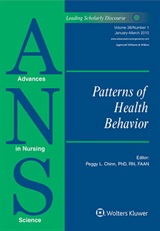
ANS Volume 38:1 Just Released! Patterns of Health Behavior


Patterns of health behavior, the topic of this issue of ANS, are at the heart of nursing’s concern. In this issue you will find 38-1 coverthought-provoking articles that address specific health behaviors that constitute human responses to health challenges. Several of these articles provide insights that expand understanding of human responses, and evidence that inform nursing practice. Watch the ANS web site and blog over the coming weeks as we feature each of these articles, with messages from the authors about their work.

Visit the ANS web site now!  Here is what you will find in this new issue!

Guest Editorial by Mickey Eliason – Neoliberalism and Health

Guest Editorial by Richard Cowling –Contextualizing Patterns of Health Behavior: A Unitary-Emancipatory-Transformative Perspective

Erika Boman, Anette H¨aggblom, Berit Lundman, Bj¨orn Nygren and Regina Santamaki FischerInner strength as identified in narratives of elderly women: A focus group interview study

Sadie P. Hutson, Joanne M. Hall and Frankie L. Pack – Survivor Guilt: Analyzing the Concept and its Contexts

Shawn M. Kneipp and Linda Beeber – Social Withdrawal as a Self-Management Behavior for Migraine: Implications for Depression Comorbidity Among Disadvantaged Women

Ingrid Ruud Knutsen – A Discursive Look at Large Bodies—Implications for Discursive Approaches in Nursing and Health Research

Deborah Christensen – The Health Change Trajectory Model An Integrated Model of Health Change

Preventing Sudden Infant Death Syndrome (SIDS)


Our current featured article is by Sherri L. McMullen, PhD, RN, NNP-BC and Mary G. Carey, PhD, RN, CNS  title “Predicting Transition to the Supine Sleep Position in Preterm Infants.”  Their article demonstrates how good nursing care, focused on anticipating the needs of families after discharge from the hospital, can make a difference – even to the point of preventing a SIDS death.  Dr. McMullen shared this message about her article, which is based on her dissertation research:

Thank you for your interest in our article entitled “Predicting Transition to the Supine Sleep Position in Preterm Infants.” This article is work related to my PhD dissertation research and I am passionate about the topic. I had the privilege of meeting Peggy at the 2014 National League for Nursing Writing Retreat in Phoenix and I am so pleased to see my McCullen-300manuscript in press. I have been a Neonatal Nurse Practitioner for over 20 years and I decided to extend my expertise to include academia and research. I miss my submersion in clinical, but think it’s really important to research clinical practice to continually improve the care we provide patients. So much of the care we offer to our smallest patients impacts them after hospital discharge.

Positioning preterm infants supine while hospitalized and after discharge is an important aspect of infant care and its relatively new topic with little research completed to date. Preterm infants are positioned in a variety of positions while in the neonatal intensive care unit to promote optimal neurodevelopment. The preterm infant’s musculoskeletal system is pliable with risks of deformity with suboptimal positioning. The supine position is an important modifiable practice that reduces the risk of sudden infant death syndrome after hospital discharge. The retrospective research completed shows there is great variability in the clinical practice and there are three factors that predict a greater than one week transition to the supine position before hospital discharge. More research is needed to determine the optimal timing of transition and what developmental impact this transition has on the preterm infant. A balance must be found between allowing enough time for the infant to become acclimated to the supine position without impacting neurodevelopment.

You can obtain a free copy of this article while it is featured on the ANS web site!  Visit the web site today, then return here to share your comments and ideas!

New ANS Topics: “Palliative Care” and “Open Topic”


new1With the beginning of a new year, we have a big announcement!  First we have added a new topic to the usual line-up of issue topics – Palliative Care for ANS 39:3 with a manuscript submission date of January 15, 2016.  In addition, we are introducing the “Open Topic,” which makes it possible to submit your manuscript at any time!

During the manuscript submission process, if you select “Open Topic” on the list of future issue topics, your manuscript will be entered into the peer review system, which should be completed within about 8 weeks of submission.  Once your manuscript has been favorably reviewed and accepted for publication, it will be scheduled for the next available issue.  ANS issues will still include manuscripts that are focused on the scheduled issue topic, but will also include “Open Topic” articles that generally address the purposes of ANS, which are to contribute to the development of nursing science and to promote the application of emerging theories and research findings to practice.

An exemplar of theory-guided practice


sullivan-bolai300

Susan Sullivan-Bolyai

All too often nurses wonder what theory has to do with their practice, sometimes even denying the relevance that theory might have to practice!  Our current featured article addresses this issue, providing a wonderful example of the relevance and usefulness of theory-guided practice.  The article, titled “Tried and True Self-Regulation Theory as a Guiding Framework for Teaching Parents Diabetes Education Using Human Patient Simulation,” is by Susan Sullivan-Bolyai, DNSc, CNS, RN, FAAN; Kimberly Johnson, BSN, CDE, RN; Karen Cullen, BSN, CDE, RN; Terry Hamm, BSN, CDE, RN; Jean Bisordi, BSN, CDE, RN; Kathleen Blaney, MPH, RN; Laura Maguire, MS, RN; and Gail Melkus, EdD, RN, FAAN.  In addition, it provides a wonderful example of a creative use of simulation to enhance patient teaching and learning.  Speaking about their article, Dr. Sullivan-Bolyal says:

in the spirit of family nursing research using Jean Johnson’s interpretation of Self-Regulation theory to guide our parent education intervention speaks to the unique core values of nursing and our contribution to searching for better ways to improve family and patient clinical outcomes. We hope this article underscores the importance of using theory to drive our nursing interventions.

Visit the ANS web site to download your copy of this article while it is featured!  Then return here, and add your comments, questions and ideas – we would be delighted to hear from you!

Modifying barriers to screening for memory loss


authors400

L to R: Drs. Tappan, Weise & Williams

Our current featured article presents an analysis of research that provides evidence for removing barriers to cognitive screening in rural populations.  The article, titled “Analysis of Barriers to Cognitive Screening in Rural Populations in the United States,” is by Florida Atlantic University scholars  Lisa Kirk Wiese, PhD, RN; Christine L. Williams, RN, DNSc, PMHCHS-BC and Ruth M. Tappen, RN, EdD, FAAN.  You can access their article without charge on the ANS web site while it is featured!  They have each prepared a message for ANS readers, plus a video sharing some background about their work.  We welcome your comments and perspectives on this important work in the comments below!

Dr. Wiese: I became interested in research about cognitive screening in rural populations as I am from WV and my mother has Alzheimer’s disease.  WV has the second highest percentage of older adults in the country, and is the only state that lies completely in Appalachia.  Appalachia has the highest sustained rates of poverty in the US, higher rates of diabetes and hypertension, less health insurance, and is less educated than the rest of the country.

Dr. Williams: Rural populations overall have a high incidence of dementia yet unique barriers to screening hinder awareness of the risk. Appalachians have geographical challenges that impact access to care. Early recognition of cognitive impairment is vital because the medications we have available to slow cognitive decline are more effective when patients are treated early. Early detection may help prevent negative consequences by ruling out treatable conditions that can cause cognitive impairment such as medication effects, cardiovascular conditions, or depression; offering treatments of cognitive and behavioral symptoms; maintaining the patients’ safety; and facilitating support for caregivers.

Dr. Tappen: Although public awareness of Alzheimer’s disease (AD) has increased exponentially, there are still many myths and misunderstandings particularly among underserved populations. In prior research done with urban underserved populations, participants described the effect of AD on the brain as “the brain collapsing in on itself.” Others talked about shaking and tremors, probably confusing AD with Parkinson’s disease and several mentioned becoming “like a baby” again. Myths and misunderstandings about AD are often a barrier to cognitive screening.