Skip to content

Critical Landscapes in Migrant Health


I am delighted to announce the publication ahead of print of an article by Sharon McGuire, OP, PhD, FNP-BC, CTN-A, FAANP, titled Borders, Centers, and Margins: Critical Landscapes for Migrant Health.  This article will appear in ANS Vol. 37:3, the July/September 2014 issue.  In this article, Dr. McGuire draws on her extensive experience and knowledge of immigration to provide a critical analysis of the contemporary dynamics of migration and the health issues that relate to migration around the world.  She has shared this message about her work in this area, and the background of this article:

First, I must express my surprise then pleasure that my article has been selected to be published ahead of print online. The article reflects the culmination of many years of work, the ever present encouragement of colleagues, and the desire to advance previous work. LivingMcGuire-Sharon200 and working among immigrants, many undocumented, has been a great gift to my life. Coming to know these very human and simultaneously heroic, humble, hard working and wise people has inspired my work as an advocate for the last 15 years and has shaped me into the person I am.

My journey began in the mid-1970s when I relocated to California to serve as a volunteer with the National Farm Worker Ministry (NFWM), allied with the organizing efforts of the United Farmworkers’ Union, led by Cesar Chavez. In this milieu my early education began and has continued as I have become comfortable crossing my own borders of culture, ethnicity and language and spirituality. Perceiving the health care needs of farmworkers led me to take up nursing in mid-life, and work along the US-Mexico border for nine years before taking up my doctoral work where I could begin sharing my insights in and beyond the academy while spending another nine years on the border. Of course my passion had become unearthing the phenomenon of migration, especially as it related the global dynamics at the macro level, and the health and welfare of immigrants at the micro level.

Migration and immigrant health are such fluid, complex situations, and I believe are of great salience to our profession. Undocumented immigrants in particular have been identified as one of the most vulnerable populations in the country…and I would say the world in whatever country they live. This article delves more deeply into neoliberalism, the politics of detention and deportation, and the spirituality of border crossers so well explored by Daniel Groody at Notre Dame, than previous works.

I would not want to leave you off, dear readers, without knowing I have the Adrian Dominican Sisters Congregation (Michigan based) to thank, as a member, for the freedom to pursue this passion, the time and support to study, and for inspiring all of us members to social justice ministries.

Dr. McGuire’s article is available at no cost while it is featured in our “Published Ahead-of-Print” section!  This article will again appear as a featured article once the July/September issue is published, but visit the ANS we site now to get this early view of this timely and important article!

Teen mothers – twenty years later!


We are delighted to include in the current issue of ANS a long-term follow-up study of teen mothers.  The article, titled “Teen Mothers at Midlife: The Long Shadow of Adversarial Family Caregiving” by Lee SmithBattle, PhD, RN and Victoria Leonard, PhD, RN, APRN, is a rare examination of evolving multi-generational relationships in the lives of teen mothers who participated in a study 21 years ago, when their infants were in the first year of life.

Teenage girls have been having babies for a very long time. My own mother had me when she was 19 years of age. Because she

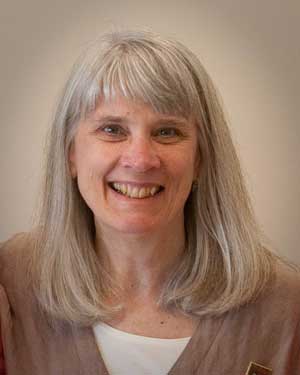
Lee SmithBattle

Lee Smithbattle

was married to my 18 year old dad, and because marriage provided a passage to adulthood for many young couples of my parents’ generation, teenage pregnancies were not an issue, even though many marriages were hastily arranged to conceal a premarital conception. As “shotgun marriages” declined, other practices emerged to conceal or punish pregnant, unwed teens. White girls were spirited away to maternity homes to give birth and to be “rehabilitated” for their sexual transgressions. They were also forced to relinquish their babies for adoption. A teenage girl in my own neighborhood shared this fate; she unexpectedly disappeared and returned home months later with no word of what had happened (and certainly no baby in tow).

Maternity homes, however, excluded black teens, so as shotgun marriages declined, black teens gave birth and raised their children with family help. A decade later, in the late 70s, as white and black teens, like older low-income women, began to keep their babies as single mothers, they faced a lot of public ostracism and scientific scrutiny. It was in this context that I began visiting pregnant and parenting low-income women as a new public health nurse. My parents’ working class background could not have differed more from the disadvantaged families I visited, but public health nursing practice, in the grand tradition of Lillian Wald, Myra Breckinridge, and Margaret Sanger, taught me important lessons about social inequalities and perverse policies, and being humble, curious, and open to experiences that differed from my own. (As an aside, these lessons are beautifully brought to life in Call the Midwife, a television series produced in the U.K. which is currently airing on public television in the US). In the late 70s, scientific discourse on teen mothers was just beginning, and the media reports and scientific literature on teen mothers were difficult to reconcile with what I was learning from the families I visited as a PHN. Yes, the teens on my caseload were not going to graduate from high school, but this was not for lack of interest or motivation but because high schools excluded them. 04_small250Perinatal and social outcomes could be worse for teen mothers than older mothers, but were often comparable when teens had access to resources and good health care. And teens who had the help and support of family members seemed to have advantages that older mothers sometimes lacked when they were bereft of partner and family support. Making sense of these issues was a strong motivating factor for me to return to graduate school.

I began this study two decades ago. When I left the homes of the teen mothers after conducting the final interviews in 1989, I never expected to see the families again, so the final good-byes brought a sense of loss. After all, I had spent close to 25 hours in each home over a 3 month period, interviewing teen mothers and family members, and hanging out in their kitchens, living rooms, and bedrooms, observing daily life with babies to tend to. I attended birthday parties, picnics, and other family events, and also participated in mundane activities like folding laundry. Vivid memories of some of the initial visits are still etched in my memory. I suppose it was these memories, as well as my curiosity about how their lives might unfold, that led me to the second study, and then the third, fourth, fifth, and sixth. Other researchers apparently have also found it difficult to end relationships with study participants; for example, Rochelle Dalla has followed a group of teen mothers on a Navajo reservation for more than 12 years. Frank Furstenberg finally ended his remarkable study of teen mothers after 30 years. I wonder how he managed to do it. George Elliot’s (1964) words capture why I will embark on the seventh study in a couple more years:

“Every limit is a beginning as well as an ending. Who can quit young lives after being in long company with them, and not desire to know what befell them in their after-years? For the fragment of a life, however typical, is not the sample of an even web: promises may not be kept, and an ardent outset may be followed by declension; latent powers may find their long-waited opportunity; a past error may urge a grand retrieval.” (Eliot, G, 1964. Middlemarch. New York: Signet.

An impressive number of qualitative studies on teen mothers (and a growing number on teen fathers) are published every year, and this work continues to challenge our assumptions and stereotypes of teen mothers and the perverse ways that social 01_small300inequities and childhood adversities shape the lives of U.S. children. Equally important, quantitative studies that control for teen mothers’ background factors confirm the long arm of social disadvantage, showing that teen mothers do about the same on a range of outcomes as older women from similar backgrounds. Stereotypes and assumptions die hard, however, especially when sex, poverty, and race are part of the mix.

In addition to the families who welcomed me into their homes, other relationships have nurtured this research. I have had the best and most generous mentors. Edna Dell Weinel always demonstrated public health nursing at its finest and Patricia Benner modeled how to listen closely and with deep respect for various voices in the text. Vickie Leonard, the co-author of this paper, has

Vicki Leonard

Vicki Leonard

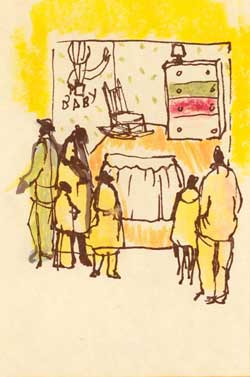
been a fellow traveler on this study from the time we began our first semester as doctoral students together. Because Vickie’s dissertation focused on older mothers with career commitments, pouring over our interviews and sharing stories from our respective families provided a rich comparison for how social worlds set up different and similar meanings, practices, and ways of being a mother. With each follow-up study, Vickie has read several cases to help clarify and refine my interpretations. Every researcher should be so lucky. The artwork accompanying this blog was created by Hilda Robinson, a dear friend and artist in Oakland, California, who turned the family stories of my dissertation into these and other paintings.

Finally, I would like to applaud Advances in Nursing Science for its commitment to publishing the lengthy papers that qualitative research requires. Amid the general press in nursing journals to publish short, empirically-based studies, ANS has courageously provided a home for scholarly qualitative work. ANS published my very first paper from Time 1, and then others along the way. Longitudinal studies are rare in nursing, and I’ve been fortunate that ANS has always welcomed a diversity of philosophical approaches and study designs. Nursing has been enriched by the courage of ANS’s editor and reviewers.

 Visit the ANS web site while this article is featured to download and read this article at no cost.  We welcome your comments here – we will respond!

ANS 37:2 “Relationships and Health” just published!


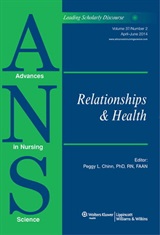
The topic of this issue of ANS – Relationships and Health – is central to nursing practice, and yet this vital connection is often taken for granted.37-2 cover Articles in this issue focus on family relationships, philosophic and theoretic foundations of human caring in the nurse-patient relationship, and the complexities of these relationships on health and well-being.

Each article in this issue is featured in our “Editor’s Pick” section of the ANS web site, and while an article is featured, it is available for free download.  It is also featured here, along with a message from the author that provides interesting background about their work.  Watch the web site to see which article is currently featured, and  return to the blog regularly to see messages from the authors!

Here is the Table of Contents for this issue

SmithBattle, Lee; Leonard, Victoria
McKelvey, Michele M.
St-Amant, Oona; Ward-Griffin, Catherine; Brown, Judith Belle; Martin-Matthews, Anne; Sutherland, Nisha; Keefe, Janice; Kerr, Michael S.
Ray, Marilyn A.; Turkel, Marian C.
Wolf, Karen Anne
MacKinnon, Karen; Moffitt, Pertice
Lobar, Sandra L.

Manuscript due date extended for ANS issue on “Post-Hospital Nursing”


Yes, indeed!  If you are close to polishing a manuscript related to the topic of “port-hospital nursing,” you have some time to send it in to be 15684347considered for publication in this issue!  The new due date is May 1, 2014!  Here is the description of this issue:

The period following hospitalization is a critical period in the process of recovery and healing. can be significantly influenced by nursing care in the hospital and in the community. For this issue we seek manuscripts that focus on nursing in post-hospital recovery. We particularly welcome articles that provide evidence on which nursing practice can be designed, as well as philosophic, theoretic, or economic analyses that address issues related to post-hospital recovery and the risk of re-hospitalization.

Nursing can play a significant role in quality of life and care after hospitalization, and this focus is growing as health care practices are changing to support efforts to reduce re-hospitalization!  So if you have something to contribute to this issue, please let us hear from you!!

Developing a Frailty Framework for Vulnerable Populations


The featured article from the current issue of ANS is titled “Development of a Frailty Framework Among Vulnerable Populations,” authored by Benissa E. Salem, PhD, MSN, RN; Adeline Nyamathi, PhD, ANP, FAAN; Linda R. Phillips, PhD, RN, FAAN, FGSA; Janet C. Mentes, PhD, APRN, BC, FGSA; and Catherine Sarkisian, MD, MSPH; Mary-Lynn Brecht, PhD.  Recognizing that nursing is at the forefront of care for most vulnerable populations, they collaborated in developing a wholistic framework that can be used to guide research with these very difficult-to-reach groups of people.  Dr. Salem shared this message about their work:


Salem-Benissa-Committee-Picture

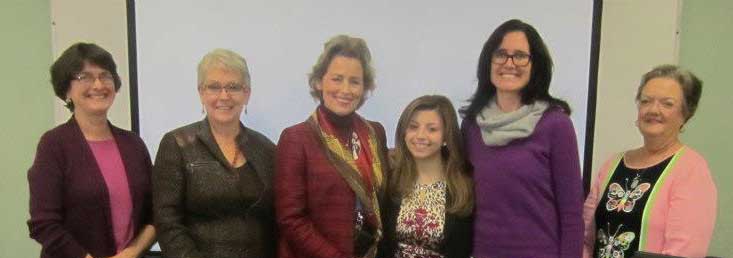
Mary-Lynn Brecht, Janet C. Mentes, Adey Nyamathi, Benissa E. Salem, Catherine Sarkisian and Linda Phillips.

We are so pleased that our article has been selected to be featured in this current issue of ANS.  I have been so blessed to work with my dissertation chair, Dr. Nyamathi, along with my committee members, Drs. Phillips, Mentes, Brecht and Sarkisian in the development of this manuscript.  Further, I have been privileged to consult with Drs. Gobbens and Morley regarding the model. The framework has been inspired by several disciplines (nursing, gerontology/geriatrics and vulnerable populations), along with those who are homeless. Frailty itself is a construct which is challenging to disentangle. When working with vulnerable populations, specifically, homeless populations, it is imperative to understand unique antecedents which may influence frailty and outcomes. Drawing upon the literature focused upon homelessness, discussion with experts, and based upon experience and discussion among coauthors, the model guides possible antecedents, along with frailty, and the outcomes.  Future models related to this construct should assess nursing intervention components and the potential for frailty to be a dynamic, rather than a static state. Further, application of the model and refinement related to other vulnerable populations are all areas of future work.

While this article is featured, you can download it at no cost.  We hope you will do so, and return here to offer your ideas and responses to this very important work.

Developing Praxis in Nursing Education


Our featured article from the current issue of ANS is titled “Work-Integrated Learning: A Didactic Tool to Develop Praxis in Nurse Education” by Elisabeth Dahlborg Lyckhage, PhD, RNT, RN and Sandra Pennbrant, PhD, RNT, RN.  In

Elisabeth Dahlborg Lyckhage

Elisabeth Dahlborg Lyckhage

this thought-provoking article, the authors examine the concept of “praxis,” clarifying various meanings and proposing a view of this concept that challenges nurse educators to examine, with students, their nursing actions from a philosophical, theoretical, and practical point of view.  They provided this message about their work as nurse educators in Sweden:

Our interest in the concept of praxis was aroused some ten years ago when we noted that the concept was used in completely different ways in nursing. Sometimes one was referring to routines, sometimes to the tangible reality (as practice), sometimes to the connection between theory and practice. To deepen and clarify the meaning of the concept of praxis, in order to use praxis as the knowledge created in the

Sandra Pennbrant

Sandra Pennbrant

meeting between theory and practice, we have used work integrated learning. University West is responsible on the national level in Sweden for developing work integrated learning. It is therefore important for teachers in the nursing program to use work integrated learning as a tool for developing praxis.


While their article is featured on the ANS web site, you can download it free of charge!  We welcome your comments and responses; read the article and return here to share your ideas!


Exploring the meaning of cultural competence


The current ANS featured article is titled “Cultural Competence in Health Care: An Emerging Theory” by Isabelle Soulé, PhD, RN.  In this article, Dr. Soulé presents the outcomes of her qualitative descriptive study to examine the current state of cultural competence in health care.  In her conclusion, she states: “This exploration of cultural competence in health care and health care education is a small step toward achieving a more complex understanding of cultural competence that moves away from superficial approaches toward recognition of the interplay of the many economic, political, geographic, and social conditions that provide a context for health disparities and health care disparities in our world today.”  Dr. Soulé provided this additional reflection on the complex relational challenges of health care in a world that is culturally diverse:

         Like so many others, I am uncomfortable with the term cultural competence.  Despite it being my primary area of research, over time, I find myself using the term less and less. I am not dissuaded by the ideals it represents such as receptivity, flexibility, curiosity, inclusivity, understanding context, and humility, but rather that the term inadvertently implies an endpoint despite what is stated to the contrary. In part, perceptions concerning cultural competence are derived from the concept being nested within US healthcare systems and healthcare education which are based on competence. Competence is indeed a worthy goal, but I argue it is not globe300enough.

Cultural competence is centrally relational in nature, and high-quality relationships require awareness, flexibility, and humility. This includes being open to learn, conceive of alternate sets of values, appreciate how mind-sets develop, and understand that all behaviors make sense in context. Inevitably, individuals and communities brought up in widely varying contexts and backgrounds live in widely different realities or “truths”. This understanding has been deeply embedded in me after 15 years of working abroad with indigenous peoples and with refugee communities from all over the world. In short, these communities have been some of my most important teachers.

In a typical US healthcare encounter, power and privilege often lie firmly on the side of the healthcare provider as a result of specialized education, professional and economic status, and even national citizenship. It can be challenging to recognize this privilege and realize the distance it can place between provider and client / family / community. This makes it difficult if not impossible to negotiate a collaborative plan of care. In order to redress power imbalances between provider and client, system and community, genuine humility is required. Humility includes respecting difference and recognizing that all perspectives have value. Difference is legitimate and people who have different ways of expressing themselves and enacting health and illness are just as valued as our own. Respecting different viewpoints as equally valid can serve healthcare providers in revealing where their viewpoints may be incomplete or limited. In addition, interacting in a non-judgmental way with people who have different ways of looking at things requires asking more questions than simply giving answers – a key skill in the development of trust and empathy.

Humility, not often addressed in professional circles, can be thought of as an accurate assessment of oneself, an ability to recognize and acknowledge limitations, and a willingness to be influenced by alternate values and worldviews. Humility may not be simply overlooked in US healthcare, but may actually be perceived as antithetical to competence, professionalism, and professional practice. Because many health professionals are educated to think in these terms, they may be quick to misunderstand or reject teachings that offer an unrecognized worldview or alternate set of truths. Moreover, building partnerships where health professionals respect the expertise of the client and family in their own healthcare decisions runs contrary to how professionalism is taught and role modeled in our schools and professions today.

Interacting from a starting point of humility rather than professional expertise (competence) can generate a very different type of healthcare encounter that, in the end, can be more satisfying to both client / family as well as healthcare providers. However, to elevate the position of humility in healthcare education and systems, radical transformation will be required. A beginning point can include creating safe places for students and faculty to discuss and learn from their less than elegant cultural moments (incompetence) without judgment, and with emphasis on openness (humility) and deep learning. In this spirit, the following questions can be used to begin this conversation:

  1. What assumptions am I making?
  2. How else can I think about this?
  3. How might the other person (family, community) be thinking about this?
  4. What am I pretending to not know?

Developing cultural competence and cultural humility – may the discussion continue.

Please do engage in this conversation by sharing your comments and ideas here!  You can download this featured article on the ANS web site at no charge while it is featured.  Then return here, and let us hear from you!

Issue topic on “Veterans Health” planned for 2015


The ANS schedule for future issue topics now includes the planned topic for Volume 38 No. 4 – “Veterans Health.”  Manuscripts are due for this issue on April 15, 2015.  Here is the description:

Given recent history of international conflict and violence, the health and well-being of those who have served the veterans300military of any country world-wide has become a major challenge that influences the well-being of families, communities and nations. For this issue of ANS we seek manuscripts that address nursing perspectives on health care for veterans, their families and communities. We welcome research reports that provide evidence for nursing practice, theoretical and philosophic perspectives, or methodologic issues related to investigating health issues and nursing concerns for this population.  Date manuscripts are due: April 15, 2015

Be sure to watch our ever-evolving list of future issues!  All of the planned issue topics for which manuscript submissions are open are on the ANS web site, and we will announce new topics here as they appear.  The current list of topics for which manuscript submissions dates are coming up are (click the link for an issue topic to wee the full description):

37:4 – Post-Hospital Nursing – December 2014
Manuscript Due Date – April 15, 2014

38:1 – Patterns of Health Behavior- March 2015
Manuscript Due Date – July 15, 2014

38:2 – Models of Care for the Future- June 2015
Manuscript Due Date – October 15, 2014

38:3 – Translational Scholarship- September 2015
Manuscript Due Date – January 15, 2015

38:4 – Veterans Health- December 2015
Manuscript Due Date – April 15, 2015

Research practices to address health equity


The authors of our current featured article provide exemplars from a study exploring African American participation in research to demonstrate the use of a combined framework for analysis that examines the interactions of environment, culture, biology and history to understand the complex problems of health inequity.  The article, titled “Uniting Postcolonial, Discourse, and Linguistic Theory to Explore Participation of African Americans in Cancer Research as an Effect of Social and Historical Race Relationships” is authored by Darryl Somayaji, PhD, RN, CNS, CCRC and Kristin Gates Cloyes, PhD, RN.  They present a compelling discussion of the need to better understand the experience of African Americans as research participants, and to use this understanding to change the social and political realities of the research environment, research practices, and the teaching of research methods. Dr Somayaji shared the following account of how this work evolved:

Kristin and I are honored that our article was selected to be featured for the current issue of ANS. I was fortunate to be a doctoral student of Dr. Kristin Gates Cloyes at the University of Utah, School of Nursing. Although our clinical backgrounds and expertise are different (Kristin’s in mental health; mine in cancer and cancer research), we share a

Dr. Somayaji (left) and Dr. Cloyes

Dr. Somayaji (left) and Dr. Cloyes

common history of interest in social justice and health equity. Kristin’s knowledge and expertise in critical research was instrumental in opening my eyes to new ways of thinking about research theory and how different approaches to research can translate to practice. The article “Uniting Postcolonial, Discourse, and Linguistic Theory to Explore Participation of African Americans in Cancer Research as an Effect of Social and Historical Race Relations” is from my dissertation work on exploring African American participation in research. Our hope is that this article will illuminate the complexity of participation in cancer research, and the importance of understanding how history, relationships, and language are closely tied to research subject identity.

The article will be available at no charge while it is featured on the ANS web site!  I invite you to read this important and thought-provoking article while it is featured, and contribute your responses and thoughts on this topic by commenting here.  This is a topic that calls for ongoing and lively discussion, and we welcome the opportunity to engage using this blog!

Focus on transitions from a nursing perspective


Eun-Ok Im, PhD, MPH, RN, CNS, FAAN is the author of our latest featured article titled “Situation-Specific Theories From the Middle-Range Transitions Theory.”  She begins her article is a concise overview of nursing’s theoretical evolution, placing the emergence of situation-specific theory in an historical context.  Dr. Im and Dr. Afaf Meleis first introduced the concept of situation-specific theory in their 1999 ANS article titled “Situation-specific theories: philosophical roots, properties, and approach” (ANS 22:2, p 11-24).  This current article provides, in addition to the historical overview, an analysis of 6 situation-specific theories and themes reflecting commonalities and variances in the theory development process.  Dr. Im shared this message about her work:

As you can see in the picture, we had lots of snow here in Philly, and hope all of you would stay warm and safe!  🙂snow

First of all, thanks a million for this opportunity to discuss my article with my respectable colleagues and students.  This article was originally initiated because of doctoral students in my theory class in Spring, 2013.  The students wanted to know about how a situation specific theory could be developed from a middle-range theory.  Although I previously wrote about the integrative approach to development of situation specific theories, the paper might not be adequate to address the students’ questions. The students were eager to learn about the exact theory development process that had been taken in previous development of situation specific theories. Also, since our original paper on situation specific theories was written in 1999, I thought this might be the right time to evaluate how situation specific theories have been developed.  Especially, I was wondering how situation specific theories were derived from middle range theories and further developed as “ready-to-wear” theories.

As the article illustrates, the development of situation specific theories from the middle-range Transitions theory were on the same directions that were originally proposed, and I could extract several themes reflecting the commonalities and differences in the theory development process.  The reviewed situation specific theories derived from Transitions theory focused on specific phenomenon of interests with narrow foci and provided clear implications for nursing practice. They were developed using multiple sources of theorizing, but mainly based on research-evidence. They

Dr. Eun-Ok Im

Dr. Eun-Ok Im

specified, added and combined major concepts and/or sub-concepts, and they had been developed to advance nursing theory toward forms of theory applicable to specific practice situations.

In the article, based on these findings, I proposed two implications for future development of situation specific theories: (a) to continue our efforts to further develop, specify, and modify the concepts and sub-concepts of situation specific theories through “integrative approaches”; and (b) to support the situation specific theories with strong collective evidence from nursing practice and apply and evaluate the situation specific theories in practice settings. From this stance, I would like to work on further recommendations for future development of situation specific theories.

Through this blog, I hope to open a conversation on the directions for future development of situation specific theories, which would be essential for future nursing knowledge development. Any thoughts would be greatly appreciated.

I join Dr. Im in encouraging you to respond to her article, and participate in a conversation here about these ideas!  This kind of conversation is vital for the future development of our discipline!  You can download your copy of her article while it is featured at no cost, so read it today, and come back here to join the conversation!