Skip to content

Nursing as Body Work


The current “Editor’s Pick ” article from the current ANS issue is titled “Critical Perspectives on Nursing as Bodywork,” authored by Karen Anne Wolf, PhD, APRN-BC, DFNAP. In this thought-provoking article, Dr. Wolf  calls for nurses to reject the objectification of the body and instead reclaim body work as integral to a holistic perspective.

Dr. Wolf shared this message about her work for ANS readers:

Nursing as work is the focus of my scholarship. In past work, I have explored the larger structural issues in the collective history of nursing. In this paper I explore the paradoxical nature of nursing as bodywork. Scratching beneath the surface of the issues of status and power opens a window on the variety of factors that shape the work of nurses in relation to their patients. The nurse-body relationship is so fundamental to nursing work that we are blind to its social impact. This results in contradictory images and experiences. For example, nurses are revered as “most trusted” and angelic in many countries yet Wolf300exposed to persistent degradation within the media and in public discourse.

Nursing work continues to be viewed as low status despite professionalization efforts. The social discomfort with the human body contributes to the paradoxes in nursing as bodywork. The relational boundaries between nurses and patients blur ordinarily taboo spaces. The intimacy of providing physical care carries the stigma of nursing as dirty work. Yet this same intimacy throughout the sacred rituals of birth, death, and vulnerability contributes to the entrusted relationship. De-stigmatizing nursing as bodywork begins with accepting our bodywork relationship. Without such an acceptance, there is a tendency to distance nursing from the body through the increasing use of ancillary nursing workers or technology. Recognizing the paradox of nursing as bodywork is a critical to the future of the profession. I would suggest that we consciously claim and embrace the relational care for the body rather than reject it. Nurses must be mindful and respect the power inherent in their privileged and intimate relationship with patients.

Download your copy of Dr. Wolf’s article at no cost while it is featured on the ANS web site! We welcome your thoughts and comments in response!

Caring as Emancipatory Nursing Praxis


The new featured article in the current ANS issue challenges readers to examine values and believes that form a foundation for nursing as caring within complex technical and economically driven systems. The article, titled “Caring as Emancipatory Nursing Praxis: The Theory of Relational Caring Complexity,” is authored by Marilyn A. Ray, PhD, RN, CTN-A, FAAN and Marian C. Turkel, PhD, RN, NEA-BC, FAAN.  They have each provided interesting background about their work, and insight in to how their ideas have emerged:

From Dr. Ray:

My journey focusing on the study of human caring in complex hospital cultures began in 1969 as an MSN student in nursing and anthropology where I conducted an ethnography of a hospital. My interest in the study of nursing as a “small” culture and health care/hospital organizations as “small” cultures led to seeking a Master of Arts in Cultural Anthropology, and a PhD in

Dr. Marilyn Ray

Dr. Marilyn Ray

Transcultural Nursing where, within my dissertation, grounded theories of nursing as transcultural caring were discovered. The substantive theory of Differential Caring unfolded showing how the dominant environmental context of different hospital units influenced the meaning of caring, such as, the interrelationship between technology and caring in an Intensive Care Unit, economics and caring in Administration, and spiritual-ethical caring in the Oncology Unit. Analysis and insight led to the discovery of the formal theory of Bureaucratic Caring (rendering the paradox of human caring in complex organizations which continues today). Subsequent research on the technology and economics of caring, exposure to Rogerian unitary science and the emerging field of complexity science/s through teaching philosophical inquiry, caring science, qualitative research methods, and conducting research with the late Dr. Alice Davidson continued to open my mind to the significance of human-environment integrality. Over the past 20 years accomplishing funded research with Dr. Marian Turkel on economic caring within many public, military, and private complex healthcare systems exposed more of how the contextual dimensions of economics, political, legal and technological phenomena enlightened our understanding of contemporary practice, and how the research illuminated the discovery of the Theory of Relational Caring Complexity. This theory deepened our commitment to seeking understanding of human rights, social justice and social caring ethics as emancipatory praxis in complex systems and prompted us to share this content.

As a doctoral student of Dr. Madeleine Leininger, my classmates and I received the gift of exploring “caring as the essence of nursing.” As a former faculty member of the University of Colorado College of Nursing (and now as a Professor Emeritus at Florida Atlantic University), I have had the opportunity of sharing ideas of and learning about, and researching caring science, ethics, unitary science, complexity sciences, and the feminist ideal of peace power with Drs. Jean Watson, Sally Gadow, Marlaine Smith, Peggy Chinn, the late Alice Davidson, and many other professionals. This knowledge has directed and continues to direct the discipline of nursing. At the same time, as an officer in the United States Air Force Reserve, Nurse Corps, I was aware of how these ideals needed to be embedded in local and global cultures, including not only the military, but also, the Transcultural Nursing Society, World Health Organization and United Nations. I am a charter member of the International Association for Human Caring and have been committed to co-creating awareness of caring science and art, respect for human dignity, cooperation, and reasoned dialogue to lay the foundation for a sustained commitment to human rights and social justice. These actions hopefully will lead to peaceful coexistence among all people and a world without war. Nurses have the obligation to be examples of human caring–to seek ethical caring knowledge, promote moral mindfulness, give voice to the voiceless, cultivate humanity, understand transcultural nursing and social/cultural contexts, and exercise ethical judgment and evaluation to facilitate the creation of peaceful communities of caring worldwide.

From Dr. Turkel:

Like my co-author and colleague, I am committed to the advancement of the scholarship of caring science and complexity science. My professional career trajectory is grounded in the philosophical tenets of caring being essential to the disciplinary foundation of nursing and the theoretical concepts of caring and complexity serving as a framework for professional nursing

Dr. Marian Turkel

Dr. Marian Turkel

practice. My journey into caring as a substantive area of study within the discipline unfolded when I entered graduate school at Florida Atlantic University (FAU) in 1989. It was a wonderful time to be at the university as our Dean, Dr. Anne Boykin was integrating caring into the curriculum and Dr. Leininger and Dr. Watson came to university sponsored conferences. I became very involved with the International Association for Human Caring (IAHC) and met Dr. Ray who was our eminent scholar. My favorite story is that I knew she was important, not sure what an eminent scholar was, and did not know if I was allowed to talk with her. She taught nursing leadership and we formed an instant personal and professional relationship as we had shared values related to caring in complex systems. As a nurse leader, I was always challenged by the paradox between caring and economics within complex systems and the social injustice that registered nurses often face in the real world of hospital nursing practice. My master’s thesis was A Journey into Caring as Experienced by Nurse Managers. Managers shared their frustration of trying to care when economics ruled decision making. My doctoral dissertation, Struggling to Find a Balance examined the paradox between caring and economics from the perspective of patients, nurses, and administrators.I was on faculty at Florida Atlantic University and the sentinel qualitative and quantitative research that Dr. Ray and I completed validated that caring was explicitly linked to improved patient and nurse outcomes and hospital system economic outcomes.

My life journey took a turn and my husband and I relocated to Chicago and then Philadelphia. I made an intentional decision to return to practice and began my journey into “praxis” (informed practice). I went back into the hospital setting but with a new lens, using research, evidence-based practice and caring theory to inform and transform practice. I continued my involvement with the IAHC, re-connected with Dr. Watson and became involved with the Watson Caring Science Institute (WCSI). As faculty within WCSI, I work with hospitals to create caring healing environments for employees, patients, and families by integrating caring theory into the practice setting. My scholarship is now focusing on leadership framed in caring science where intention setting, caring , love, peace, and values ground the practice of leadership. I just ended my IAHC Presidency May 2014 with a conference in Kyoto, Japan sponsored by IAHC and Kobe University. The conference theme was the Universality of Caring with over 781 Registered nurses from 20 countries and regions in attendance. On a personal note, I am moving back to Florida in July and returning to Holy Cross Hospital where I used to work and met my husband. My vision is to co- create a very innovative Service-Academic Partnership with Florida Atlantic University College of Nursing. In caring and peace, Marian

Visit the ANS web site to see this wonderful article – you can download it at no cost while it is featured!  Then return here to share your comments and ideas!

Double-duty care-giving: Nurses’ Unpaid Family Work


The authors of the current ANS featured article examine the phenomenon of nurses’ unpaid family work – a growing trend in the face of inadequate health care resources.  In other professions, unpaid professional services are considered “pro bono”  professional service to the community.  But for nurses, their unpaid work in families is invisible and unrecognized, and as the authors indicate, this unpaid work has implications for nurses’ paid work as well.   The article, titled “Professionalizing Familial Care: Examining Nurses’ Unpaid Family Care Work” by Oona St-Amant, MScN, RN; Catherine Ward-Griffin, PhD, RN; Judith Belle Brown, PhD; Anne Martin-Matthews, PhD; Nisha Sutherland, MScN, RN; Janice Keefe, PhD; and Michael S. Kerr, PhD is a report of a grounded theory study based on interviews with 32 nurses over a 6 to 12 month period.  The lead author, Oona St-Amant shared this background about their work:

As co-authors, we are delighted that our work has been selected to be featured in this current issue of ANS. Our article entitled “Professionalizing Familial Care: Examining Nurses’ Unpaid Family Care Work” builds on a body of work which st-amant250investigates the experience of double duty caregiving (DDC), that is, the provision of care to an older relative by a health care professional. At the helm of this work is Dr. Catherine Ward-Griffin who has built a program of research on the negotiation of care boundaries between and among health care providers, older adults and family caregivers. Several of the co-authors such as Drs. Brown, Keefe, Martin-Matthews and Kerr have been actively involved in several studies in developing this work.

As lead author, I have been extremely fortunate to complete my doctoral studies under the supervision of Dr. Ward-Griffin and commence a program of research centered on various forms of unpaid care work, including family caregiving, double duty caregiving and international volunteer health work in a variety of contexts. In this article, we shed light on nurses’ unpaid family care work. Unlike when other professionals employ their paid skills and employment resources in an unpaid fashion, nursing unpaid care work is not characteristically valued as “pro bono” (for public good), even when the transfer of skills is similar. Instead, akin to other forms of unpaid family care work, double duty caregiving tends to be invisible work. And yet, approximately 35-40% of nurses over 35 years of age engage in this work, and this figure is expected to increase with an aging population.

In this article, we examine the specific strategies that contribute to the professionalization of care work in familial domain. Additionally, we explore some of the implications of professionalizing family care. In response to this evolving body of work, the research team in collaboration with multiple project collaborators developed a policy brief with explicit recommendations for action. Specifically, the policy brief sets out five recommendations at various levels of policy including 1) employers/health care agencies; 2) health care administrators, human resource managers, researchers, policy makers; 3) employers/health care administrators; 4) national, provincial and territorial professional health associations; and 5) governmental officials, employers, and union representatives.  You can download the DDC Policy Brief here.

We welcome your responses and comments on this article!  Visit the ANS web site to download a copy of this article at no charge, then return here to share your ideas!

Issue scheduled on “Technologies, Nursing & Health”


We have just scheduled the issue topic for ANS Volume 39:1 – Technologies, Nursing & Health!  Manuscripts for this issue will be due no later than July 15, 2015, but we accept manuscripts for review before the due date if you want to have some extra time for revisions after the manuscript review process.  Here is the description of what we seek for this issue:

Vol 39:1 – Technologies, Nursing & Health Nursing, of necessity, has adapted over the past half century to the burgeoning presence of technology that has been developed for the diagnosis and treatment of sickness and disease. For this issue of ANS we seek scholarly works that extend the critical analysis of technologies from a nursing perspective, and works that provide evidence upon which to build nursing practice in ways that balance the use of appropriate technologies with the person-to-person relationship and caring that is central to nursing practice. We welcome articles that present empirical research, philosophic analyses, and development of theoretical models that inform the appropriate use of technology. Date manuscripts are due: July 15, 2015

As a reminder, here is the lineup of all of our future topics with manuscript due dates:

Patterns of health behavior
Vol 38:1 –   March 2015
Manuscript Due Date: July 15, 2014

For this issue of ANS we seek manuscripts that focus on nursing perspectives related to specific health behavior patterns (for example fear, hope, despair, uncertainty, inner strength). Manuscripts can be based on empiric evidence related to these patterns as factors in health and illness, conceptual and theoretic developments, or philosophic perspectives grounded in nursing. We particularly welcome articles that provide direction for the development of nursing practice.

Models of Care for the Future
Vol 38:1 –   June 2015
Manuscript Due Date: October 15, 2014

As nations worldwide seek to establish models of care that provide quality and efficiency, nurse leaders are emerging to play a significant role in the development of these models. For this issue of ANS we are seeking manuscripts that provide theoretical underpinnings of creative models of care, as well as evidence that supports their implementation. Manuscripts should be clearly grounded in a nursing perspective; the content can include philosophic, theoretic, empirical or ethical aspects related to the model.

Translational Scholarship
Vol 38:3 –   September 2015
Manuscript Due Date: January 15, 2015

For this issue of ANS we are seeking manuscripts that provide methodologic innovations that bring nursing theory, research and practice together, including translational research, emancipatory and participative approaches. Nursing research reports of studies using these methodologies are welcome, as are manuscripts that provide philosophic, theoretical or methodologic explanations of these approaches to scholarship. Manuscripts should include a strong emphasis on the development of nursing as a discipline.

Veterans Health
Vol 38:4 –   December 2015
Manuscript Due Date: April 15, 2015

Given recent history of international conflict and violence, the health and well-being of those who have served the military of any country world-wide has become a major challenge that influences the well-being of families, communities and nations. For this issue of ANS we seek manuscripts that address nursing perspectives on health care for veterans, their families and communities. We welcome research reports that provide evidence for nursing practice, theoretical and philosophic perspectives, or methodologic issues related to investigating health issues and nursing concerns for this population.

Technologies, Nursing & Health
Vol 39:1 –   March 2016
Manuscript Due Date: July 15, 2015

Nursing, of necessity, has adapted over the past half century to the burgeoning presence of technology that has been developed for the diagnosis and treatment of sickness and disease. For this issue of ANS we seek scholarly works that extend the critical analysis of technologies from a nursing perspective, and works that provide evidence upon which to build nursing practice in ways that balance the use of appropriate technologies with the person-to-person relationship and caring that is central to nursing practice. We welcome articles that present empirical research, philosophic analyses, and development of theoretical models that inform the appropriate use of technology.

Be sure to visit the ANS web site to see our planned issue topics, information for authors, and access to all articles published in ANS since the very first issue in 1978!

The Other Mother


The article that is featured now on the ANS web site is titled  “The Other Mother: A Narrative Analysis of the Postpartum Experiences of Nonbirth Lesbian Mothers” by Michele M. McKelvey, PhD, RN.  As LGBTQ rights have emerged as a social movement, research related to the experience of LGBTQ people and families has begun to appear in scholarly literature across all disciplines.  Dr. McKelvey’s study addresses a human experience that is shared by many women world-wide, but in the context of a lesbian family, the experience of motherhood involves unique challenges.  Dr. McKelvey shared this background about her study :

My interest in lesbian mothers grew out of my personal and professional experiences. As an obstetrical nurse for more than 20 years, I noticed an increase in the number of gay and lesbian couples becoming parents. Although these parents have a great deal in common with most new parents, they also have unique needs and experiences. For these women, becoming mothers was an intentional, thoughtful journey. Many became pregnant after years of infertility treatment, miscarriages, and other physical and emotional losses. All mothers certainly love their children but I believe that there is something special

Michelle McKelvey

Michelle McKelvey

about these mothers. My nurse colleagues and I wanted to provide sensitive, culturally appropriate care to lesbian mothers. As I searched the literature, I realized that studies about any aspect of lesbian motherhood were rare. Lesbian mothers were virtually absent in the literature.

I was extremely inspired by the work of Eliason, Dibble and DeJoseph (2010) publicizing nursing’s silence on LGBT Issues in ANS. While physicians and our interdisciplinary colleagues have endorsed LGBT issues, we, as nurse, have remained silent. It is my hope that publications like mine will help to break that silence, embrace LGBT health and end disparities in this community.

I was so fortunate to be a doctoral student of Dr. Cheryl Beck at the University of Connecticut. Dr. Beck, my beloved mentor and major advisor, ignited my passion for qualitative research. As a beginning doctoral student, I conducted my first pilot study, a descriptive phenomenological study of the childbearing experiences of lesbian mothers. I followed up this study with a metasynthesis on the same topic. My doctoral student colleagues and faculty mentors encouraged and celebrated my research.  With their support and nurturing, I was able to find my voice and ultimately recognize nonbirth lesbian mothers. During my doctoral studies, I also became a mother. My wife Jill and I welcomed our precious daughter, Molly, into our family on January 5, 2010. She continues to be our greatest blessing.

My ANS article is based upon my doctoral dissertation: The Other Mother: A Narrative Analysis of the Postpartum

Molly's family

Molly’s family

Experiences of Nonbirth Lesbian Mothers. As I listened to the stories of nonbirth lesbian mothers’ first year of motherhood, I realized that marriage equality is a significant health issue. Marriage equality provided these mothers with validation as legal parents as well as the legal protection that their children could not be taken away from them. Without this legal parentage, these mothers were essentially legal strangers to their own children. The results of my study validated my steadfast belief that indeed, the personal is political (Hanisch, 1969).

I have always believed that “timing is everything”. Although I probably could have completed my PhD years ago I “trust the process” that it was completed at exactly the right time. Marriage equality for same sex couples continues to evolve throughout our country. Social acceptance of LGBT people has grown exponentially.  The Institute of Medicine (2011) and The Joint Commission (2011) published significant documents calling for health care professionals to provide family-centered, respectful care to LGBT individuals and their families. These monumental documents validated the crucial need for my research.

I look forward to continuing my program of research on lesbian mothers. The results of my study suggest several possible research opportunities. It is my honor to share my research with the readers of ANS. I am sincerely grateful to the editors and reviewers. ANS has always been a leader in nursing scholarship and innovation. I am grateful for the journal’s willingness to embrace cultural diversity and particularly issues related to LGBT health.

While this article is featured on the web site, it available for free download – so visit the web site today!  Then share your comments with us here – we are eager to hear from you!


Critical Landscapes in Migrant Health


I am delighted to announce the publication ahead of print of an article by Sharon McGuire, OP, PhD, FNP-BC, CTN-A, FAANP, titled Borders, Centers, and Margins: Critical Landscapes for Migrant Health.  This article will appear in ANS Vol. 37:3, the July/September 2014 issue.  In this article, Dr. McGuire draws on her extensive experience and knowledge of immigration to provide a critical analysis of the contemporary dynamics of migration and the health issues that relate to migration around the world.  She has shared this message about her work in this area, and the background of this article:

First, I must express my surprise then pleasure that my article has been selected to be published ahead of print online. The article reflects the culmination of many years of work, the ever present encouragement of colleagues, and the desire to advance previous work. LivingMcGuire-Sharon200 and working among immigrants, many undocumented, has been a great gift to my life. Coming to know these very human and simultaneously heroic, humble, hard working and wise people has inspired my work as an advocate for the last 15 years and has shaped me into the person I am.

My journey began in the mid-1970s when I relocated to California to serve as a volunteer with the National Farm Worker Ministry (NFWM), allied with the organizing efforts of the United Farmworkers’ Union, led by Cesar Chavez. In this milieu my early education began and has continued as I have become comfortable crossing my own borders of culture, ethnicity and language and spirituality. Perceiving the health care needs of farmworkers led me to take up nursing in mid-life, and work along the US-Mexico border for nine years before taking up my doctoral work where I could begin sharing my insights in and beyond the academy while spending another nine years on the border. Of course my passion had become unearthing the phenomenon of migration, especially as it related the global dynamics at the macro level, and the health and welfare of immigrants at the micro level.

Migration and immigrant health are such fluid, complex situations, and I believe are of great salience to our profession. Undocumented immigrants in particular have been identified as one of the most vulnerable populations in the country…and I would say the world in whatever country they live. This article delves more deeply into neoliberalism, the politics of detention and deportation, and the spirituality of border crossers so well explored by Daniel Groody at Notre Dame, than previous works.

I would not want to leave you off, dear readers, without knowing I have the Adrian Dominican Sisters Congregation (Michigan based) to thank, as a member, for the freedom to pursue this passion, the time and support to study, and for inspiring all of us members to social justice ministries.

Dr. McGuire’s article is available at no cost while it is featured in our “Published Ahead-of-Print” section!  This article will again appear as a featured article once the July/September issue is published, but visit the ANS we site now to get this early view of this timely and important article!

Teen mothers – twenty years later!


We are delighted to include in the current issue of ANS a long-term follow-up study of teen mothers.  The article, titled “Teen Mothers at Midlife: The Long Shadow of Adversarial Family Caregiving” by Lee SmithBattle, PhD, RN and Victoria Leonard, PhD, RN, APRN, is a rare examination of evolving multi-generational relationships in the lives of teen mothers who participated in a study 21 years ago, when their infants were in the first year of life.

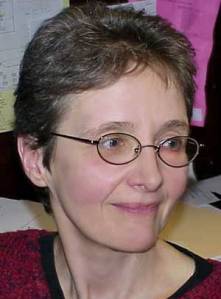
Teenage girls have been having babies for a very long time. My own mother had me when she was 19 years of age. Because she
Lee SmithBattle

Lee Smithbattle

was married to my 18 year old dad, and because marriage provided a passage to adulthood for many young couples of my parents’ generation, teenage pregnancies were not an issue, even though many marriages were hastily arranged to conceal a premarital conception. As “shotgun marriages” declined, other practices emerged to conceal or punish pregnant, unwed teens. White girls were spirited away to maternity homes to give birth and to be “rehabilitated” for their sexual transgressions. They were also forced to relinquish their babies for adoption. A teenage girl in my own neighborhood shared this fate; she unexpectedly disappeared and returned home months later with no word of what had happened (and certainly no baby in tow).

Maternity homes, however, excluded black teens, so as shotgun marriages declined, black teens gave birth and raised their children with family help. A decade later, in the late 70s, as white and black teens, like older low-income women, began to keep their babies as single mothers, they faced a lot of public ostracism and scientific scrutiny. It was in this context that I began visiting pregnant and parenting low-income women as a new public health nurse. My parents’ working class background could not have differed more from the disadvantaged families I visited, but public health nursing practice, in the grand tradition of Lillian Wald, Myra Breckinridge, and Margaret Sanger, taught me important lessons about social inequalities and perverse policies, and being humble, curious, and open to experiences that differed from my own. (As an aside, these lessons are beautifully brought to life in Call the Midwife, a television series produced in the U.K. which is currently airing on public television in the US). In the late 70s, scientific discourse on teen mothers was just beginning, and the media reports and scientific literature on teen mothers were difficult to reconcile with what I was learning from the families I visited as a PHN. Yes, the teens on my caseload were not going to graduate from high school, but this was not for lack of interest or motivation but because high schools excluded them. 04_small250Perinatal and social outcomes could be worse for teen mothers than older mothers, but were often comparable when teens had access to resources and good health care. And teens who had the help and support of family members seemed to have advantages that older mothers sometimes lacked when they were bereft of partner and family support. Making sense of these issues was a strong motivating factor for me to return to graduate school.
I began this study two decades ago. When I left the homes of the teen mothers after conducting the final interviews in 1989, I never expected to see the families again, so the final good-byes brought a sense of loss. After all, I had spent close to 25 hours in each home over a 3 month period, interviewing teen mothers and family members, and hanging out in their kitchens, living rooms, and bedrooms, observing daily life with babies to tend to. I attended birthday parties, picnics, and other family events, and also participated in mundane activities like folding laundry. Vivid memories of some of the initial visits are still etched in my memory. I suppose it was these memories, as well as my curiosity about how their lives might unfold, that led me to the second study, and then the third, fourth, fifth, and sixth. Other researchers apparently have also found it difficult to end relationships with study participants; for example, Rochelle Dalla has followed a group of teen mothers on a Navajo reservation for more than 12 years. Frank Furstenberg finally ended his remarkable study of teen mothers after 30 years. I wonder how he managed to do it. George Elliot’s (1964) words capture why I will embark on the seventh study in a couple more years:

“Every limit is a beginning as well as an ending. Who can quit young lives after being in long company with them, and not desire to know what befell them in their after-years? For the fragment of a life, however typical, is not the sample of an even web: promises may not be kept, and an ardent outset may be followed by declension; latent powers may find their long-waited opportunity; a past error may urge a grand retrieval.” (Eliot, G, 1964. Middlemarch. New York: Signet.

An impressive number of qualitative studies on teen mothers (and a growing number on teen fathers) are published every year, and this work continues to challenge our assumptions and stereotypes of teen mothers and the perverse ways that social 01_small300inequities and childhood adversities shape the lives of U.S. children. Equally important, quantitative studies that control for teen mothers’ background factors confirm the long arm of social disadvantage, showing that teen mothers do about the same on a range of outcomes as older women from similar backgrounds. Stereotypes and assumptions die hard, however, especially when sex, poverty, and race are part of the mix.
In addition to the families who welcomed me into their homes, other relationships have nurtured this research. I have had the best and most generous mentors. Edna Dell Weinel always demonstrated public health nursing at its finest and Patricia Benner modeled how to listen closely and with deep respect for various voices in the text. Vickie Leonard, the co-author of this paper, has
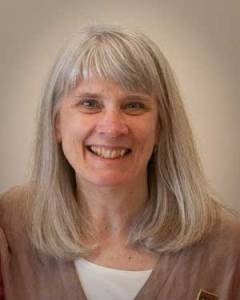
Vicki Leonard

Vicki Leonard

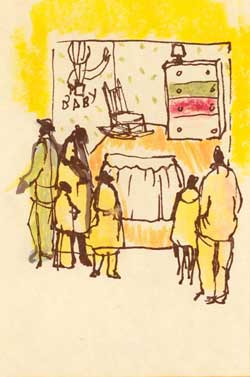
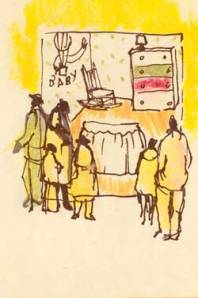
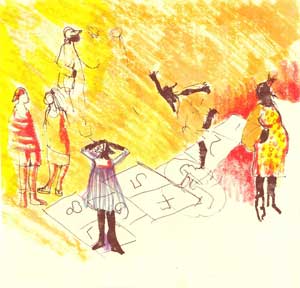
been a fellow traveler on this study from the time we began our first semester as doctoral students together. Because Vickie’s dissertation focused on older mothers with career commitments, pouring over our interviews and sharing stories from our respective families provided a rich comparison for how social worlds set up different and similar meanings, practices, and ways of being a mother. With each follow-up study, Vickie has read several cases to help clarify and refine my interpretations. Every researcher should be so lucky. The artwork accompanying this blog was created by Hilda Robinson, a dear friend and artist in Oakland, California, who turned the family stories of my dissertation into these and other paintings.

Finally, I would like to applaud Advances in Nursing Science for its commitment to publishing the lengthy papers that qualitative research requires. Amid the general press in nursing journals to publish short, empirically-based studies, ANS has courageously provided a home for scholarly qualitative work. ANS published my very first paper from Time 1, and then others along the way. Longitudinal studies are rare in nursing, and I’ve been fortunate that ANS has always welcomed a diversity of philosophical approaches and study designs. Nursing has been enriched by the courage of ANS’s editor and reviewers.

 Visit the ANS web site while this article is featured to download and read this article at no cost.  We welcome your comments here – we will respond!

ANS 37:2 “Relationships and Health” just published!


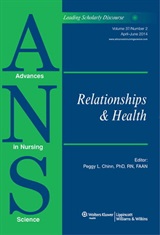
The topic of this issue of ANS – Relationships and Health – is central to nursing practice, and yet this vital connection is often taken for granted.37-2 cover Articles in this issue focus on family relationships, philosophic and theoretic foundations of human caring in the nurse-patient relationship, and the complexities of these relationships on health and well-being.

Each article in this issue is featured in our “Editor’s Pick” section of the ANS web site, and while an article is featured, it is available for free download.  It is also featured here, along with a message from the author that provides interesting background about their work.  Watch the web site to see which article is currently featured, and  return to the blog regularly to see messages from the authors!

Here is the Table of Contents for this issue

SmithBattle, Lee; Leonard, Victoria
McKelvey, Michele M.
St-Amant, Oona; Ward-Griffin, Catherine; Brown, Judith Belle; Martin-Matthews, Anne; Sutherland, Nisha; Keefe, Janice; Kerr, Michael S.
Ray, Marilyn A.; Turkel, Marian C.
Wolf, Karen Anne
MacKinnon, Karen; Moffitt, Pertice
Lobar, Sandra L.

Manuscript due date extended for ANS issue on “Post-Hospital Nursing”


Yes, indeed!  If you are close to polishing a manuscript related to the topic of “port-hospital nursing,” you have some time to send it in to be 15684347considered for publication in this issue!  The new due date is May 1, 2014!  Here is the description of this issue:

The period following hospitalization is a critical period in the process of recovery and healing. can be significantly influenced by nursing care in the hospital and in the community. For this issue we seek manuscripts that focus on nursing in post-hospital recovery. We particularly welcome articles that provide evidence on which nursing practice can be designed, as well as philosophic, theoretic, or economic analyses that address issues related to post-hospital recovery and the risk of re-hospitalization.

Nursing can play a significant role in quality of life and care after hospitalization, and this focus is growing as health care practices are changing to support efforts to reduce re-hospitalization!  So if you have something to contribute to this issue, please let us hear from you!!

Developing a Frailty Framework for Vulnerable Populations


The featured article from the current issue of ANS is titled “Development of a Frailty Framework Among Vulnerable Populations,” authored by Benissa E. Salem, PhD, MSN, RN; Adeline Nyamathi, PhD, ANP, FAAN; Linda R. Phillips, PhD, RN, FAAN, FGSA; Janet C. Mentes, PhD, APRN, BC, FGSA; and Catherine Sarkisian, MD, MSPH; Mary-Lynn Brecht, PhD.  Recognizing that nursing is at the forefront of care for most vulnerable populations, they collaborated in developing a wholistic framework that can be used to guide research with these very difficult-to-reach groups of people.  Dr. Salem shared this message about their work:


Salem-Benissa-Committee-Picture

Mary-Lynn Brecht, Janet C. Mentes, Adey Nyamathi, Benissa E. Salem, Catherine Sarkisian and Linda Phillips.

We are so pleased that our article has been selected to be featured in this current issue of ANS.  I have been so blessed to work with my dissertation chair, Dr. Nyamathi, along with my committee members, Drs. Phillips, Mentes, Brecht and Sarkisian in the development of this manuscript.  Further, I have been privileged to consult with Drs. Gobbens and Morley regarding the model. The framework has been inspired by several disciplines (nursing, gerontology/geriatrics and vulnerable populations), along with those who are homeless. Frailty itself is a construct which is challenging to disentangle. When working with vulnerable populations, specifically, homeless populations, it is imperative to understand unique antecedents which may influence frailty and outcomes. Drawing upon the literature focused upon homelessness, discussion with experts, and based upon experience and discussion among coauthors, the model guides possible antecedents, along with frailty, and the outcomes.  Future models related to this construct should assess nursing intervention components and the potential for frailty to be a dynamic, rather than a static state. Further, application of the model and refinement related to other vulnerable populations are all areas of future work.

While this article is featured, you can download it at no cost.  We hope you will do so, and return here to offer your ideas and responses to this very important work.