Skip to content

Just announced: Future issue topic “Models of Care for the Future”


ANS Vol 38:2  will focus on Models of Care for the Future.  As nations worldwide seek to establish models of care that provide quality and efficiency, nurse leaders are emerging to play a significant role in the development of these models.  For this issue of ANS we are seeking manuscripts that provide theoretical underpinnings of creative models of care, as well as  evidence that supports their implementation.  Manuscripts should be clearly grounded in a nursing perspective; the content can include philosophic, theoretic, empirical or ethical aspects related to the model.   Manuscripts will be due October 15, 2014.

For a complete updated listing of all future issue topics, and the due dates for manuscripts, visit the ANS web site!

Health and Peace


The current Editor’s Pick article, titled “Peace Through a Healing Transformation of Human Dignity Possibilities and Dilemmas in Global Health and Peace” addresses the challenges of the premise that health is a bridge for peace.  The author, Donna J. Perry, PhD, RN, uses her research within the Israeli-Palentinian conflict as an exemplar of these challenges.  She provided this commentary on her work:

We needn’t look far to see the devastating effects of collective violence.  The daily headlines are filled with tragedies of war across the globe.  Harder to find are the stories of countless acts of peacemakers, struggling to build communities of good relations.  These groups often do not receive the recognition or support that they deserve.  Their actions are sometimes unrecognized and even disparaged because they challenge the very paradigms that perpetuate violence. Yet they continue the struggle for peace, despite obstacles and risks.One such example is the group Combatants for Peace which I discuss in my article.  The Combatants for Peace movement was started by Israelis and Palestinians who had been actively involved in the cycle of violence and who chose to renounce violence and work for peace. These photos from the Combatants for Peace web site illustrate some of their activities.”  I conducted a qualitative study with members of this inspirational group a few years ago that is reported in the book, The Israeli-Palestinian Peace Movement: Combatants for Peace. 

The research study with Combatants for Peace illustrated that members of the group experienced their own transformation and the transformation of those around them.  It was in their personal experiences of change that hope was born and kept alive.  This awareness of the possibilities for human transformation for peace is expressed in the words of one of the Palestinian members of CFP (Perry, 2011, p. 233).

“If I changed . . . the way that I’m thinking, maybe I could change others. . . I feel more powerful.  Really.  Because the power of the human being is in his mind and his ideas. . . if you could change somebody maybe you give him more power . . . He could be a better person.”We in nursing need to be part of this human transformation to build a healthier society.  My doctoral studies were inspired by the conviction that the knowledge gained would help me to help others in a new way.  Led by a concern for the many social problems impacting health, such as violent conflict, social injustices and human rights abuses, I felt that it was important to bring a nursing lens to increase understanding of these issues.  Through research, solidarity and advocacy we, as nurses, can partner with communities to help them create change that advances human dignity.

You can download and read this article at no cost while it is featured on our web site!

Translating Research to Reach for Peace


I am delighted to feature this article to introduce the current ANS issue focusing on “Health and Peace.”  The article, authored by Patricia Liehr, PhD, RN; Kate Morris, BA, MA; Mary Ann Leavitt, RN, BSN, CCRN and Ryutaro Takahashi, MD, PhD is titled “Translating Research Findings to Promote Peace: Moving From ‘Field to Forum’ With Verbatim Theatre.”  The background on this research, and the development of the theater play, is a fascinating story that Dr. Liehr has generously shared with us here:

Our manuscript, entitled “Translating research finding to promote peace: Moving from “field to forum” with verbatim theatre” began years ago when I began working with Japanese researchers. The research side of this story has merged with the creative arts side of the story to present With Their Voices Raised, which was first performed in November 2012. The Playwright/Dramaturg note and the Researcher note were in the program for the inaugural performances in 2012. They are included here to provide a context for understanding the origins of the manuscript.

Researcher Note

            The performance that we will watch tonight has its roots in research that began nearly two decades ago when Japanese and American researchers were studying blood pressure changes while talking to Japanese elders who had suffered a stroke. Our study purpose was to understand how the pathophysiology of stroke affected blood pressure recorded during talking. We asked our research participants to talk for four minute about their health; how they were managing the limitations imposed by their stroke…while we recorded blood pressure every two minutes.

Our participants took us down an unexpected path. The stories they shared while speaking wove in how they survived World War II, with the implicit and sometimes explicit suggestion that surviving a stroke was “nothing” compared to their World War II experience. As the research team considered what we were hearing, we decided that we needed to know more about surviving WWII for both Japanese and American elders. The bombings of Pearl Harbor and Hiroshima were selected as points of comparison, where each participant would be called upon to recollect aggressive actions taken by the opposing country.

About the same time the research was launched, we knew that we wanted to share these findings in ways other than traditional scholarly venues, like scientific journals. We wanted to touch people who may never read a scientific journal; wanted to reach youth who may be experiencing aggression in their own lives. We have published our research findings in a scholarly journal. Now….tonight, you are joining our journey as With Their Voices Raised shares the wisdom of our participants through documentary theatre. With your guidance, we will move on to share this wisdom with young people. We thank you for being here.

The Research Team: Patricia Liehr, Chie Nishimura, Mio Ito, LisaMarie Wands, Ryutaro Takahashi

Playwright/Dramaturg Note

When I was first approached in the spring of 2010 by American and Japanese nursing researchers to develop a theatre presentation based on approximately fifty Pearl Harbor and Hiroshima survivor testimonies, I had only a general

Invitation to performance, Miami Dade College, November 13, 2013

Invitation to performance, Miami Dade College, November 13, 2013

understanding of the events leading to United States involvement in World War II. My knowledge of the Pacific theater was based upon a recollection of a grainy photograph in my American History high-school text book of the U.S. Arizona engulfed in smoke and flames at Pearl Harbor on Dec 7, 1941. I had also read Hiroshima by John Hersey, but had no connection with the term hibakusha. I had a lot to learn.

In the winter of 2011 I traveled to Hiroshima, Japan and had my picture taken underneath the Memorial Monument for Hiroshima. Inside the Peace Museum I noticed a pocket watch, forever stopped at 8:15, tattered swatches of blackened clothing, and tiny pieces of concrete that were once buildings and homes. I watched video footage of the atomic bomb, its mushroom cloud of ash and debris rising high into the morning sky. I saw archaic clips of bald hibakusha, their faces covered with red dots, their teeth black and decaying. Finally, I signed the visitor’s book, along with countless others, in a pledge and plea for peace throughout the world.

In the spring of 2012 I visited Oahu, Hawaii. I climbed the steps of the control tower at the Pacific Aviation Museum on Ford Island and listened to the silence of the salt air. I rode a ferry over to the USS Arizona and saw the oil-slick ‘tears’ on top of the water while the ship’s turrets remained below. I took the “Home of the Brave” bus tour and drove past the countless headstones at Punchbowl National Cemetery, all decorated with an American flag. Finally, I signed the visitor’s book, along with countless others, thanking our brave servicemen and women for their sacrifice and service to our country.

Needless to say, working with the Pearl Harbor and Hiroshima survivors’ stories opened up a whole new path to my studies and the way I viewed the world. It also introduced me to documentary or verbatim theatre as a way to disseminate history and perpetuate research outside the textbook and classroom. By presenting With Their Voices Raised it is my hope that together we may learn by listening, by sharing, and by thoughtfully exploring our cultural differences and similarities in the hopes of a more peaceful future for us all. With that thought in mind, I welcome any comments or questions you may have in the talk-back following the performance and written in the survey.

Thank you, Kate Morris

Where do we go from here?

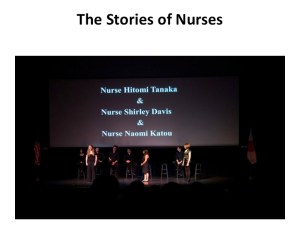
With Their Voices Raised will be performed in Miami on November 13, 2013.  The announcement for the performance has been included above in this blog message, as has a photo from the Florida Atlantic University performance (11-11-2012), capturing a
Voices of Nurses

Voices of Nurses

segment where the script focused on the stories of nurses. (Download a PDF copy of the performance invitation). Also included below is a video clip from the end of the performance at the Morikami Museum and Japanese Gardens on December 6, 2012. Some important terms that are used in the script and will occur in the video clip are:

Genbaku – short for Genshi-bakudan, the Atomic bomb

Hibaku – A-bomb exposed. Being subjected/exposed to the bomb/radiation

Hibakusha – A-bomb survivor. One who was subjected/exposed to the bomb/radiation.

Our next efforts will be directed to taking the script to high school students who will assume the roles of the 8 actors, perform the play, and engage with classmates in a discussion of the meaning of living through aggression. With this research-based creative experience, young people will have a history lesson as well as a lesson about the human spirit that calls for peace.

Patricia Liehr, Katy Morris, Mary Ann Leavitt, Ryutaro Takahashi

To download your copy of this article while it is featured, visit our ANS web site now!  Watch the video clip here!

Liehr: Promoting Peace with Verbatim Theater from Peggy L Chinn on Vimeo.

ANS Issue “Peace & Health” just released!


This just-released issue of ANS focuses on the topic of  “Peace and Health.” I believe that nursing can significantly influence conditions the

ANS 36:3 "Peace & Health"

ANS 36:3 “Peace & Health”

promote peace. In fact to reach for an ideal of  high-level wellness and health for all, understanding and creating peace is an absolute necessity. The articles in this issue of ANS stand as a signal that within the nursing community, this potential does exist. Nursing

scholarship and research contributes to understanding relationships between peace and health, and evidence that can be used to build family-wide, community-wide, nation-wide and even world-wide possibilities for peace. I hope that as a reader you will be inspired to join these authors, and many others in the nursing community to build a science, and a practice, that promotes peace!

Recognizability: Assessing External Validity


This week’s “Editor’s Pick” article is titled “Recognizability: A Strategy for Assessing External Validity and for Facilitating Knowledge Transfer in Qualitative Research” by Hanne Konradsen, PhD; Marit Kirkevold, DrEd; and Karin Olson, PhD.  Dr. Konradsen sent this message for our blog:

Dear ANS and readers

konradsen250

Hanne Konradsen

When you sit and type on your computer, you often wonder “will anyone ever read this?”, “will anyone else think this is interesting?” and “will this in any way help improve lives or situations for patients?”

In debates external validity has been an issue that has divided qualitative researchers in many different groups. We argue in this article, that recognisability could serve as a strategy for quality assessment in relation to grounded theory. And for facilitating knowledge transfer. This implies that the researcher must be active in the scientific as well as public debate. Hopefully some will read the conclusions from the research. But it is equally important that the researcher must present the results in different forums. This gives the possibility for a wide variety of people to give their opinion regarding the results, and assess the recognizability of the findings. From these responses the researcher can then collect and paint a picture of whether others find the results important and whether the results of the research can contribute to future patient care.

You can download your copy of this article while it is featured!  Visit the ANS web site now!


Conversational Interviewing


This week’s Editor’s Pick article is titled “Making Meaning in Qualitative Research With Conversational Partnerships: A Methodological Discussion” by Susan M. Hunter Revell, PhD, RN.  In this article, Dr. Revell describes the interviewing method she uses in her research.  This is a 3-part approach to interviewing that facilitates a deep understanding of a person’s experiences.  I highly recommend this article for anyone interested in qualitative methods, because Dr. Revell provides a rich description of the method, and discusses some of the challenges she encountered in using the method.  She uses an example of her own approach to this type of interview with a person who has experienced a traumatic spinal cord injury.  By using a 3-part interview, she was able to reflect on the person’s words, the messages that Revell-wheelchair_smwere conveyed in both verbal and non-verbal elements of the interview, and plan subsequent interviews to explore meanings of the person’s experience in greater depth.  Dr. Revell starts her discussion of the example as follows:

 When using the responsive interviewing method, it is the conversational partnership that becomes the instrument in the study. The following discussion reflects on this perspective including the importance of establishing trust and rapport in the conversational partnership, challenges faced regarding the researcher role, and some unexpected findings from using the method.

To read more of her insights in this discussion, visit the ANS web site now!  Her article is available for download at no cost while it is being featured!

Experience of genetic vulnerability


This current featured article addresses the fundamental focus of nursing identified by Margaret Newman and her colleagues – caring in the human health experience.  The article, titled “Theory Development From Studies With Young Women With Breast Cancer Who Are BRCA Mutation Negative” is authored by Rebekah Hamilton, PhD, RN; Samantha Kopin, BA.  Here is Dr. Hamilton’s message about their work:

I am very pleased to have this article on theory development published in ANS.  Theory development is an integral but infrequently accomplished process in grounded theory research.  It takes time…time that is generally not going to be supported by research funds, at least not at the NIH level.  For a grounded theorist one of the interesting things about theory development is considering the impact of context.  In the group of young women interviewed for this study, the influence of family history quickly became apparent in their level of skepticism over the negative result of the BRCA test.  Most of them initially stated that they simply didn’t believe the results.  Their perception of their risk for future breast cancer development was grounded firmly in their family’s experiences around breast cancer and other cancers as well.  While the young women who had no family history of early onset breast cancer were puzzled they were not influenced by past events and were much more likely to want to simply “move on”…to get over the treatments and get beyond the breast cancer.  Those with a family history did not express this idea of “moving on” because they attributed their experience to genetics…and that moves with you.

As a researcher it was encouraging and interesting to see some of the concepts developed in the first theory (Theory of Genetic Vulnerability) present in the second analysis.  The concepts of “Experiencing the family disease”, Testing for a mutation” , and “Foregrounding inherited genetic risk” were also present with the participants that had a family history of breast cancer while only “Testing for a mutation” was evident in those without a family history.  The clinical implications of this is that a nurse must realize that the “facts” that are presented to someone when faced with genetic testing must blend well enough with the family history or it will largely be discounted or at least perceived as not particularly relevant to the patient.

I recently presented the original theory at the International Family Nurses Association in Minneapolis and received interesting and supportive comments on using a mid-range grounded theory in a family practice setting to help the RN or APN guide an assessment of a patient.  It was suggested by a colleague that perhaps the most pertinent questions are not related to what brings a patient into the clinic on  that day but what they perceive to be the vulnerabilities of their families.  Would we get different answers about our patient’s concerns and perceptions of their own and their family’s risks?  Might be an interesting conversation to have!

Outside_the_circle_of_genetic_vulnerability.pdf-2

We invite you to join the conversation here on this blog!  Go to the ANS web site to download your copy of this article at no charge!

Grounded Theory and the Literature Review


The current Editor’s Pick article addresses a methodological issue that remains controversial – the timing of the literature review in the grounded theory method.  This article, titled  “The Timing of the Literature Review in Grounded Theory Research: An Open

Tracey Giles

Tracey Giles

Mind Versus an Empty Head” is authored by Tracey Giles, MNg, MACN, RN; Lindy King PhD, BN, DippAppSc, RN; and Sheryl de Lacey, PhD, MA, BAppSc, RN.  Ms. Giles describes their work, and invites you to respond with your perspectives on this issue:

What an absolute pleasure it is to have our article published in Advances in Nursing Science and featured as the editor’s article of the week on the ANS blog. I am a nursing lecturer and PhD candidate at Flinders University School

of Nursing and Midwifery. The aim of my PhD research is to explore decision making by health care professional and family members around family presence during cardiopulmonary resuscitation in an acute care setting using a constructivist grounded theory method (GTM).

I wrote this article with the support and guidance of my PhD supervisors in response to the often confusing advice I

Lindy King

Lindy King

encountered around the timing of the literature review in GTM research. My initial reading of methodological texts and articles revealed inconsistent and conflicting recommendations, many of which were to delay the literature review until analysis begins, or even until codes begin to emerge. However this advice was not compatible with my constructivist approach to GTM research. A constructivist approach actively repositions the researcher as a co-constructor of experience and meaning and takes into account their past and present perspectives, experiences and knowledge. This often includes an extensive knowledge of the existing literature.

A critical examination of the methodological literature was therefore undertaken in order to clarify and justify my use of the literature, and to offer recommendations to other researchers who are considering GTM as a potential research approach. We found that previous recommendations to delay the literature review are out-dated and that preconceptions are not only unavoidable but can enhance creativity,

Sheryl deLacey

Sheryl deLacey

theoretical sensitivity and rigour. We concluded that any bias that could potentially distort data analysis can be addressed by using correct, GTM transparent techniques and by ensuring the researcher openly acknowledge the influence of previous work in their perspective of what is emerging from their own data. We believe that if used reflexively, a preliminary literature review can enhance GTM research.

Thank you for the opportunity to share our ideas about GTM research. We look forward to your feedback about our recommendations.

Visit the ANS web site now to download your copy  of the article, and contribute your comments and feedback here!

Creativity and Quality: Qualitative research with people with aphasia


beritabr-1

Berit Arnesveen Bronken

The authors of the current Editor’s Pick article in ANS provide an inspirational example of overcoming a research challenge that may seem impossible!  The challenge: to understand the experience of people with aphasia, despite their limitations in being able to convey their experience in spoken or written language.  The authors, Berit Arnesveen Bronken, MNS and Marit Kirkevold, EdD, provide thought-provoking explanations to address this challenge.  In addition, their approaches and their conclusions provide creative and rigorous approaches for conducting qualitative studies with all populations.  This article, titled “Between the Lines: Generating Good Qualitative Data in Studies Involving Persons With Aphasia” is a “must read” for anyone who is planning and conducting qualitative research.  Here is a description of their work:

maritk

Marit Kirkevold

Studying experiences of persons with aphasia following stroke challenge traditional norms of generating data of good quality because the research methods are based on abilities to produce and understand oral and written language, read and write. A longitudinal design, using a combination of research methods contributed to generate relevant and important data from a dialogue-based nursing intervention which included persons with moderate to severe aphasia.

To get your copy of this article, visit the ANS web site while it is being featured, and you can download it at no cost!

Improving outcomes of care transitions


I am delighted to post our first author video for this current “Editor’s Pick” article from the current issue of ANS! The article titled “Comorbidities in the Context of Care Transitions” is authored by  Janet H. Van Cleave, PhD, RN; Rebecca L. Trotta, PhD, RN; Susan Lysaght, PhD, RN; Melinda R. Steis, PhD, RN; Rebecca A. Lorenz, PhD, RN; and Mary D. Naylor, PhD, RN. In this article the authors  present the findings of their Dimensional Analysis approach that resulted in a schematic that can be useful for future nursing research studies that focus on evaluating outcomes of programs designed to improve health of vulnerable populations involved in care transitions.  Watch the video, in which Janet Van Cleave describes the study!

To download your copy of this article, visit the ANS web site.  Featured articles are free to download for a limited time, so do not delay!